News Item
Unique working model gives young patients a doll-sized view of complex cancer treatment machines
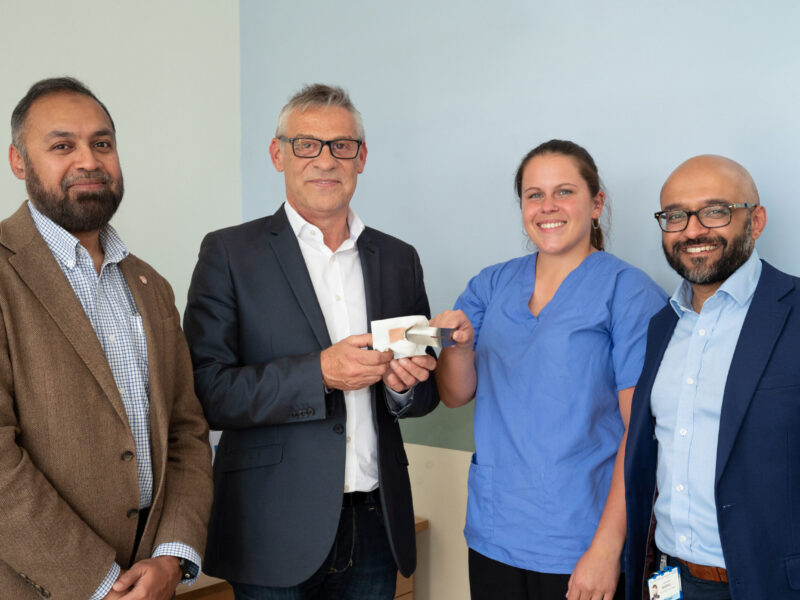
“Barbie” and her friends have a unique new accessory to thanks to the efforts of engineers and radiotherapists at St James’s University Hospital in Leeds – a realistic one-sixth scale model of a linear accelerator cancer treatment machine.
The specially designed simulator helps children undergoing radiotherapy treatment familiarise themselves with the high-tech kit that is being used to treat them. It is intended to take some of the fear out of the experience, and builds on the work the hospital already does, including promoting play.
Controlled by a series of motors which the children can operate with buttons, a doll in a specially made hospital gown and mask is laid on the treatment couch, which moves up and down and from side to side. The linear accelerator also rotates realistically around the doll, and the colours and materials have been designed to look like the real department.
The model even has two working TV screens for young patients and their siblings to watch specially-made cartoons.
Paediatric radiotherapist Lucy Hume came up with the idea as part of work to develop better distraction techniques. By making child cancer patients more comfortable with their surroundings, they are less likely to need a general anaesthetic during radiotherapy treatment, which both slows down the treatment and recovery and is potentially more risky for the patient.
“We already try and make the hospital seem as friendly as possible for our young patients, and when possible will take them into the linear accelerator chambers – for instance we have sometimes held a teddy bear’s picnic in there,” she explained. “However the machines are very busy and in use much of the time so that isn’t always possible.
“I came up with the idea of designing a model of the actual machine so children could learn about their treatment through play with our staff,” Lucy added. “The Yorkshire Cancer Centre Appeal generously provided £5,000 to fund the project, and our engineers have painstakingly designed and built it. The finished model is absolutely fantastic and we can’t wait to start using it.”
For radiotherapy clinical technologist Wayne Sykes, whose role includes looking after the hospital’s 12 full scale linear accelerators – each one of which cost £1.6 million – Lucy’s idea was a unique challenge but one which he and his colleagues have embraced enthusiastically.
“It has been built gradually as time allowed over the last four months, starting with a series of 3D drawings to ensure it is accurate and to scale,” he explained.
“Great care has been taken to replicate the real machine as closely as possible, using small 12-volt motors so that it operates as much as possible like the real thing. It has generated a lot of interest within the department and we hope the children will have fun learning from it.”
Lucy recently won a national award to go on a research trip to Australia and New Zealand to learn more about distraction techniques for child cancer patients, and plans to take pictures of the model with her. It is also hoped other cancer centres in the UK will be interested in the idea of the children’s simulator.