
Cookie settings

We use some essential cookies to make this website work.

We’d like to set additional cookies to understand how you use www.leedsth.nhs.uk, remember your settings and improve our services.

We also use cookies set by other sites to help us deliver content from their services.

View cookies
You have accepted additional cookies. You can change your cookie settings at any time.
You have rejected additional cookies. You can change your cookie settings at any time.
Skip to main content
Leeds Teaching Hospitals NHS Trust logo
  • About us
  • News
  • Patient resources
  • Careers
  • Contact
  • Charity
  • Reachdeck
  • Home
  • Hospitals

    Our hospitals

    • Leeds General Infirmary
    • St James’s University Hospital
    • Leeds Children’s Hospital
    • Leeds Dental Institute
    • Chapel Allerton Hospital
    • Seacroft Hospital
    • Wharfedale Hospital

    Want to rearrange an appointment?

  • Patients and visitors

    Patients and visitors

    • Is it an emergency?
    • Martha’s Rule – Call 4 Concern
    • Visiting times
    • Appointments
    • Information for visitors
    • Get involved
    • Preparing to come to hospital
    • Patient resources
    • Help and support
    • Make a payment

    Is it an emergency?

  • Services

    Search services

    • A
    • B
    • C
    • D
    • E
    • F
    • G
    • H
    • I
    • J
    • K
    • L
    • M
    • N
    • O
    • P
    • Q
    • R
    • S
    • T
    • U
    • V
    • W
    • X
    • Y
    • Z
    • 0-9
  • Consultants

    Search consultants

    • A
    • B
    • C
    • D
    • E
    • F
    • G
    • H
    • I
    • J
    • K
    • L
    • M
    • N
    • O
    • P
    • Q
    • R
    • S
    • T
    • U
    • V
    • W
    • X
    • Y
    • Z
    • 0-9
  • Research

    Research

    • Our Research
    • R&I Annual Conference 2025
    • Innovation Pop up
    • Be Part of Leeds Research
    • For Researchers
    • Research Academy
    • Contact us
  • Home
  • Our hospitals

    Hospitals - overview
    • Leeds General Infirmary
    • St James’s University Hospital
    • Leeds Children’s Hospital
    • Leeds Dental Institute
    • Chapel Allerton Hospital
    • Seacroft Hospital
    • Wharfedale Hospital

    Want to rearrange an appointment?

  • Patients and visitors

    Patients and visitors - overview
    • Is it an emergency?
    • Martha’s Rule – Call 4 Concern
    • Visiting times
    • Appointments
    • Information for visitors
    • Get involved
    • Preparing to come to hospital
    • Patient resources
    • Help and support
    • Make a payment

    Is it an emergency?

  • Search services

    Services - overview
    • A
    • B
    • C
    • D
    • E
    • F
    • G
    • H
    • I
    • J
    • K
    • L
    • M
    • N
    • O
    • P
    • Q
    • R
    • S
    • T
    • U
    • V
    • W
    • X
    • Y
    • Z
    • 0-9
  • Search consultants

    Consultants - overview
    • A
    • B
    • C
    • D
    • E
    • F
    • G
    • H
    • I
    • J
    • K
    • L
    • M
    • N
    • O
    • P
    • Q
    • R
    • S
    • T
    • U
    • V
    • W
    • X
    • Y
    • Z
    • 0-9
  • Research

    Research - overview
    • Our Research
    • R&I Annual Conference 2025
    • Innovation Pop up
    • Be Part of Leeds Research
    • For Researchers
    • Research Academy
    • Contact us
  • About us
  • News
  • Patient resources
  • Careers
  • Contact
  1. Home
  2. Services
  3. Pathology
  4. Pathology tests & tubes
  5. Antimony

Antimony

EDTA plasma

Antimony is widely used in alloys. Its use in semi-conductors is important. Antimony compounds are used in flame-proofing, paints, ceramics, enamels, glass, pottery, rubber technology & dye stuffs. Antimony derivatives have considerable toxicity.

Tube

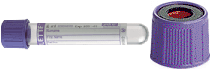
03 (EB) – EDTA Blood

ID

Tests&Tubes0152

Additional information

Clinical indication for test: suspicion of antimony toxicity. Please discuss request with the Duty Biochemist (0113 39 26922 option 2). An empty tube from the same lot number should ideally be sent along with the blood sample.

Turn around

Turnaround time stated by Guildford trace element lab: 5-10 days

Send to

Blood Sciences LGI
(Test referred to: Guildford trace elements lab.)

Contact

For further details please contact Leeds Pathology customer services: [email protected].

Advice

Full Referred Test details logged internally on the referred test database [BSF2REC17003]
Download

Collection Con

Minimum volume: 2 mL whole blood Instructions to lab: DO NOT centrifuge. Store in fridge. If an empty tube also sent, please send to Guildford along with the sample.

Sample REQ

Blood

Ref. Range Notes

< 1.1 nmol/L

Units

nmol/L

Share this page

Leeds Teaching Hospitals NHS Trust logo

Telephone

0113 2432799

Switchboard open 24 hours

Quick links

  • Hospitals
  • Patients and visitors
  • Patient resources
  • Patient Feedback
  • Our Partners
  • Contact

Support our charity

Leeds Hospital Charity Logo

Follow us

Visit us on YouTube Visit us on Linkedin Visit us on Facebook Visit us on Instagram
  • Contact
  • Accessibility
  • Privacy
  • Cookies
  • Terms and conditions
  • Staff intranet
  • Information Governance

Copyright © 2025 Leeds Teaching Hospitals NHS Trust.

Lovingly crafted by Mixd