
You have been given this leaflet because you may benefit from a treatment called Negative Pressure Wound Therapy (NPWT). This leaflet will explain more about NPWT and why this may be helpful in the treatment of your wound.
If after reading this you have any further questions, please speak to your nurse or medical team.
What is NPWT?
Most wounds heal with standard dressings, however sometimes other treatments are needed for more difficult to heal wounds. This may be because the wound is large, deep, or because it is leaking high levels of wound fluid.
NPWT is a wound healing treatment that uses gentle suction via a wound dressing and a small electrical pump. It can be used in hospital and for patients in their own home.
The electrical pump is portable but will require connecting to a power supply to charge and maintain the battery.
What are the benefits of NPWT?
NPWT may help your wound heal by
- Increasing blood supply to the wound.
- Removing excess wound fluid.
- Encouraging healthy tissue to form.
- Protecting the wound from bacteria.
- Reducing healing time.
How long will I need NPWT for?
This varies for each person and depends on the size and type of wound. The doctors and nurses will decide how long you need this type of therapy for, depending on how your wound is progressing after each dressing change.
How is NPWT applied?
A special type of gauze or foam is used and cut to the size of the wound. A non-adhesive dressing maybe used in the base of the wound, the gauze or foam is placed on top. A sticky film seals the dressing in place.
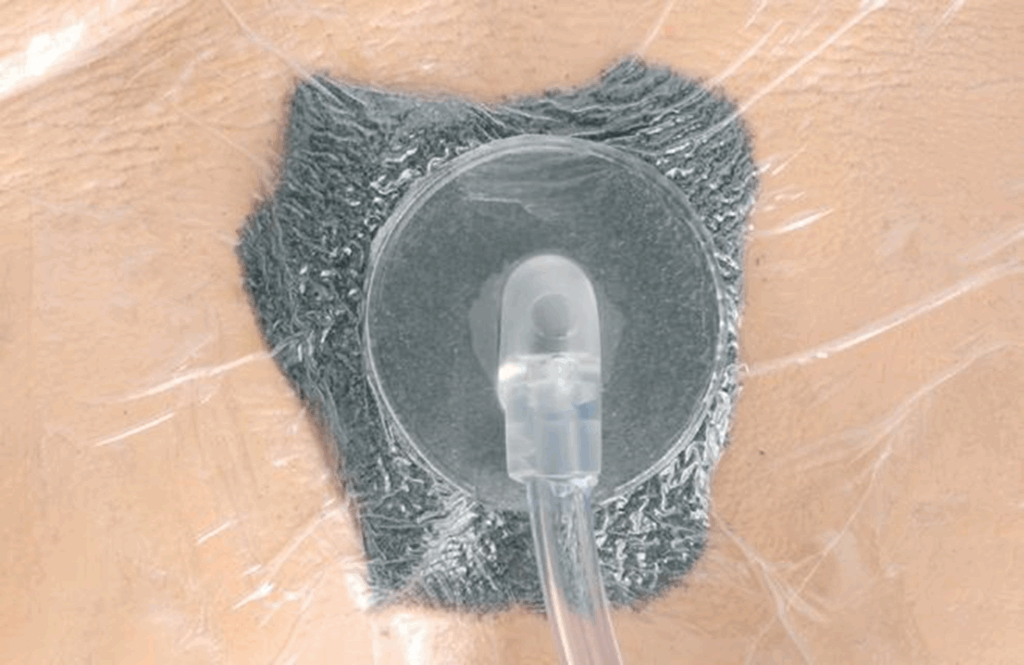
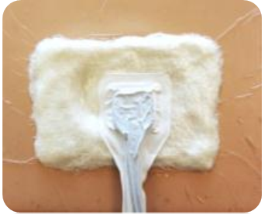
A tube connects the dressing to the electrical suction pump, which then connects to a collection canister within the pump itself.
Once the dressing is in place and the pump is switched on and the suction (negative pressure) begins, it will gently draw fluid away from the wound, into the canister.
Will I have any pain?
Most people do not have pain with this treatment, although some wounds are painful despite treatment. When the pump is turned on you may feel a “pulling” sensation, this soon eases off. You can request painkillers before the dressing is taken off.
Will I be able to move around whilst on the therapy?
YES: the therapy should not restrict your mobility. The pumps tend to have a bag which you can carry over the shoulder. The pump has an internal battery; and can be disconnected from the charger for periods of time to move around. But it is recommended to reconnect the power when not moving around.
If you are unsteady on your feet or are concerned that this therapy may cause a fall, then it is recommended that a Fall Risk Assessment is completed by the nursing team or Physiotherapy team, this should also be completed before discharge home.
How often will my dressing need changing?
Most patients with NPWT require dressing changes every 2-3 days. This can vary and will depend on the type of wound and which dressing is being used. Your nurse/specialist will decide on how often your dressing needs changing.
Do I need to stay in hospital for my treatment?
For many patients, NPWT is started after surgery, so the treatment normally begins in hospital. However once you are medically fit for discharge but you still need NPWT, you can be discharged home with the treatment.
The Community Nurses or the nurses at you GP surgery will support you with this once home.
NPWT dressings are not suitable for everyone, often it is down to patient preference, comfort and personal choice. Most wounds will manage perfectly fine with a conventional dressing and continue to heal. The doctors, your ward nurse, and the Tissue Viability nurses will be able to discuss the treatment options with you and help you decide what is best for you and your wound.
Some patients are not suitable for NPWT at home. If you are unable to move round safely with the pump, you will not be discharged with NPWT and conventional dressings will be used instead to manage your wound.
What happens if the pump alarms?
The pump may alarm for a number of reasons which may include:
- The canister is full or there is a blockage in the tubing.
- Low Suction: this is usually because of an air leak in the dressing.
- The battery is low: the battery symbol will be red- please plug the pump into the mains.
- If you hear the alarm in hospital, inform your nurse, if at home contact the company on their 24 hour helpline (see back page for details), the Community Nursing team, or your GP surgery who will help you sort out the problem.
Alarm messages that may be displayed
- Attention ! Low Battery
– Plug into mains as soon as possible. - ! Warning ! Low Vacuum
– The vacuum level is lower than the prescribed therapy.
– Contact your nurse or doctor. - ! Warning ! Leak
– The system has detected a significant leak.
– Contact your nurse or doctor. - ! Recharge ! V. Low Battery
– Battery is very low. Plug into an electrical outlet as soon as possible. - ! Warning ! High Vacuum
– The system has encountered a high vacuum condition.
– Contact your nurse or doctor. - ! Device Failed ! Please Return
– The device has an unrecoverable error.
– Contact your nurse or doctor. - ! Recharge ! V. Low Battery
– Battery is extremely low. Plug into an electrical outlet as soon as possible. - ! Recharge ! V. Low Battery
– The system has encountered an excessively high vacuum and will
automatically switch off.
– Contact your nurse or doctor. - ! Attention ! Inactive
– The device has been left in standby mode for longer than 15 minutes. Contact
your nurse or doctor. - ! Recharge Now ! Battery Fail
– Device battery is very low. Plug into an electrical outlet as soon as possible.
– After 2 minutes the device will power off. - ! Warning ! Blockage/Full
– The system detects the canister is full or there is a blockage in the system.
– Contact your nurse or doctor.
Showering, Washing and Dressing
We advise that you avoid having a bath or shower whilst having NPWT this is because of the length of time disconnected from the pump. However you may be able to arrange a time with your nurses to arrange a bath/shower the day the dressing is due to avoid having the pump disconnected.
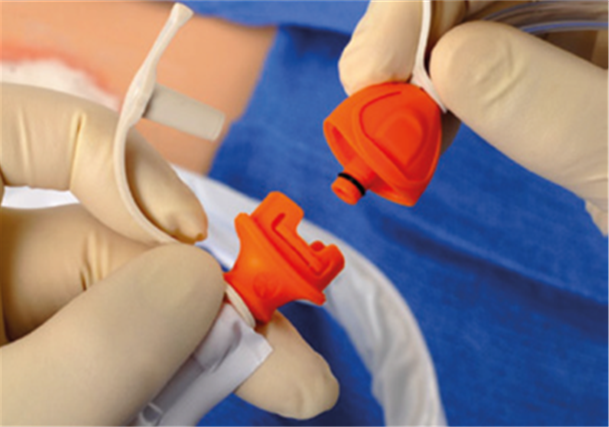
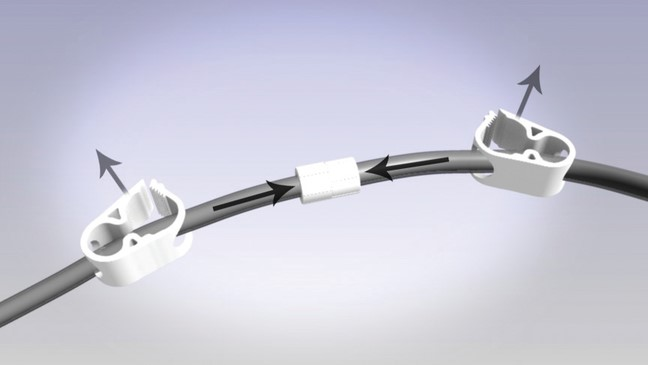
Your pump is electrical so cannot come into contact with water. When you are getting dressed you can briefly disconnect the canister tubing from the dressing. (See diagrams below).
You will need to reconnect the tubing immediately. The pump may alarm whilst you are doing this, but once connected should stop alarming.
Does the pump need to be switched on all of the time?
Yes: it is important that you do not switch off the pump and it is working 24 hours a day. If the pump is switched off for more than a few minutes, wound fluid will collect in the dressing and the surrounding skin becomes wet. The air-tight seal may be lost, if this is off for more than two hours it will need reapplying.
What if I notice a large amount of blood in the canister?
- If you notice a few specks of blood in the canister or tubing please notify your nurse.
- If you notice dark red fluid/blood within the canister which has immediately filled up, please notify your nurse/doctor immediately (in hospital).
- If you are at home please call 999 for urgent medical help.
If this occurs:
- Stop the pump.
- DO NOT remove the dressing.
- Lie flat.
- Urgently ask a relative or friend to fold a towel and apply direct pressure over this area.
Please also contact your nurse or doctor if:
- You notice a big change in colour or quantity of the fluid in the canister e.g if it changes from clear to cloudy or bright red.
- Your wound looks more red than usual or smells.
- You experience pain.
- The alarm will not turn off.
- The NPWT device has been turned off for longer than two hours.
What can I do to help my wound heal?
When having a wound it is essential that you eat a balanced diet to help with wound healing. You need to eat enough carbohydrates, protein, vitamins and minerals to aid your recovery.
For some complex wounds, or if your health is poor, extra nutritional supplements may be required. Please speak to your nurse and doctor about this.
If you are a diabetic, it is also important to follow advice from your diabetes nurse to ensure that your blood sugars remain well controlled. This is very important for wound healing.
Proteins
These foods are rich in proteins: eggs, meat, fish, milk, lentils, tofu and cheese.
Carbohydrates (Energy Foods)
These foods are rich in carbohydrates: Rice, pasta, potatoes and bread.
Vitamins
Try to eat plenty of fruit and vegetables as these contain vitamins. If this is difficult you may need to take some extra vitamin supplements. Also speak to your nurse and doctor about this.

Avoid smoking
Smoking a cigarette reduces the blood supply to your skin. This lowers the amount of vital oxygen and nutrients going to your skin, meaning healing may be slower.
Other important information
- Do not take your pump into the MRI scanner.
- Be careful not to spill any fluids onto the pump; it must remain dry at all times.
- Take care not to crush or drop the pump.
- Do not attempt to fix or tamper with any settings on your pump; this could have a detrimental effect on your wound.
- If the pump is damaged in anyway please tell a member of staff or call your care provider so your pump and wound can be assessed immediately.
- Extension cords should not be used with this therapy device.
Daily tips for users:
- Check several times a day to ensure that:
- The pump is switched on and the green light is lit.
- Check your pump is adequately charged especially if leaving the house.
- The dressing has collapsed and has a wrinkled appearance.
- The device is in a vertical position where possible.
For further advice you can contact the team providing your care
Hospital inpatients
- Speak to your nurse on the ward/unit, they can contact the Tissue Viability team for further advice.
Outpatients
- Contact your community nurse team
Company helplines
Solventum
Available 24 hours / 7 days a week.

Smith and Nephew
Available 24 hours / 7 days a week.
Discontinuation of Negative Pressure Wound Therapy
Therapy completed in hospital: The hospital staff will remove the pump and arrange for collection from the ward.
Therapy completed at home: The pump remains the property of the supplying company. Once your therapy is completed the community team should take the pump with them, in an eventuality that the pump is left at home, please contact the company via the number above and arrange for collection from your home. You should inform your nursing team if you have arranged for this to happen.