
This information is for patients undergoing a colonoscopy or an ileoscopy via their stoma.
Your doctor has recommended that you have a Colonoscopy or Ileoscopy. This leaflet will explain the procedure and what to expect on the day of the test.
If you have further questions, please telephone the department or discuss them with a member of staff on the day of your procedure.
What is a colonoscopy?
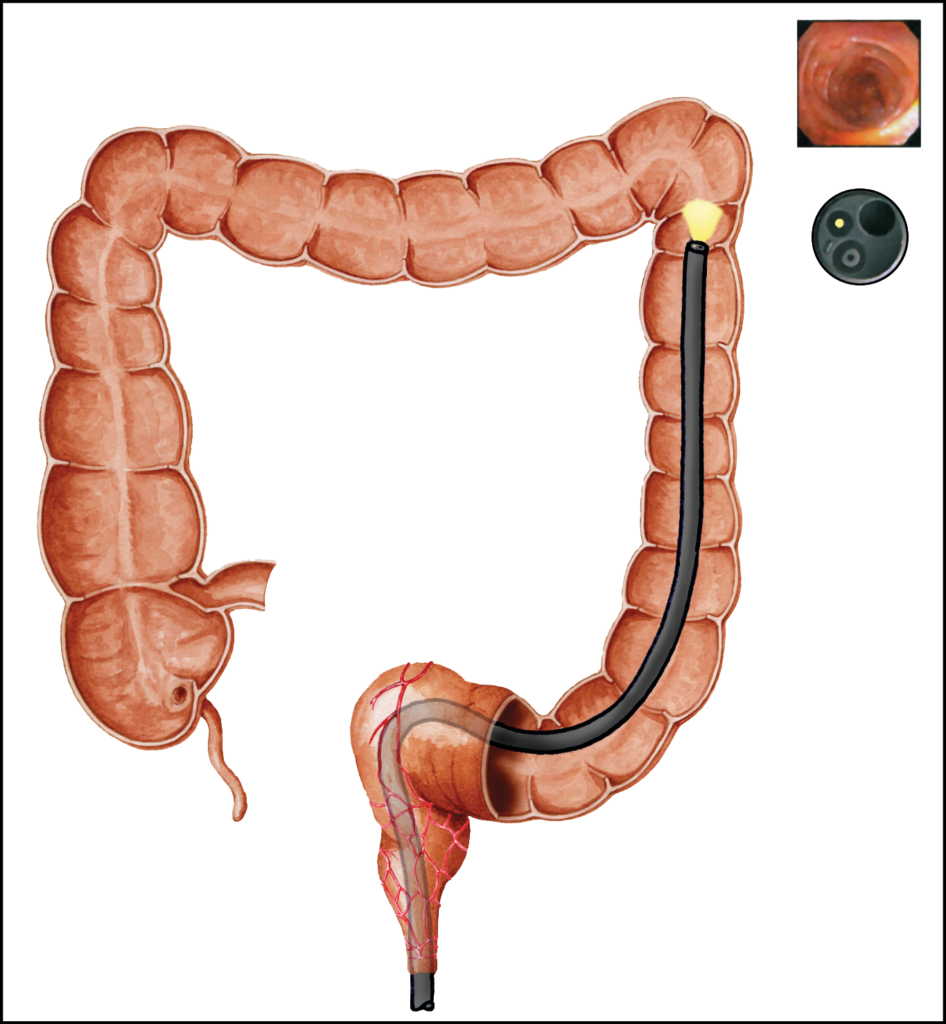
A colonoscopy (Figure 1) is a test that examines your large bowel (colon). A thin flexible tube with a camera on the end is used for this procedure and is passed through the anus. Pictures from this camera are seen on a television screen by the endoscopist that you can also view.
Figure 1.
How does this differ from a standard colonoscopy?
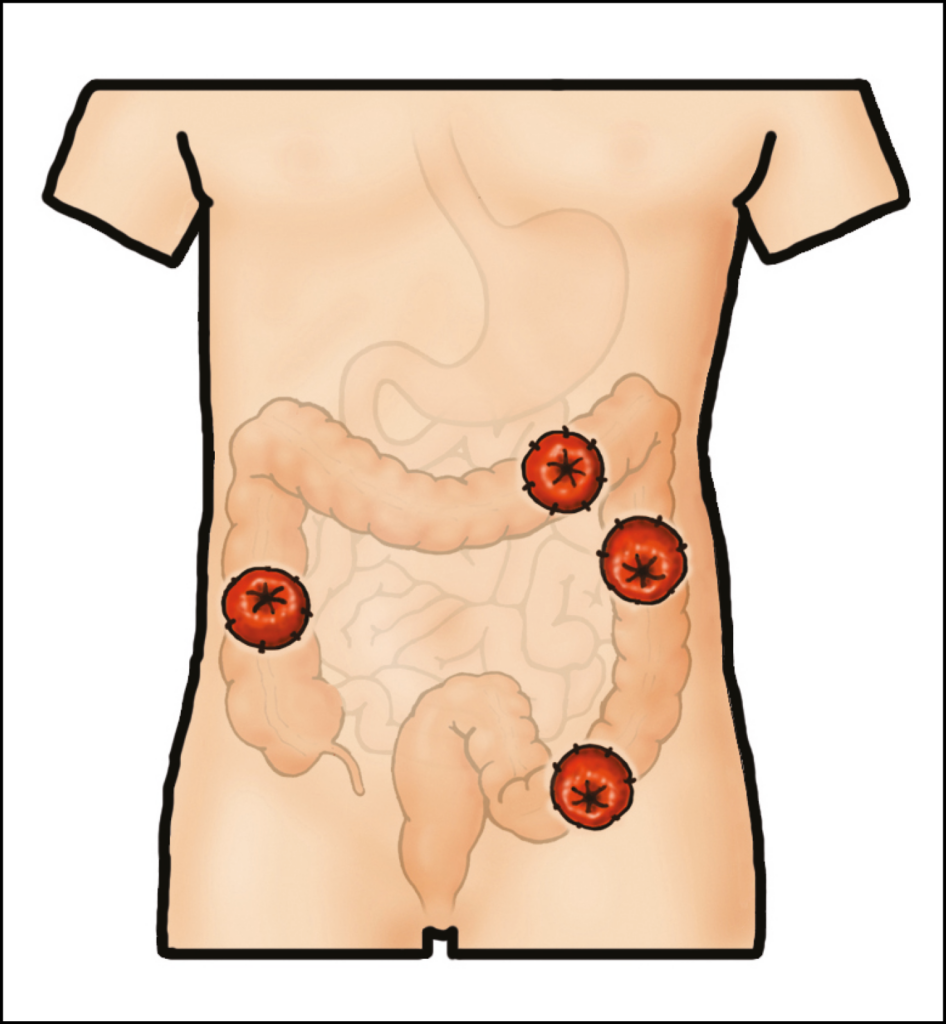
Normally the colonoscope is passed into the colon through your back passage however for patients with a stoma, it is inserted via the stoma site to the rest of the bowel (Figure 2).
Figure 2
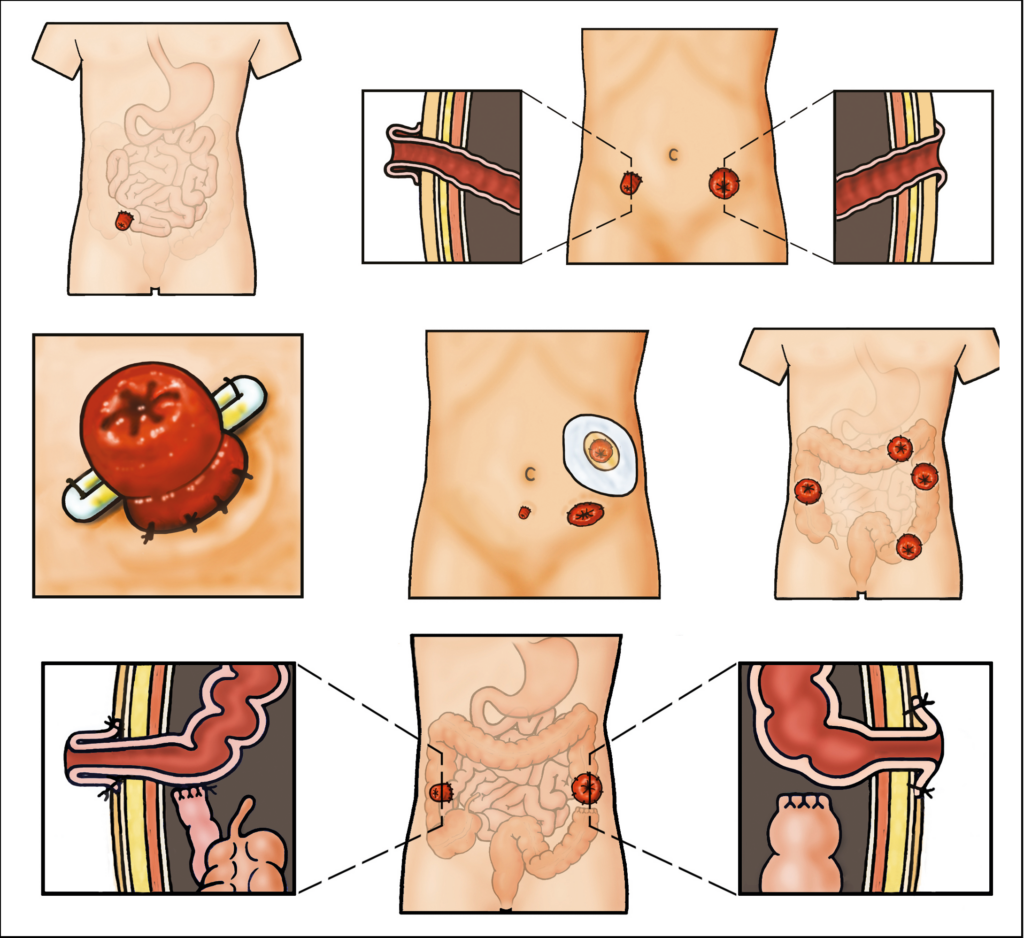
For patients with an ileostomy it is inserted via the ileostomy (Figure 3) to the small bowel.
Figure 3
Why am I having an colonoscopy/Ileoscopy?
Your referring clinician will have reviewed you in clinic and requested for you to have an endoscopic procedure via your stoma to investigate symptoms you have been having; for example, a change in bowel habit, anaemia, or rectal bleeding. Your doctor may want a review of a chronic condition such as crohns or ulcerative colitis or they may want to check internally post-surgery. They may also want to check for a recurrence of polyps.
During your procedure the endoscopist (doctor or nurse practitioner) may take a small piece of tissue (biopsy) to aid diagnosis. It may also be necessary to remove polyps from the bowel wall. Both removing polyps and taking biopsies are painless, and is achieved by passing special equipment down the inside of the camera – you will not feel this.
All tissue samples have to be sent away to the laboratory so the results will not be available straight away. You will be able to discuss the results of your biopsies with the doctor who referred you.
What are the benefits to having a colonoscopy/ileoscopy?
A colonoscopy/ileoscopy provides detailed information of the appearances of the lining of the bowel. The information gained during the test may reveal a cause for your symptoms and will assist your doctor in your further treatment.
If you prefer not to have a colonoscopy/ileoscopy, we would advise you to discuss the implications with your doctor.
What are the alternatives to having a colonoscopy/Ileoscopy?
The other method of examining your bowel is a CT scan. Although this test offers valuable information, it provides less information about the lining of your bowel and does not allow biopsies to be taken or removal of polyps.
What are the risks of having a colonoscopy/ileoscopy?
The risks associated with your test are detailed on your consent form and below. Please read this.
If you have any questions, speak to the nurse or endoscopist on the day, or alternatively, ring the Endoscopy Unit. Complications are rare but it is important that you are aware of them before the test begins. As with any medical procedure, the risk must be compared to the benefit of having the procedure carried out.
- Having a colonoscopy/ileoscopy carries a small risk of making a hole in the bowel wall (a perforation), this occurs in 1:1000 examinations. Perforations usually need to be repaired with an operation.
- If the endoscopist removes a polyp, then the risk of perforation, although still rare, increases slightly to 1:500 occasions.
- The average risk of bleeding after a polyp has been removed is 1:100 but the risk increases with the size of the polyp.
- Bleeding into the stoma bag can occur after the test, especially if biopsies have been taken or a polyp has been removed. This usually stops without any treatment: however; occasionally, treatment may be needed to stop this.
- Using sedation can affect your breathing. To reduce this risk, we monitor your pulse and oxygen level. The endoscopist may give you minimal sedation if they feel that you at at high risk of breathing difficulties during the test. This often applies to patients with heart disease and breathing problems such as Asthma, and Chronic Obstructive, Pulmonary Disease (COPD).
- There are known adverse effects from the intravenous drugs administered during the procedure, ranging from mild & common to rare & serious. These include headaches, nausea, fainting, and depression of respiratory and nervous system, which may result in aspiration pneumonia, anaphylaxis and coma. Although these serious complications are rare, they are common in patients with deeper sedation and/or general anaesthesia.
- Despite sedation, some patients experience abdominal discomfort or pain due to the air put in the bowel. This should decrease when the test has ended and will be helped by passing wind.
Before your appointment: What preparation will I need for my colonoscopy / ileoscopy?
For the endoscopist to see the bowel wall clearly it is essential that the bowel is completely empty. The doctor requesting the test will have considered your situation and concluded that it is either safe for you to have the bowel preparation or that it may not be required.
If you have received oral bowel prep and have an ilestomy, please contact us as this may not be suitable for this procedure. If bowel preparation is not required, then specific advice will be given to you regarding fasting instructions.
If you are asked to take bowel preparation please follow the instructions given carefully.
If you do not use a drainable stoma bag then you may need to obtain one through your stoma supplier or your colorectal team. The bowel preparation that has been sent to you works as a powerful laxative and makes your bowel clean. Your bowel preparation medicine and instruction sheet will have been sent to you.
Having an enema via your anus to look at your rectal stump
Your clinician may decide you need an enema either through your stoma or via your rectal stump prior to your procedure.
You can administer this yourself at home one hour prior before your test, or, you can arrive to the department fifteen mins earlier for a nurse to administer it.
Please follow the instruction sheet carefully
It is important that this preparation works. Failure to follow these instructions may result in an unsuccessful procedure.
Please contact the endoscopy pre-assessment nurses if you are experiencing any problems taking your bowel preparation. It is important that you keep hydrated during the bowel preparation process.
Whilst you are taking the bowel cleansing solution, you should stay close to the toilet, as your stoma is likely to be active. It is recommended to have hand towels close by and a mattress protector.
Do I keep taking my tablets?
- If you are taking iron tablets (ferrous sulphate/ferrous fumarate), please stop them seven days before your test
- Please telephone the endoscopy unit if you are have not received an information sheet or instructions if you are diabetic, have sleep apnoea or are if you are taking tablets that prevent blood clots. Examples of blood thinning tablets are: Warfarin, Dabigatran, Apixaban, Rivaroxaban, Edoxaban, Aspirin, Clopidogrel (Plavix) or Dipyridamole, (persantin), Prasugrel (Efient), Ticagrelor (Brilligue) and Acenocoumarol (Sinthrome).
- If you are taking Codiene, Loperamide (immodium) or Co-phenotrope (Lomotil), please stop three days before the start of your procedure.
- Women taking the oral contraceptive pill should be aware that taking bowel preparation might prevent the absorption of the pill. Additional contraceptive precautions should be taken until the next menstrual period.
- Please continue to take all your other medication as normal especially for high blood pressure.
What pain relief is available?
It is important that you are comfortable during the procedure to ensure that the endoscopist can perform the procedure successfully.
On the day of your procedure or during your pre assessment appointment the nurse will discuss these options with you. Please note that all patients requesting sedation will be assessed if they are medically fit for the administration of sedation.
For colonoscopy you have two choices of pain control
Sedation and a pain relief drug
This will be given via a needle that is inserted into your vein. The sedation will make you feel relaxed and possibly a little drowsy but you will not be unconscious. Sedation is a combination of Midazolam a sedative and Fentanyl a pain killer. You will hear what is said to you and will be able to carry out simple instructions given during the test.
Sedation can make you forgetful. Afterwards, you may not remember all of the test. Sedation remains in your system for 24 hours.
If you choose this option, you will need a responsible adult to take you home from the unit (not via public transport) and to stay and look after you for 24 hours.
Sedation will NOT be given if the above has not been arranged, prior to the test.
For 24 hours after the test you should not:
- Be left at home alone or look after children
- Drive (you will not be covered by your insurance policy)
- Return to work
- Use any type of machinery
- Drink alcohol
- Sign important documents
If you are unable to make these arrangements, please contact the endoscopy unit for advice, as we may need to arrange a hospital bed for the night
Entonox
This is the gas and air mixture commonly used by women during childbirth – it can help with the discomfort during your procedure
The gas is administered by a special mouthpiece which you will hold yourself during the procedure. The Entonox gas works within 30 seconds and you may feel slightly light-headed and sleepy. You control the amount of gas that you have yourself by simply removing the mouthpiece, but the nurse looking after you will monitor you closely throughout the procedure and make sure you are using the gas successfully.
Entonox has some rare side-effects; these are mild nausea, dizziness and a dry mouth. As the effects of Entonox wear off quickly so do the side-effects. One of the benefits of Entonox is that you can drive or use public transport and are free to do what you want following the procedure, provided you feel well. You will not need anyone to look after you.
Entonox is not suitable for everyone (particularly if you have COPD or a collapsed lung). Please discuss your options with the nurse and / or the endoscopist before your test.
 What will happen on the day of the test?
When you arrive at reception in the endoscopy unit your personal details will be checked. The assessment nurse will collect you and take your medical history, discuss and explain the procedure and take your blood pressure and pulse. You will be asked for your consent form (supplied with this leaflet). This will be attached to your notes and taken to the procedure room. Please make sure that you have read this through before you come for your procedure as when you sign your consent form you are agreeing that this is the procedure you want – remember, you can change your mind about having this procedure at any time.
Please note: Every effort will be made to see you at your appointment time, however, due to hospital inpatient emergencies, delays may occur. The endoscopy staff will keep you informed of any delays.
On arrival to the department
The department may not have stoma supplies so it is important that you bring your own supply from home. Accessible toilet and changing facilities are available throughout the department. If you feel you need assistance or support please ask the nurses on arrival.
When you put on the hospital gown, remember to have the opening to the front. The nurses may comment that the opening should be at the back, however please remind them that your procedure will be carried out through the stoma.
What will happen in the procedure room?
You will be greeted by two nurses who will remain with you during the test. The nurses and endoscopist will complete a checklist to ensure all your information is correct.
If you are having sedation a cannula will be placed in your vein, you will be given oxygen through a small plastic tube in your nose. If you are having Entonox you will be shown how to use the mouthpiece that delivers the gas. You will be asked to lie flat on the trolley. You will be asked to remove your current stoma bag so that the test can be undertaken.
If you use a stoma adhesive remover this will be used to remove the one currently attached to yourself. If you cut your stoma to size, please inform the nurses of your stoma measurement so that after the procedure, they can place on a clean bag. Or, if preferable you can pre-cut your stoma bag to size beforehand so it is ready for application after the procedure.
Your pulse and oxygen levels are monitored by a probe placed on your finger during the test, the sedation will then be given. The endoscopist will initially examine the stoma site with a finger to make sure it is safe to pass the camera and introduce the endoscope into the stoma and guide it around your bowel.
During the procedure, the endoscopist introduces air into the bowel. You may experience bloating from the air and cramp like pain as the camera goes around bends of the bowel.
Air will be relieved by passing wind via the stoma (this is normal and you must not be embarrassed as the endoscopist will expect you to do this). If you are finding the procedure more uncomfortable than you would like, please let the nurse know and you may be given more sedation or a painkiller. If you are using Entonox and you feel that this is not giving you adequate pain relief, sedation can be administered. However, the decision of sedation will depend on the nursing assessment outcome that was completed prior to your procedure.
If the procedure continues to be uncomfortable a decision may be made to end the test.
Please Note: All hospitals in the trust are teaching hospitals and it may be that an endoscopist training to do colonoscopy/ileoscopy performs your procedure under the direct supervision of a consultant.
Student nurses, doctors or medical representatives involved with the equipment used during the procedure may also be present during your procedure to observe the test. If you do not wish them to be present please inform the endoscopist.
What happens if a polyp is found?
One of the aims of a colonoscopy/Ileoscopy is to detect polyps. Polyps are growths that can occur on the bowel wall that can range in size. Some are perfectly innocent but others can slowly develop into bowel cancer if they are not removed. Removing polyps is a simple and painless procedure, this is termed a polypectomy.
Some polyps are removed straight away; however, sometimes people with larger polyps have to come back for another procedure with an endoscopist who specialises in the removal of larger polyps.
What happens after the test?
A clean stoma bag will be attached after the procedure and before you enter the recovery area. In the recovery area accessible toilets are available for you to freshen up afterwards if needed. The nursing staff can assist you with this afterwards if needed.
You will be transferred to the recovery room after the test. The length of your stay in recovery will be dependent on the pain relief method you have chosen. The nurse in the recovery room will monitor you during your recovery, prepare you for discharge and give you aftercare instructions. This can take up to 3 – 4 hours. You will be allowed home when the nurse and doctor are happy that you are ready to be discharged.
The recovery nurse will prepare you for discharge to go home and give you aftercare instructions. Most patients feel some abdominal discomfort for a few days following the procedure, this should resolve on its own as you pass wind. The endoscopy unit will provide you with information about the best way to manage this. You will be able to restart most of your normal medications immediately following the procedure. If you are taking blood thinning medications, then the endoscopist will decide when it should be safe to restart this medication.
If you are staying in hospital after your procedure you will be transferred to the ward when you have recovered. Your appointment letter will inform you if you have to stay in hospital. If you do, you should arrange for someone to collect you from the ward the following day.
Further information
This information has been designed as a general guide to your procedure. If after reading this, you have any questions that you feel have not been answered, please contact the endoscopy department on the numbers below.
Administration Team: for any enquiry about your appointment including cancellation, presence of an interpreter or hospital transport.

