Brachytherapy is a type of radiotherapy treatment in which small sealed amounts of radiation are placed inside your body to treat your cancer.
Sometimes this type of treatment is given in isolation, or can be used in combination with external beam radiotherapy or chemotherapy. Each treatment is personalised for every patient and their tumour. Your treatment will be unique to you.
Brachytherapy is mainly used to treat prostate and gynaecological cancers. It may also be used to treat some oesophageal, rectal and skin cancers as well.
Dr Rachel Cooper about Brachytherapy
In the video below, Dr Rachel Cooper, one of our clinical oncologists, explains the principles about brachytherapy.
Dr Rachel Cooper about Brachytherapy
Brachytherapy is a type of internal radiation treatment where we place radioactive sources inside the cancer. Unlike external beam radiotherapy, where the radiotherapy comes from outside the body, brachytherapy delivers radiation from inside the tumor to the outside. This allows us to administer a very high dose of radiotherapy over a short distance, treating the cancer while sparing the surrounding normal tissue.
Brachytherapy can either be a permanent or temporary implant. Permanent implants, for example, are most commonly used in prostate brachytherapy. Temporary implants are more commonly used in gynecological cancers.
Brachytherapy can be used to treat various cancers, including gynecological cancers like cervical cancer, endometrial cancer, vulvar, or vaginal cancer, with cervical cancer being the most common. It can also treat prostate cancer, which is one of the most common areas for its use. Additionally, brachytherapy is increasingly used to treat other cancers, such as breast cancer, rectal cancer, anal cancer, esophageal cancer, head and neck cancers, skin cancers, and sometimes cancers around the eye.
The advantages of brachytherapy include that it is often done in a relatively short period of time. It can be targeted precisely to the cancer, which allows us to deliver a high dose of radiotherapy directly to the tumor. This targeted approach also means that we can limit the dose to surrounding structures compared to external beam radiotherapy. The toxicity associated with brachytherapy is often less than that of external beam radiotherapy or surgery, which may be the other alternatives.
However, one disadvantage is that many patients do not fully understand brachytherapy, which can cause apprehension or fear. Once they undergo the treatment, they often realize that it is less difficult than many other treatments. The challenge lies in overcoming their initial fear and apprehension.
If a patient wants to learn more about brachytherapy, I would suggest they speak with their treating oncologist. The oncologist can help determine if brachytherapy is an option for their treatment, either in combination with surgery or external beam radiotherapy, or as an alternative treatment. Unfortunately, brachytherapy may not be appropriate for every patient, but by asking the question, it allows the clinician to consider it and discuss with colleagues whether it is a suitable option.
The brachytherapy department works as a multi-disciplinary team (MDT) which means that different health professionals work together to share specialist knowledge and expertise to make sure that all patients have the best possible treatment and care available. You may not meet all of the team as some work behind the scenes looking after our equipment or planning your treatment.
Most of our staff wear theatre scrubs so sometimes it may be difficult identifying who they are. Every member of our staff will introduce themselves and have a Leeds Teaching Hospitals ID card and wear a name badge.
There may be some waiting time between the stages of your treatment so please feel free to bring a book, tablet or phone with you. There is free hospital WIFI available for patients and visitors.
Contact us
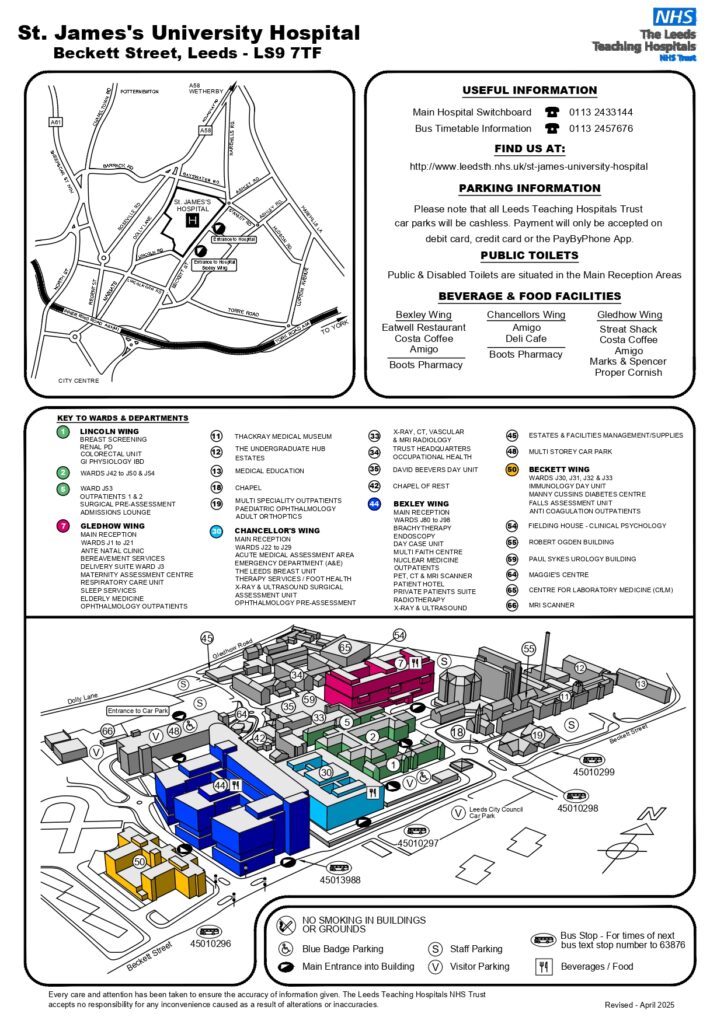
Brachytherapy is situated in the Bexley Wing at St James’s Hospital. Ask at Bexley Wing reception for directions to The Rutherford Brachytherapy Suite.

The Brachytherapy department

Find us
The brachytherapy department is located on level -1 in Bexley Wing at St James’s University Hospital.
If you are travelling by car:
You can park in the multi-storey car park for free by showing the parking attendant your appointment letter when exiting the car park. You can access the Bexley wing on level 0 and take the red lift to level -1 where you will find the brachytherapy department.
If you are travelling using hospital transport:
You will be dropped off on level 0 where you can access the Bexley wing and take the red lift to level -1 where you will find the brachytherapy department.
If you are travelling by public transport:
You can enter the brachytherapy department via the Beckett Street entrance. You can either walk straight up the stairs to level -1, alternatively you can enter the radiotherapy department and use the red lifts on the right-hand side to access -1 where the brachytherapy department is located. The nearest train station is Leeds station which is located 2 miles away and there are buses which can take you directly to St James’s University Hospital.
View of Bexley Wing, St James University Hospital
Bexley Wing – blue 44 on map