
Your doctor has recommended that you have a liver biopsy.
This information will explain what a liver biopsy is, what it involves and the possible risks. The aim is to provide you with as much help and information as possible before you have your procedure. If you have any concerns after reading this informationt please discuss them with a member of the healthcare team.
What is a liver biopsy?
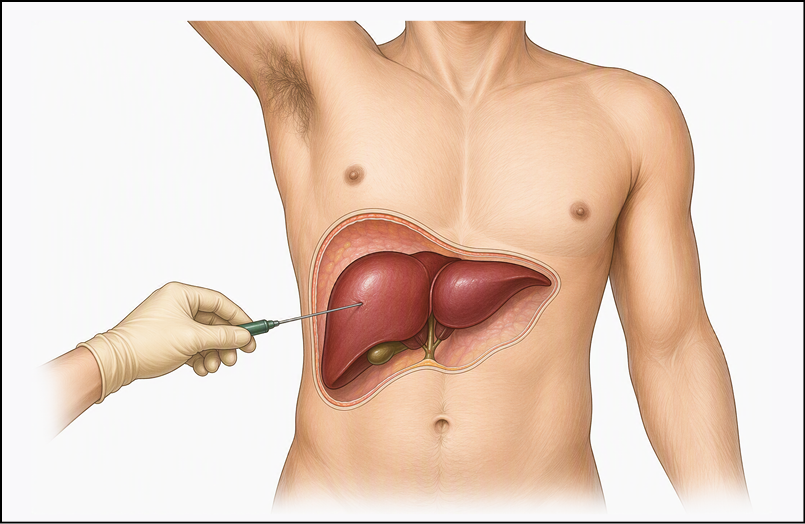
A liver biopsy is a procedure where a small sample of tissue is taken from the liver using a biopsy needle. The sample will be sent to the laboratory and examined under a microscope.
Why do I need a biopsy?
There are many different causes of liver disease and abnormalities in liver tests and scans. Sometimes the only way to diagnose liver disease is with a liver biopsy.
What are the benefits?
The main benefit is to assist your doctor in finding the cause and extent of your liver abnormality and help plan the correct management.
How do I prepare?
You will receive a letter with your biopsy appointment and a time for your pre-assessment telephone call. This is to confirm that you understand the benefits, risks and associated complications of the procedure and that you are willing to have the biopsy. Please have a list of your medications ready. If there is anything that you are unsure about or want to clarify, please do not hesitate to ask. You will be asked to undergo swabs and blood tests prior to your biopsy appointment and informed where to go for these.
Admissions secretary
Please confirm that you will be able to attend both appointments by contacting the admissions secretary below on:

Unable to attend
If you find that you cannot attend the date of your liver biopsy, please contact either the admissions secretary or the Liver Day Case Unit on either:
What happens on the day of my biopsy?
You will have been told where to come and what time during your pre-admission phone call. You should have a light breakfast and take any regular medication as advised by your doctor. Bring some overnight clothes, toiletries and if you wish, something to read. A small number of patients need to stay in hospital overnight after their procedure. We ask you to leave valuables at home where possible.
How is a Percutaneous Liver Biopsy Performed?
Your procedure will take place in the Ultrasound Department in Bexley Wing. Your details will be confirmed and your pulse and blood pressure measured. The radiologist/sonographer will briefly explain the procedure to you and confirm that you are happy to proceed. If you have any worries or questions at this stage, do not be afraid to ask.
The radiologist/sonographer will perform a quick ultrasound scan of your liver to find the safest site to take the biopsy from and the position you need to be in. They will clean the skin with an antiseptic solution and give you an injection of local anaesthetic into the skin and around the surface of the liver. This will sting for a few seconds before going numb. Local anaesthetic works extremely quickly and you should not feel any pain; however, you may still feel some pressure as the biopsy is taken.
Allergies/Conditions
It is important you notify us if you have any allergies or conditions (e.g. heart conditions) ahead of the scan, especially if your procedure involves the use of IV contrast or medications
Staff involved
Interventional Radiology (IR) procedures are performed by a multidisciplinary team. The team includes the following key Staff:
Interventional Radiologist (Consultant/Fellow):
A doctor specially trained in minimally invasive, image-guided techniques who performs the procedure.
Sonographers:
Health care professionals who are specially trained to complete certain invasive procedures.
Senior Clinical Support Workers (SCSWs):
Assist with the setup of the room, patient positioning, and maintenance of sterile condition
What are the risks?
A liver biopsy is a common procedure performed in Leeds Teaching Hospitals NHS Trust and the vast majority are done without any serious complications.
The most common complication is pain or discomfort which is usually controlled with pain killers.
There is a small risk of bleeding and you will be advised if you need to stop blood thinning medication. This can be a small amount, that usually stops quickly, from the site, or internally, which happens in less than 1 in 200. Sometimes this requires a blood transfusion and rarely a further scan to find the bleeding point and an angiogram (insertion of a small tube into the artery) to stop the bleeding blood vessel (angiogram). Very rarely is an operation required.
There is the possibility that the needle may injury other organs in the area such as gallbladder, lung, kidney or bowel but this is rare, less than 1 in 1000 cases.
Recovery?
You will be asked to lie flat and will have your pulse and blood pressure measured at regular intervals to look for signs of bleeding. It is quite normal to experience some mild discomfort over the biopsy site or referred to the right shoulder region. This usually responds to simple painkillers. After two hours, you will be allowed to sit up in bed; however, you must remain in bed for a total of 6 hours. If you remain well, you will then be allowed to get up and walk around the ward before being discharged home the same day.
Aftercare?
We recommend that a responsible adult accompanies you home, either by car or taxi. You should not drive yourself. We do not advise you to use public transport as it is unsafe if you become unwell. Under no circumstances should you go home on your own and you must have someone stay with you overnight. You should rest for the remainder of the day and avoid strenuous activity for 48 hours. You can eat and drink as normal.
Keep the biopsy site covered and dry for the first 24 – 48 hours. You can resume normal activities after 48 hours.
If you become sweaty, pale or feel faint, or If you become unwell – we would recommend attending your local emergency department.
When do I get my results?
Once the results of your liver biopsy are ready, an outpatient appointment will be arranged in 3 – 4 weeks to discuss the results with you and decide on any further treatment, if necessary.
Further information
NHS Choices British Liver Trust Patiet.infoIf you develop a temperature or redness around the biopsy site or experience pain that is not settling with painkillers, please contact either your local GP or NHS on: