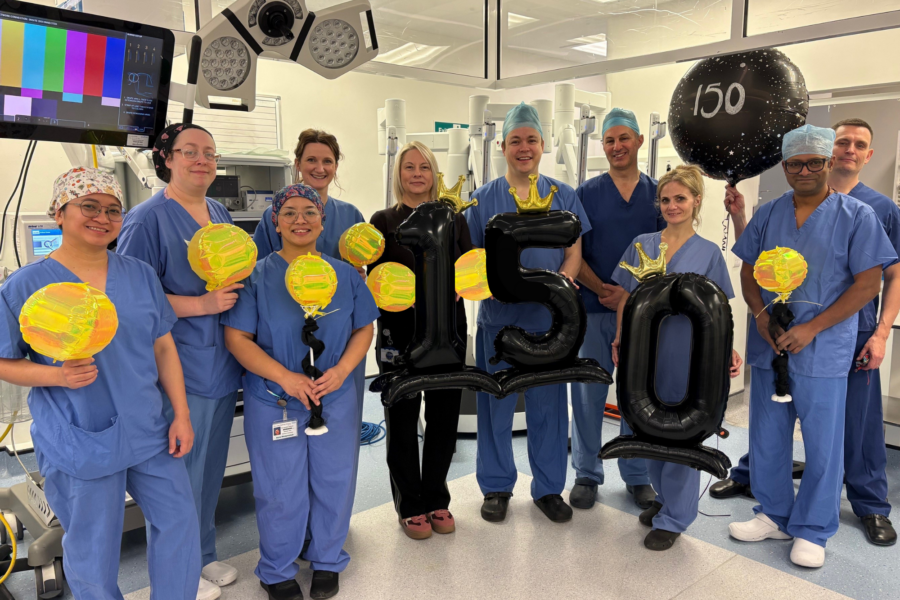
One hundred and fifty endometriosis patients have now had robotic surgery in our hospitals – benefiting from less invasive procedures and faster recovery times.
During Endometriosis Awareness Month, and just over two years after the robotic programme was introduced, the whole team at the Trust is celebrating this landmark.
Clinical Lead for Gynaecology, Mr James Tibbott, said: “We’ve built up from zero to 150 robotic surgeries in two years. This is a really fantastic achievement for the whole team, everyone from those who book our patients in, to those involved in setting up the surgical space and the delivery of care post operation.
“Robotic surgery has opened up a lot of opportunities for improving and innovating within women’s healthcare. It offers better patient outcomes, quicker operations, and quicker recovery, and means we can treat more patients. Hopefully this paves the way for better healthcare for women with endometriosis, and for women in general.”
The team uses a Da Vinci robot, which has four interactive robotic arms and a high-definition 3D vision system. The surgeon controls the robot to perform key-hole surgery, typically on more complex endometriosis cases. This allows surgery to be precise and controlled, with a better range of movement and vision.
Benefits of robotic surgery for patients include less pain, smaller scars, lower risk of haemorrhage or infection, a shorter stay in hospital, and shorter recovery time.
Aimee Bulloch, from Liversedge, had robotic surgery in November 2024 and said: “I can’t praise the team highly enough. The care from the endometriosis team was exceptional and is still ongoing to this day.
“The robot, although scary to look at, provided me with results that would not have been achievable without a stoma bag and lengthy hospital stay afterwards.
“What they did that day was nothing short of amazing; they removed endometriosis from my bowel, appendix, ovaries and pelvis with no lasting damage to these organs. Incredible!
Endometriosis affects one in 10 women and those assigned female at birth. It is a condition where cells similar to the lining of the womb grow in other parts of the body, often causing inflammation, scar tissue and pain.
The endometriosis team at Leeds was recently fully accredited as a British Society for Gynaecological Endoscopy (BSGE) Endometriosis Centre.
The accreditation recognises the whole team’s high standards of care, clinical expertise, patient-centred approach, and commitment to ongoing research and innovation.