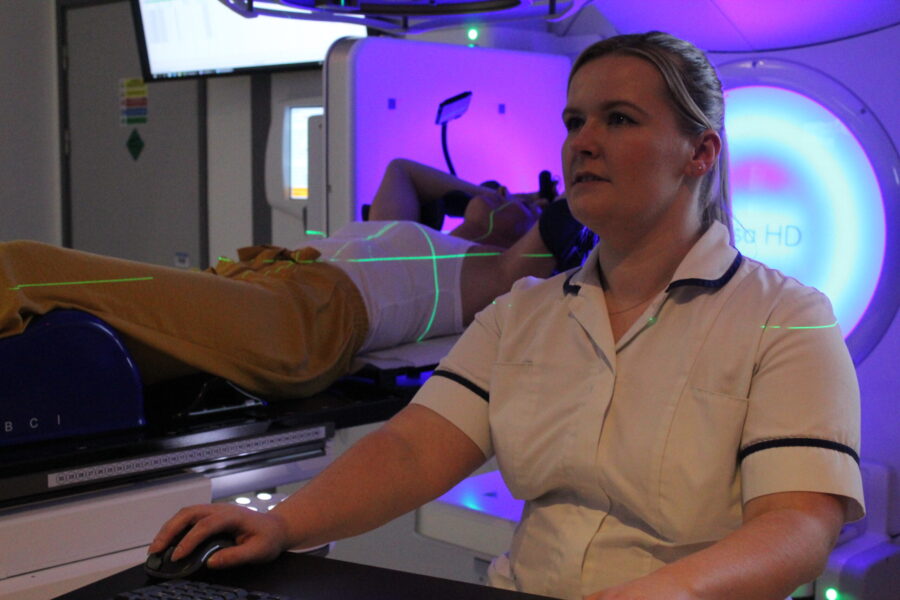
New state-of-the-art technology at Leeds Cancer Centre at St James’s University Hospital means that breast cancer patients can have radiotherapy treatment without the need for permanent tattoos on their body.
Now, thanks to £600,000 of additional funding from Leeds Hospitals Charity all patients can benefit from Surface Guided Radiotherapy (SGRT) treatment systems from VisionRT.
52-year-old Leanne Dalby, from Halifax was diagnosed with early-stage breast cancer earlier this year after a routine screening appointment.
Seven weeks after diagnosis, Leanne had surgery at her local hospital in Huddersfield and was referred to Leeds Cancer Centre for radiotherapy treatment to prevent her cancer from spreading or returning.
After reading NHS leaflets, Leanne had mentally prepared herself that she would need permanent tattoos to act as guides for her radiotherapy treatment, and was pleasantly surprised when she was told she wouldn’t need to be tattooed, She said: “My mum, who we sadly lost to breast cancer last year, had tattoos when she received radiotherapy some 18 years ago. So when I was told that thanks to new technology that I didn’t need to have the tattoos, I was surprised and really pleased! I am looking forward to booking a holiday and being able to wear a bikini and other summer clothing without worrying about exposing an unwanted tattoo.”
As well as eliminating the need for patients like Leanne to have permanent tattoos for radiotherapy, this advanced surface imaging also provides more accurate and safe radiotherapy treatment to around 1,800 breast cancer patients treated in Leeds every year. The integration of this technology will also reduce treatment slot times, increase capacity and enable more patients to receive radiotherapy quicker.
This game-changing technology also enables patients with communication impairments to have access to the best possible radiotherapy treatment.
Ordinarily, staff would use a speaker system to communicate with patients to let them know when to hold their breath and lie still during treatment, this is vital to ensure that healthy cells and organs aren’t damaged.
This meant that for deaf patients and those with other communication challenges, there was no way to communicate, and they were unable to have this treatment because of a risk of damage to their heart during treatment.
Leanne spoke to us about how this benefitted her during treatment. She said: “I had to use breath hold to protect my heart as the cancer had been in my left breast. I am a little hard of hearing, but the technology uses a visual guide so that as well as listening to the staff through an intercom, I could also look at the visual guide to show if I was holding the right amount of breath for the technique to work.”
The new technology installed on linac machines used for radiotherapy treatment, allows staff to use a light system to alert patients when they need to hold their breath and lie still in the same position. A visual aid called a real time coach is suspended above the patients face to provide a visual guide to their level of breath hold, giving patients real time feedback on their position to ensure they stay in the correct position for their treatment.
Peter Enever, Head of Radiotherapy at Leeds Cancer Centre, said: “This is a major step forward in patient-centred cancer care here in Leeds, as we strive to deliver world-class care to patients across the region. SGRT not only improves the precision of treatment and removes the need for permanent skin markings, but it also gives more of our patients the opportunity to benefit from cutting-edge treatment.”
Rebecca Baldaro-Booth, Director of Grants and Impact at Leeds Hospitals Charity, said: “We’re delighted that thanks to the generosity of our donors, we have been able to invest £600,000 in this project, helping to transform radiotherapy treatment for breast cancer patients.
“Leeds Hospitals Charity is committed to reducing health inequalities patients can face in hospital, and this is a fantastic example of how charitable funding can unlock opportunities for more patients to have access to the best possible care.”
Peter and his team hope that by Autumn every single breast cancer patient will have tattooless treatment thanks to this new technology.