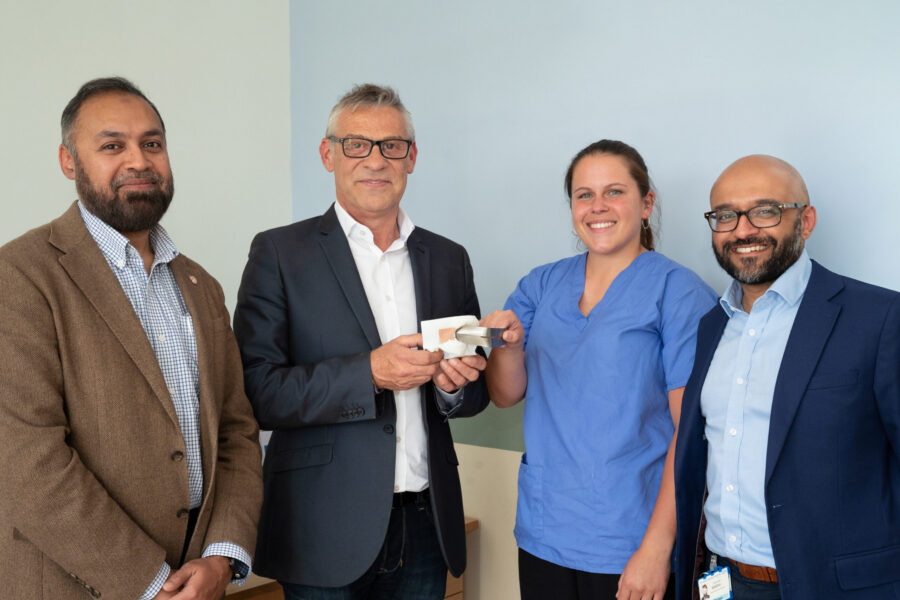
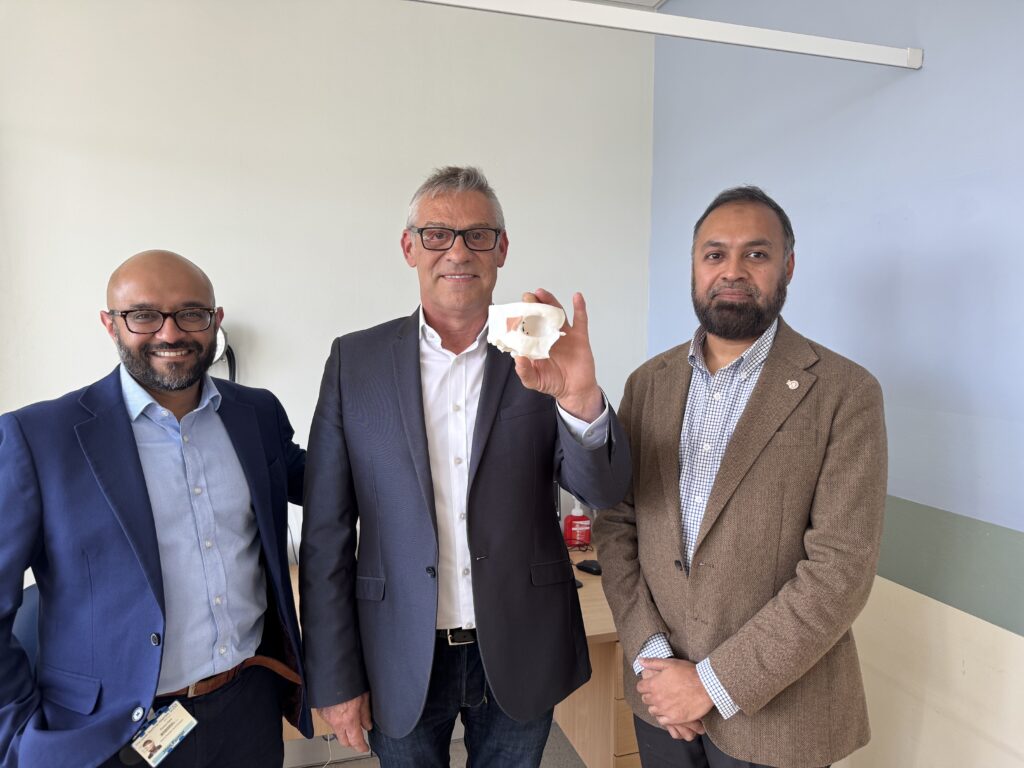
From left to right: Mr Asim Sheikh – Consultant Neurosurgeon, Andrew Wood, Magdalena Paluszkiewic – Reconstructive Scientist and Mr Jiten Parmar – Consultant Maxillofacial Surgeon
Photo credit: Leeds Teaching Hospitals NHS Trust
Surgeons at Leeds Teaching Hospitals NHS Trust have successfully carried out the UK’s first brain aneurysm clipping, performed by keyhole surgery through the eye socket.
The pioneering procedure, undertaken on 60-year old Andrew Wood from Wakefield, was planned and performed by an expert team of specialists at the Trust and marks another milestone in the use of minimally invasive surgery.
Andrew was diagnosed with a brain aneurysm during an MRI scan at Leeds General Infirmary in Spring 2025 and received ongoing care by specialists at the Trust to monitor the condition.
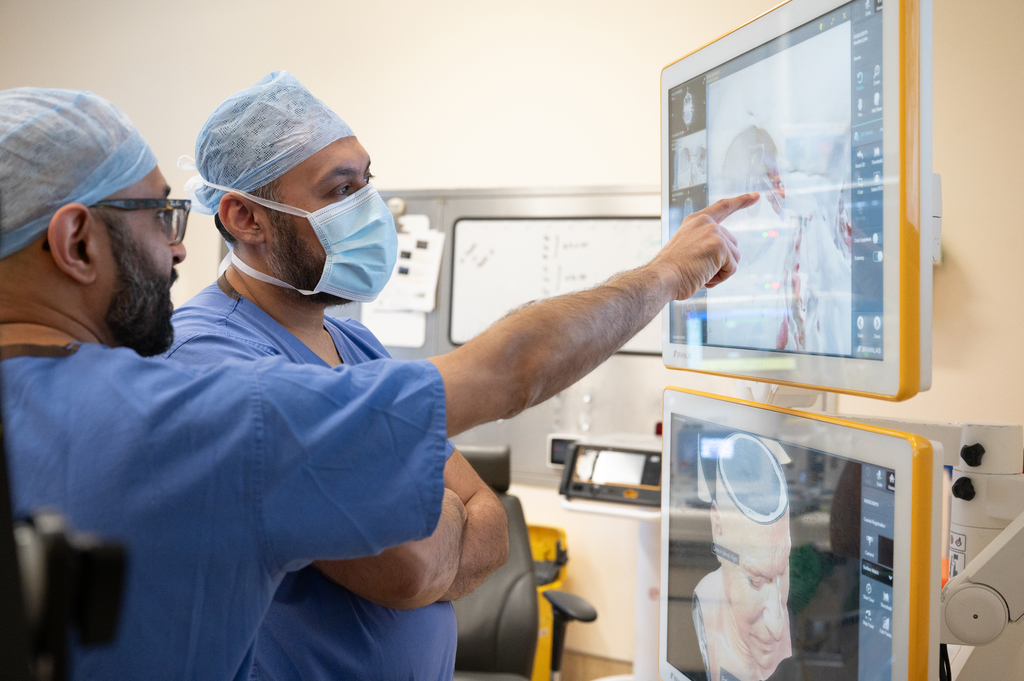
A brain aneurysm is weak, ballooned area on a blood vessel in the brain. If an aneurysm bursts, it can cause a serious bleed in the brain which can result in a stroke or in the worst cases prove fatal.
Patients are carefully monitored to track the size and placement of the aneurysm in order to determine the best way to treat it.
One treatment method is clipping, where a neurosurgeon carefully places a tiny metal clip across the base or “neck” of the aneurysm to stop if from bursting. Rather than performing traditional open surgery to clip Andrew’s aneurysm, the specialist craniomaxillofacial team at the Trust used an innovative technique to access the aneurysm by making a small incision on the outer area of eye. This minimally invasive approach avoids the need for a large skull opening and can significantly reduce trauma, pain and recovery times for patients.
The operation was performed by Mr Asim Sheikh, Consultant Neurosurgeon, Mr Kenan Deniz, Consultant Neurosurgeon and Mr Jiten Parmar, Consultant Maxillofacial Surgeon, supported by a highly skilled multidisciplinary team including anaesthetists, theatre staff and specialist nurses.
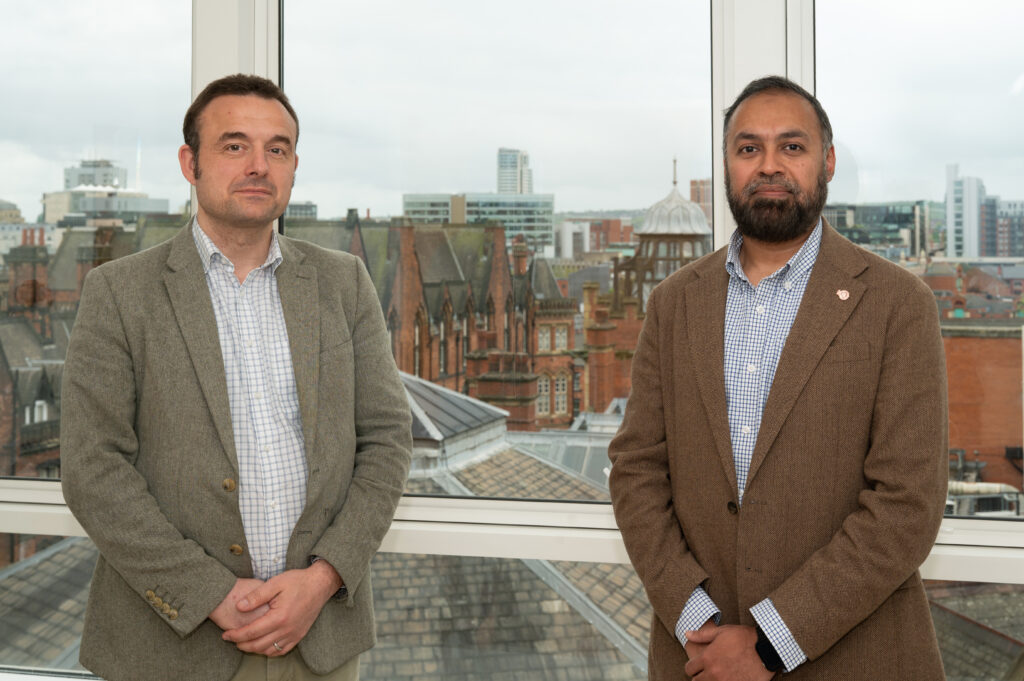
In preparation for the procedure, the team, supported by Biomedical Engineer Lisa Ferrie and Reconstructive Scientist Magdalena Paluszkiewicz, created a bespoke 3D printed model of the patient’s eye socket and surrounding skull base anatomy as well as the aneurysm.
This allowed surgeons to carefully plan and rehearse the operation multiple times before the operation, ensuring the safest and most precise approach.
This innovative technique highlights how Leeds neurosurgery and maxillofacial surgery is harnessing advanced imaging, digital planning and cutting-edge surgical methods to improve outcomes for patients across West Yorkshire and beyond. The team has used similar techniques to remove a brain tumour through the eye socket and this latest innovative approach, paves the way for this to be used for more patients across the country.
Mr Asim Sheikh, Consultant Neurosurgeon at Leeds Teaching Hospitals NHS Trust said: “This procedure represents a significant step forward in minimally invasive brain surgery in the UK. By accessing the aneurysm through the eye socket, we can avoid a large craniotomy, minimise disruption to surrounding tissue and help patients recover more quickly at home. The use of 3D printed technology to plan and practise the surgery was invaluable. It meant we could tailor the approach precisely to Andrew’s anatomy and undertake the operation with an added layer of confidence and safety. We are proud to be able to offer patients in West Yorkshire access to some of the most advanced neurosurgical and maxillofacial techniques available anywhere in the country.”
Mr Parmar, Consultant Maxillofacial Surgeon at Leeds Teaching Hospitals NHS Trust said “This case highlights how working in partnership across specialities, combining decades of experience and working closely with our engineering team can result in a better outcome for our patients. This case epitomises the combined excellent skills of maxillofacial surgeons and neurosurgeons. Most importantly, we achieved a brilliant result for the patient who went home the next day.”
Andrew Wood said: “From the day I was told I had an aneurysm, I felt confused and didn’t fully understand how serious it could be. I learned it wasn’t considered immediately life-threatening, but the uncertainty stayed with me. As I read more, I became increasingly worried about what might happen if it grew or ruptured, and whether I would have the chance to see my children again. Living alone made those thoughts even harder to manage, and I found myself feeling anxious and unable to focus on everyday life.”
“When I was seen by the team at the Trust, they explained everything clearly and with great compassion. Learning that the aneurysm had grown was frightening, but I felt reassured by the care and honesty I received.
I had to come to terms with the risks, even writing a letter to my children in case the worst happened, which was incredibly difficult. Thanks to the skill of the surgical team, I’ve been given a second chance.
I’m really grateful for their kindness and expertise – they are an outstanding team. I’m proud to have been part of such an important procedure and I’m amazed at how quickly I recovered and returned home.”
Brain aneurysms can be life-threatening if they rupture, making early diagnosis, careful monitoring and effective treatment crucial. The success of this first-in-the-UK procedure demonstrates the Trust’s commitment to delivering innovative, patient-centred care and to continually advancing surgical practice for the benefit of communities across the region.
Photo credit: Leeds Teaching Hospitals NHS Trust