

Introduction
This information has been provided for you, as a parent or carer of a child who has injured their brain following an accident or illness.
Children’s Neurosciences ward
The ward cares for children who have a brain injury following an accident or illness as well as children with other neurological problems. Children from infancy to 16 years are admitted can be admitted to the ward.
The aim is to provide you with information about your child’s stay whilst on the ward.
This information will be concentrating on:
- The early rehabilitation stages – the process, the people involved and what to expect when your child is on the ward.
- The planning and preparation for discharge home.
Important points to remember
Each child will progress in a different way following a brain injury and will experience different problems. It is not possible for anyone to predict exactly how well or how fast your child will recover. We understand that it is really hard for parents when we cannot give a clear idea about what the future might look like.. One of the reasons for this is that your child could take one of the many paths in recovery as shown in the following diagram:
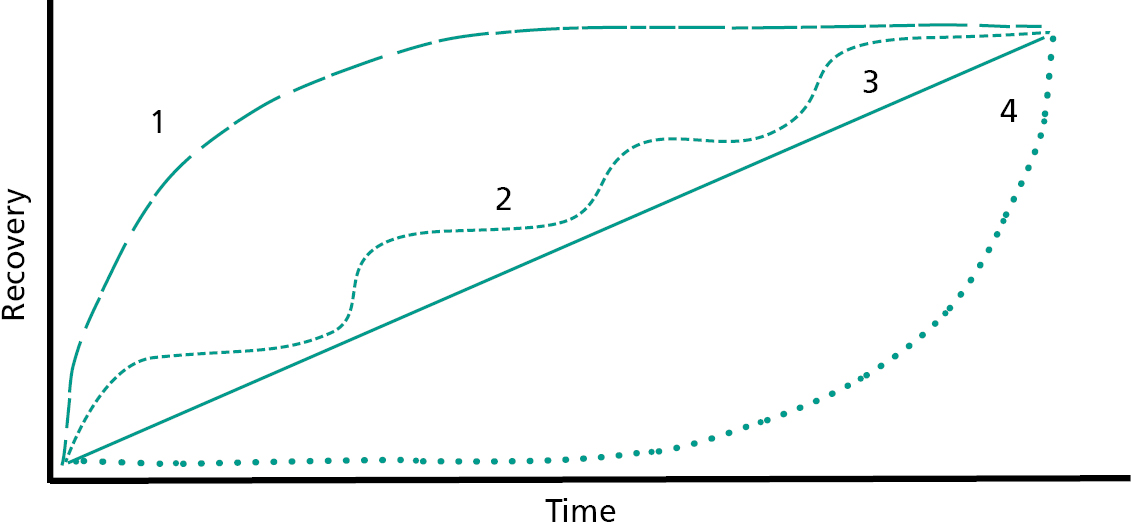
- Fast recovery in early stages which then slows down.
- Periods of fast recovery followed by periods of slow progress.
- Steady progress in recovery.
- Slow recovery in early stages which then speeds up but eventually your child will reach their potential in rehabilitation
As you can see, every child progresses differently and at varied speeds. There are many factors which impact a child’s rehabilitation including a child’s age, a child’s engagement in sessions and the area of the brain that’s been impacted.
It is important to mention that some difficulties may arise later as the brain continues to develop throughout childhood and adolescence. At the time of injury only problems present can be detected. As children get older and are expected to acquire new skills, problems may then become apparent. One example is that we are often aware of difficulties with movement earlier than difficulties with how are brain is thinking , these difficulties can sometimes take longer to emerge.
We ask parents to try and do the following:
- Try to get enough sleep, although this may be difficult if you’re sleeping on the ward. Some families feel better sleeping on the ward whilst others feel better sleeping at home or in parent accommodation. It’s normal for sleep to be impacted after a frightening experience howeverif you are finding it difficult to sleep longer term, speak to your GP.
- Try to eat regularly. If you can, familiar food can be helpful or eating small regular foods can be more manageable. A balanced diet will help with your energy levels up but we know sometimes this isn’t always possible when a child’s in hospital.
- Overtime, we support families to try and get into a routine on the ward. This includes waking up at a similar time, washing/showering, having regular meals and trying to go sleep at the same time. We know these things won’t always be possible and if there’s anything we can do to help, please let us know.
- We understand that families who have other children at home can find it particularly difficult both practically and emotionally to manage a neuro-rehab admission. We always encourage families to think about who can help with childcare. It can be helpful to let the siblings’ school know about an admission so that the school can provide additional support if needed.
- Make a list of any problems you are facing while you are in hospital and try to resolve them one at a time. Think about whether friends, other members of your family or members of the team can help you with these problems.
- Try to find time for yourself, whether this is a few minutes to make a cup of tea or to go for a walk. We will always try to support family members to have a break from the ward where staffing allows. Sometimes members of the team can see children for sessions on their own e.g. school or physio and this can be a good time for family members to have a break.
- You might want to think about joining a support group, e.g. Children’s Brain Injury Trust (CBIT) to talk with parents who have been in similar situations (see details at the back of this booklet).
The Team on the ward
The Multi-Disciplinary Team (MDT) Involves:
The team works together to provide joined up care, endeavouring to involve the family at all times.
Back to topWhat happens on the ward
Once on the ward your child will start the process of assessment and rehabilitation. Rehabilitation is the term we use for starting the process of recovery. It is a shared approach between your child, your family and a team of specialised professionals. This can include direct sessions with your child as well as exercises or strategies suggested for you to complete with your child outside of therapy sessions. It may involve considering adaptations and planning support that may help or be needed.
We support children to start their rehabilitation whilst admitted however it is a long process which will continue after discharge from the ward.
Ward Rounds
Each morning your child will be seen by the doctors on the daily ward round. On a Tuesday a larger team ward round takes place attended by the Lead Consultant and the therapy team. The purpose of these ward rounds is to review your child’s rehabilitation progress, not only medically but from all the therapy perspectives. The team are happy to answer any questions you may have. They may also arrange to meet with you at another convenient time.
Timetables
Each child has their own weekly timetable which is designed to meet their individual needs. It can usually be found on the wall beside your child’s bed. All therapy, school and rest times are included. The therapy and school sessions are as long as the team feel your child can cope with at that stage of their recovery. At first these are often as short as 10 minutes because your child will tire easily. This may seem a short amount of time, but it is important to remember that overstimulation is unhelpful. Rest is just as important as activity. As your child progresses, therapy and school sessions will become longer.
Goal Planning
As part of rehab, we will set goals for your child’s recovery. This is to help your child, you and the team have a focus for your child’s recovery. We will discuss these goals with you and your child (if appropriate). This may include both short-term goals and long-term goals. We will review your child’s progress towards their goals every one to two weeks in the weekly team meeting.
Questions
If you have any questions or concerns please do not hesitate to contact any members of our team. You may find it useful to write down any questions you may have and then discuss these with the team or your key worker as you see them
Other Information You May Need
Helpful Contacts
Child Brain Injury Trust
The Child Brain Injury Trust supports children and young people with an acquired brain injury (a brain injury acquired after birth), their families and the professionals involved with them.


Leeds Headway
Headway aims to promote understanding of all aspects of brain injury and to provide information, support and services to people with a brain injury their families and carers.
The Children’s Trust
For children with brain injury.