
Why will I need help to deliver my baby?
There are several reasons you may need help, including if:
- You are fully dilated and your baby is not moving through the birth canal as expected.
- There are concerns about your mental and/or physical wellbeing which require a speedier delivery.
- There are concerns about your baby’s wellbeing requiring a speedier delivery.
An assisted birth will mimic a spontaneous birth with minimum risk for you and your baby. Forceps or ventouse will only be raised as options if they are assessed as helping you give birth safely based on your individual circumstance.
You’re much less likely to require an assisted birth if you have had a vaginal birth before.
How common is an assisted vaginal birth?
Overall about 1 in 8 (10-15%) births in the UK will be an assisted vaginal birth although this is much less common in women who have had a vaginal birth before. 1 in 3 women having their first baby will have an assisted vaginal birth.
Your healthcare professional will discuss ways to reduce your chance of needing an assisted vaginal birth during your pregnancy.
Will I be asked for consent?
Yes. A doctor will ask for your permission to use forceps or ventouse to help deliver your baby. They will also explain:
- why they think you need an assisted birth
- what instrument they want to use
- the potential risks to you and your baby.
After your baby is born, you will have a chance to talk to your doctor or midwife about why you needed an assisted birth.
You can talk to your midwife about how to avoid an assisted birth before labour and a professional will be there to help you on the day.
What is a Ventouse birth?
A ventouse (vacuum extractor) uses suction to attach a plastic cup on to your baby’s head.
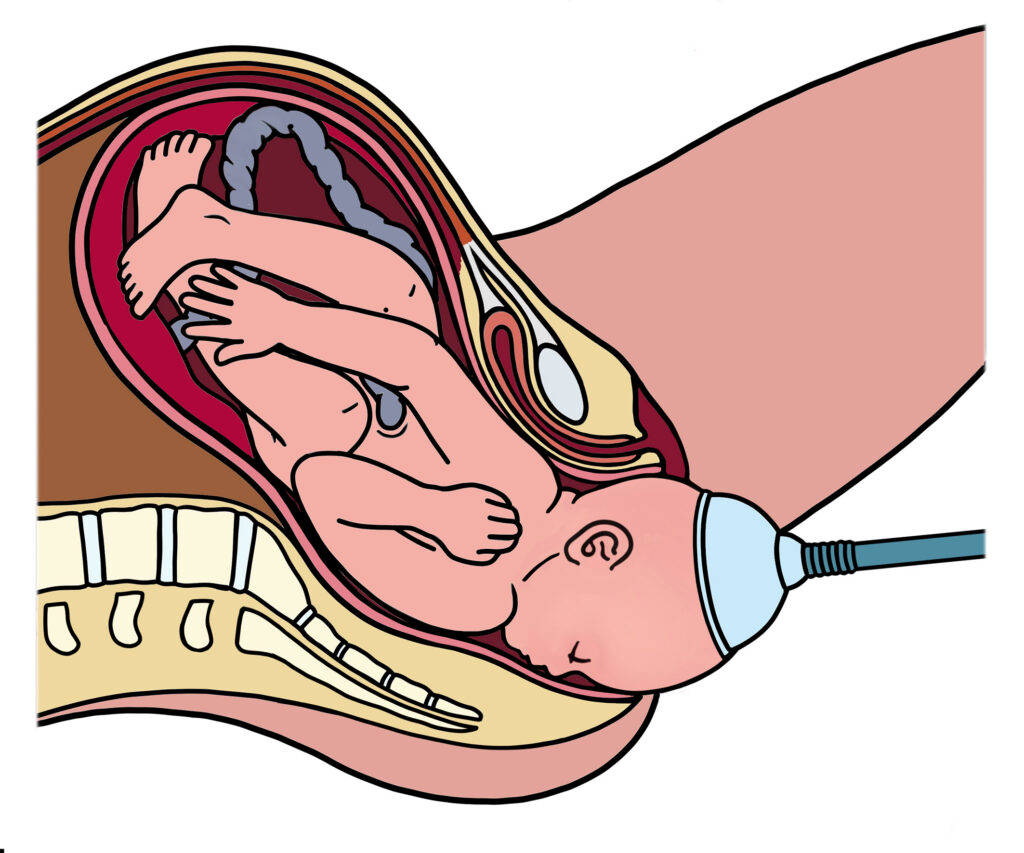
The doctor will wait until you are having a contraction and then ask you to push while they gently apply traction to help deliver your baby.
This may be repeated over three to four contractions.
What is a Forceps birth?
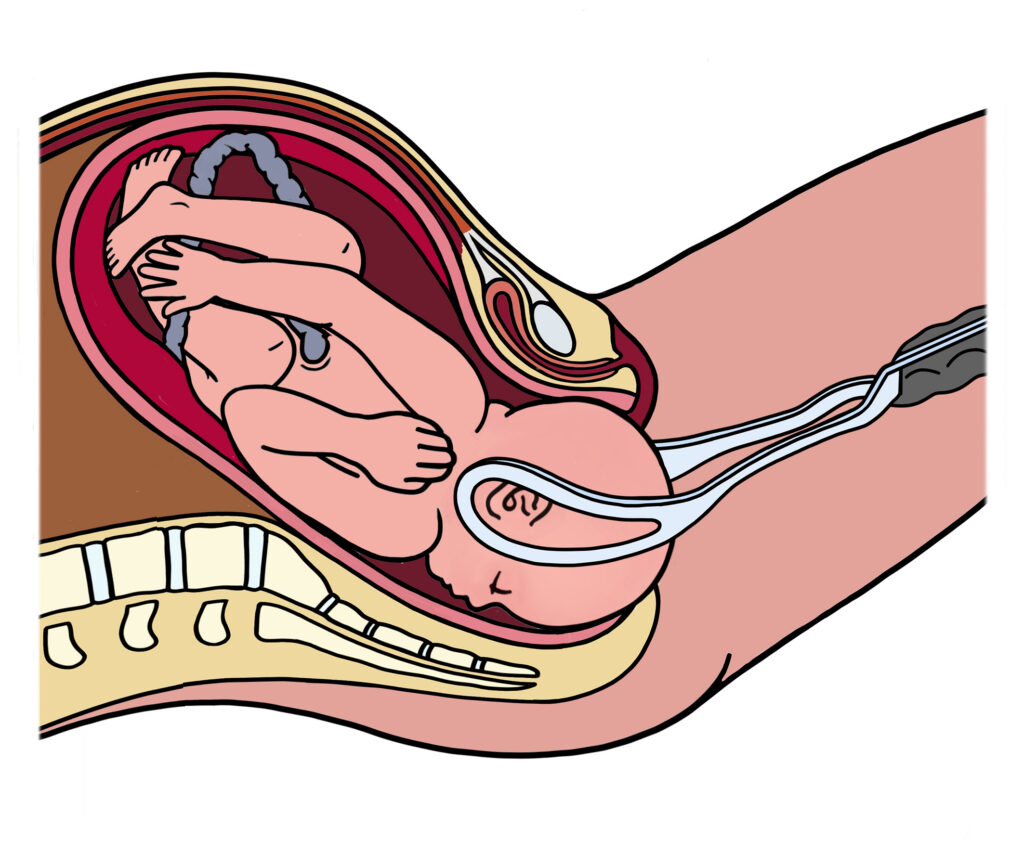
Forceps are smooth metal instruments that look like large spoons. They are curved to fit around your baby’s head.
The doctor will carefully put them around your baby’s head, wait until you have a contraction and then ask you to push while they gently apply traction to help deliver your baby. They may need to pull more than once.
Which instrument will be used?
Your doctor will choose the type of instrument most suitable for you, your baby and your situation.
There are many different types of ventouse and forceps, some of which are specifically designed to turn the baby around, if needed. Both instruments are effective in different situations, forceps may be used if your baby is in a sub-optimal position or higher up the birth canal, a ventouse may be used if your baby is in a lower position.
A ventouse is less likely to cause vaginal tearing than forceps, but is not suitable if you are less than 34 weeks pregnant as the baby’s head is softer.
What happens during a forceps or ventouse assisted birth?
Your doctor will examine your abdomen and do a vaginal examination to confirm that an assisted delivery is best for you. Your bladder will be emptied by passing a small tube (catheter) into it.
They may use a local anaesthetic injection inside the vagina (pudendal block) or a regional anaesthetic injection given into the space around the nerves in your back (an epidural) to block any pain.
If your baby’s head needs turning, you may be transferred to theatre for the birth of your baby. Here regional anaesthesia (epidural/spinal) will be given for pain relief.
Are assisted births always successful?
Not always. If your doctor has tried using a ventouse or forceps and they do not think your baby can be born safely vaginally, they will recommend your baby is born by caesarean section.
Assisted vaginal birth is less likely to be successful if:
- Your baby is large.
- Your baby is in a position which makes spontaneous birth more difficult.
- Your baby’s head is not low down in the birth canal.
What are the risks of having an assisted birth?
Ventouse deliveries have an increased risk to your baby of developing localised bleeding under the skin at the site where the suction cap is applied. A ventouse delivery is also more likely to fail.
Bleeding
Vaginal bleeding is normal after giving birth. Immediately after an assisted birth, you may have some heavier bleeding. This will be recognised by the team and managed at the time.
When you are in the hospital after the birth and when you go home, tell your midwife or health visitor if you are losing blood in large clots, because you may need some treatment.
Vaginal tears or episiotomy
You may have a vaginal tear or an episiotomy. This is a cut made in the area between your vagina and anus, called the perineum. Even without the forceps or ventouse the perineum may tear during delivery. If you have a vaginal tear or episiotomy, this will be repaired with dissolvable stitches.
If you have an assisted birth, you’re more likely to have a third- or fourth-degree tear.
This is a vaginal tear that involves the muscle or the wall of the anus or rectum.
This type of tear affects:
- 1 in 100 women having a normal vaginal birth.
- Up to 4 in 100 having a ventouse delivery.
- 8 – 12 in 100 having a forceps delivery.
Bowel and bladder problems
Urinary incontinence (leaking wee) can happen after childbirth and the risk of this can increase after a ventouse or forceps delivery. It is important you follow advice regarding pelvic floor exercises.
Anal incontinence (leaking wind or poo) can happen after vaginal birth, particularly if you had a third- or fourth- degree tear.
If you have any concerns about incontinence, do not delay discussing this with your midwife who can refer you to a women’s health physiotherapist.
Blood clots
Pregnancy increases the risk of blood clots forming in the veins in your legs and pelvis (deep vein thrombosis) and this risk is higher after an assisted birth. You can help reduce this risk by staying as mobile as possible after you give birth. You may also be advised to wear special stockings and to have daily injections of heparin, which makes the blood less likely to clot.
Sudden onset of chest pain or shortness of breath and pain and swelling in the legs are all signs of blood clots and must be reviewed urgently.
Are there any risks for the baby?
If you have a ventouse delivery, the suction cup can:
- Leave a mark on the baby’s head, which should disappear after a day or two. Rarely, some marks may last longer or may be more serious. If this is the case your baby will be reviewed by the neonatal team and a plan of care put into place.
- Cause a bruise on a baby’s head. It rarely causes any problems with babies except for a slight increase in jaundice in the first few days. Rarely, some marks may last longer or may be more serious. If this is the case your baby will be reviewed by the neonatal team and a plan of care put into place.
Forceps can:
- Leave a mark on the baby’s face – this is very common and usually small, and usually disappears within 24-48 hours.
- Sometimes leave small cuts on the baby’s face or scalp, which will heal quickly.
Can I decline an assisted delivery?
The doctor will not proceed without your consent. If you decide that you don’t want an assisted birth, please share this with your midwife as soon as you have made that decision, so the medical staff can act accordingly and make safe decisions with you about alternatives, in good time during your labour. However, caesarean section can be difficult at full dilatation if the baby’s head is low. In this situation, the risk of trauma to mother and baby is much greater at caesarean section than with an assisted delivery.
Caesarean sections in this situation can also impact on future pregnancies, with the risk of preterm birth increasing by 20% in future pregnancies
How will I feel after I leave hospital?
Much like after any birth, you may feel a little bruised and sore. Any stitches will heal within a few weeks and pain relief will help.
Will I need an assisted birth next time?
Not necessarily. Most women who have an assisted birth deliver their baby without help next time.
Informed consent
Before you agree to a treatment or procedure, a doctor, nurse or another member of your healthcare team will explain what will happen.
This leaflet gives you extra information to help you understand your care and make the decision that is right for you. It is OK to ask questions.
Please talk to us if:
- there is anything you do not understand
- you would like something explained again
- you have any questions or worries
- you need more information before making your decision.
Your care, your choice.
You have the right to be involved in decisions about your care. We will listen to you and support you to make your decision.
Take time to think about what is important to you. Please tell us about anything that may affect your decision so we can give you the information and support you need.