
What is a catheter-directed venous thrombolysis and/or mechanical thrombectomy?
Catheter-directed thrombolysis is the breakdown of blood clots using medication. A small thin tube is inserted into the relevant vessel and then a ‘clot busting’ medication known as Tissue Plasminogen Activator (tPA) can be injected directly aiming to dissolve the clot. A medication known as Heparin (an anti-coagulant, or ‘blood thinner’) is usually injected alongside the tPA.
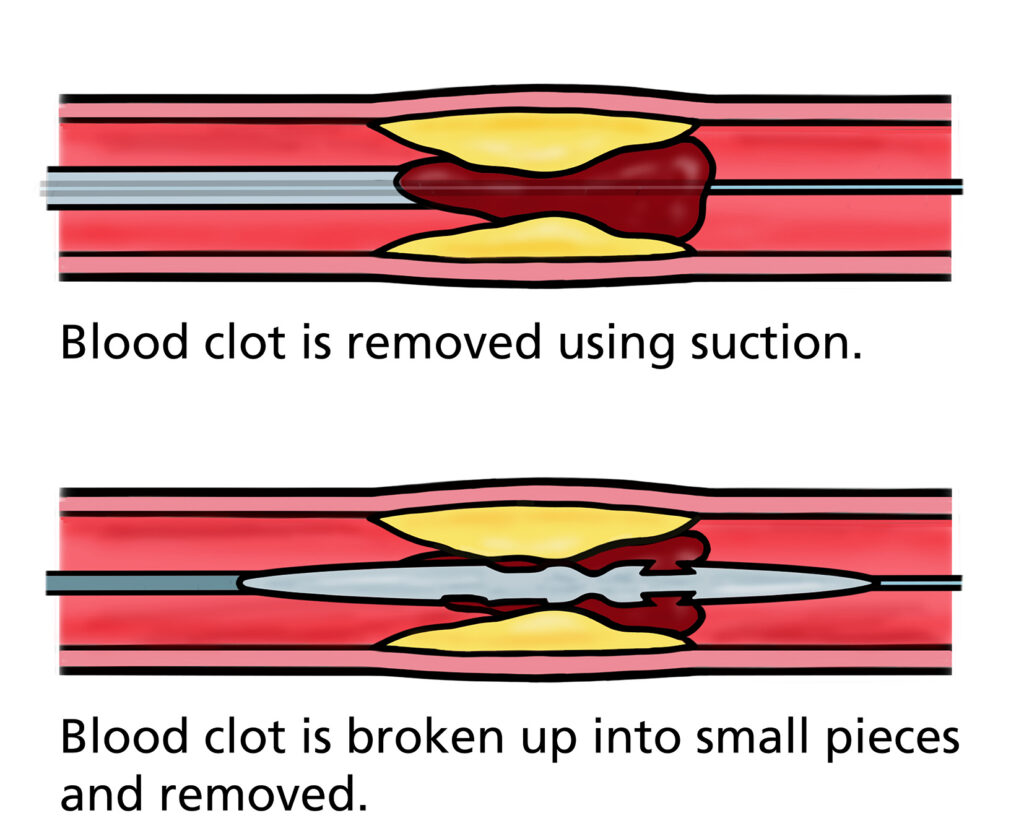
Mechanical thrombectomy involves removing a blood clot from a blood vessel using a catheter. Suction is attached to the catheter or small angioplasty balloons (or a combination of both) will be used to remove the clot.
How is this operation performed?
Consent
Before the procedure, the Radiologist will meet you in our recovery area to discuss the procedure in more detail, the risks and answer any of your questions to your satisfaction before you provide your permission and sign your consent form
Anaesthetic
Usually done under local anaesthetic, a medication like lidocaine, is injected into the skin and deeper tissues where access into a blood vessel is acquired usually from the groin or the arm. The local anaesthetic may sting when it is injected but then the area should feel numb.
Operation
The operation is performed under sterile conditions and the skin near the point of insertion will be cleaned with antiseptic and you will be covered with sterile drapes. The access into the vessel will be done using a needle, then what is known as a sheath will be placed and the needle removed.
The sheath is a small tube that maintains access to the vessel whilst reducing any risks of blood loss and allowing the use of wires and catheters.
The Radiologist will use the wire and catheter to move to the right position – where the blood clot is.
From there they can then carry out the operation – either thrombolysis or thrombectomy depending on what the chosen method is. X-ray equipment and contrast dye will be used to check imaging and catheter/wire positioning throughout the operation.
The contrast dye may give you a warm feeling and give you the sensation that you are passing urine.
Staff involved
Interventional Radiology (IR) procedures are performed by a multidisciplinary team. The team includes the following key Staff:
Interventional Radiologist (Consultant/Fellow):
A doctor specially trained in minimally invasive, image-guided techniques who performs the procedure.
Radiology Nurses:
Highly trained nurses who care for the patient before, during, and after the procedure. They assist with sedation, monitor vital signs (heart rate, breathing, oxygen levels), and may “scrub in” to assist the radiologist directly.
Radiographers:
Experts in imaging equipment who operate the machines to provide real-time guidance for the doctor.
Senior Clinical Support Workers (SCSWs):
Assist with the setup of the room, patient positioning, and maintenance of sterile conditions.
What are the risks?
Catheter-directed thrombolysis
- Biggest risk is bleeding. Most of the ‘clot busting’ drug will stay in the clot. However, some inevitably leaks into your circulation causing an unwanted risk of a bleed
- This has a low risk of a bleed in the brain causing stroke and potentially being fatal
- Risk of minor bleeding to site
- Small risk of allergy to x-ray dye (severe reactions is less than 1 in 5000)
- Bruising from the access site – risk of haematoma/pseudoaneurysm requiring further treatment
Mechanical Thrombectomy
- Dislodging clot material leading to a potential occlusion in another vessel
- Damage to the vessels accessed/nearby, potentially causing a bleed or aneurysm requiring further intervention
- Bruising from the access site – risk of haematoma/pseudoaneurysm requiring further treatment
- X-rays will be used to make images of your body and guide your doctor during the procedure. X-rays are a type of radiation. We are all exposed to low levels of natural radiation as part of our everyday lives and medical x-rays give an extra dose of radiation. Radiation can increase your chances of developing cancer many years or decades after the exposure. The chances of this happening to you as a result of this procedure are considered to be very low.
What else to expect from this operation?
Admission
Usually carried out on patients, who are already in-hospital, you will arrive to radiology theatres from the ward you were on and these will be arranged for you:
- Specific and up-to-date blood tests are required to make sure it’s safe to carry out the operation.
- A cannula will be inserted in your arm, and you may need a fluid drip overnight or antibiotics before your operation.
- You will be put into a theatre gown.
Pre-operative preparation
To promote patient safety during your operation, the following patient preparation are required:
- There is no need to fast for this operation, as it is performed under local anaesthesia.
- To lessen your risk of getting an infection, you will be prescribed a course of antiseptic wash and nasal cream.
- Most blood thinning medications need to be omitted, please discuss with us if you are taking any.
- If you have bleeding disorders or your blood clotting function is below threshold, you may require a blood transfusion; please inform us if you have concerns.
Recovery
After the operation, you will be transferred to our recovery area, where you will be closely monitored. If you have undergone a mechanical thrombectomy:
- The sheath (plastic tube) is removed and manual pressure is applied to the punctured site to stop it from bleeding.
- Your vital signs and the punctured site will be monitored closely.
- You will be placed on bed rest for several hours to allow you to recover from the operation and reduce your bleeding risk.
If you have undergone catheter directed thrombolysis:
- A catheter is left in the vessel (from your groin or arm) which will be secured. This is attached to an infusion pump that will allow for further delivery of the ‘clot-busting’ drugs, which will infuse over the next 24-48 hours.
- Your vital signs and the punctured site will be monitored closely and regularly, and a urinary catheter may have to be placed.
Aftercare
Once stable, you will then be transferred back to the ward.
For mechanical thrombectomy, you may expect the following:
- We need to keep you in hospital to review if the operation is successful and your pain is adequately controlled.
- Your blood tests will also be checked to allow your doctor to ascertain when it’s safe for you to be discharged from the hospital.
For thrombolysis, you may expect the following:
- Whilst the infusion is ongoing, you will be nursed in a High Dependency Unit (HDU) and be on bed rest (flat in bed for groin access; you could sit up with arm access).
- You will come back to radiology theatres after 24 hours to check if the thrombolysis worked. An angioplasty may be required if it shows a narrowing once the clot is gone (see separate leaflet).
Care at home
All being well, you will normally be discharged after 2-4 days.
- Exercise: limit your activities, get plenty of rest and gradually introduce light exercise after a week unless advised otherwise.
- Work: we advise a period of about seven days off-work to rest; a sick note may be requested from your doctor if needed.
- Driving/travel: There is no clear guidance saying you shouldn’t travel by plane after your operation. However, please avoid driving for at least 72 hours afterwards to allow adequate recovery time and ensure you can safely perform an emergency stop if required.
- Medicines: medications for pain, sickness and mild fever will be included, when you’re discharged; if you were asked to stop taking blood thinners, we will also include instructions when to resume those.
- Follow-up: this will be organised by the ward doctor.
- Medicines: medications for pain, sickness and mild fever will be included, when you’re discharged; if you were asked to stop taking blood thinners, we will also include instructions when to resume those.
- Follow-up: this will be organised by the ward doctor.
Contact details
We hope some of your questions have been answered by this leaflet. If there are any questions you would like to ask before you come for your operation, please get in touch.
Interventional Radiology – SJUH


Interventional Radiology – LGI
How to get to our department
We are located in the Ground Floor of Lincoln Wing at St James’s University Hospital.