

Urticaria, also known as hives, is an itchy blotchy rash that looks like a nettle sting.
Some people also get swelling of their skin, lips and around the eyes. This is called angioedema.
Urticaria is very common and is sometimes caused by allergies to dust, pollen and pets or foods like eggs, milk, fish and nuts. If urticaria is caused by one of these, the rash would appear soon after contact with the allergen.
Not all hives are caused by allergies.
Many people are troubled by urticaria without any obvious cause.
The sudden appearance of an urticarial rash for several days is often due to a viral infection.
If the rash continues for more than six weeks the condition is known as chronic urticaria.
Chronic urticaria
Chronic urticaria is a common condition. It can sometimes be a problem and get in the way of daily activities.
Some people find that their rash can be caused by
- Heat – bathing in hot water
- Cold – weather and water
- Pressure – after sitting for a long time
- Emotion – this is known as cholinergic urticaria.
In some people the rash can be caused by an autoimmune disease (a problem with the body’s immune system).
How the immune system causes hives
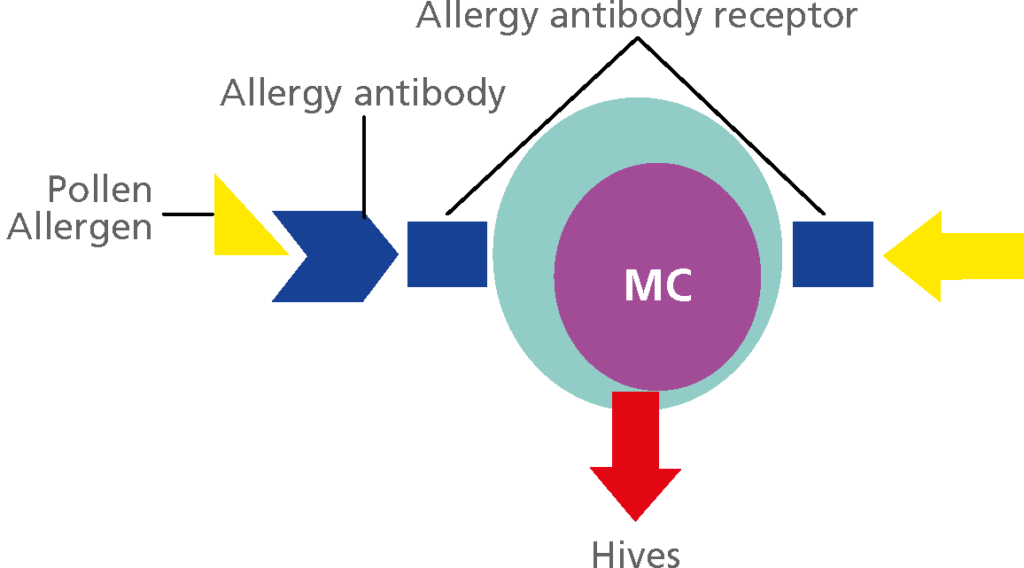
In an allergic reaction
An Allergic reaction (such as pollen) tells the mast cell (MC to release chemicals which cause hives and an allergic reaction. An allergy antibody makes this happen.
In Chronic Urticaria
The allergy antibody receptor is short circuited without any allergen or allergy antibody around. The MC then releases chemicals that cause hives.
Treatment for chronic urticaria
There is no cure. Many children have the rashes for six months to a year.
The doctor may take some blood tests to look for conditions that can make urticaria worse.
The rash can be controlled by taking antihistamine medicines every day.
Antihistamines do not have long-term side effects and are not addictive. Even if you taken for a long time your child will not become immune (no longer have an affect to the antihistamine).
Sometimes a high dose of these medicines is needed to control the symptoms.
Long-term management
Chronic urticaria is a long-term condition. Most people will have symptoms for about six months, but they can continue for one or two years. About half of people with chronic urticaria may have other episodes in the future.
Clinic appointments
The clinic letters often ask that antihistamines are stopped before the clinic appointment. This information is meant for children having skin prick testing for their allergies.
If your child has chronic urticaria and is taking antihistamines every day, this advice does not apply to your child. Do not stop the antihistamines before the clinic appointment.
Please feel free to contact us if you are unsure or If you have any questions or concerns.

