

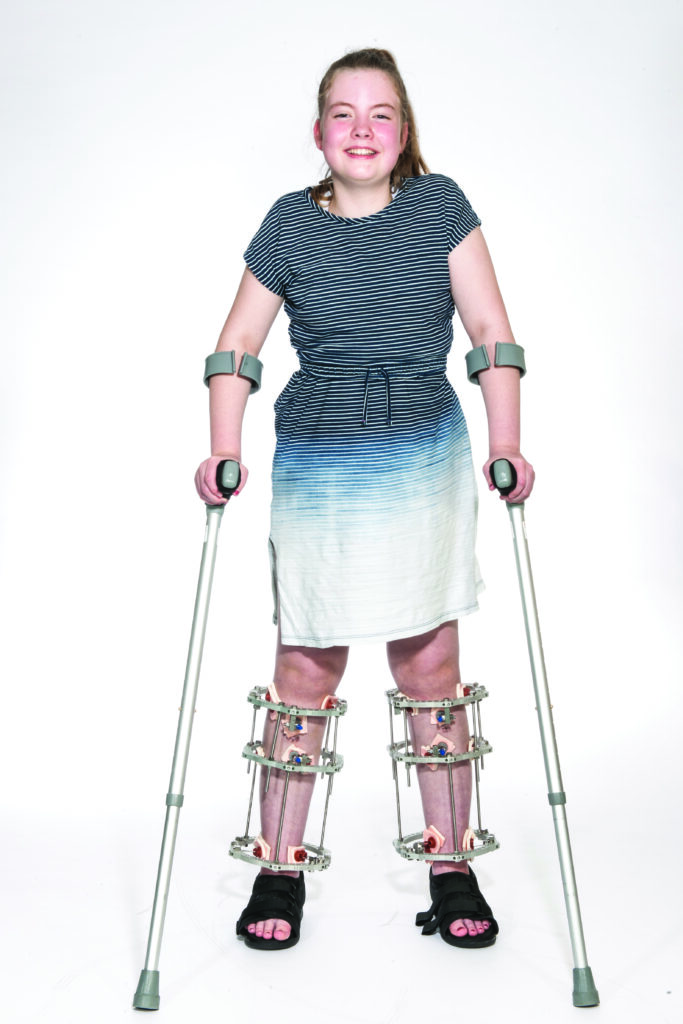
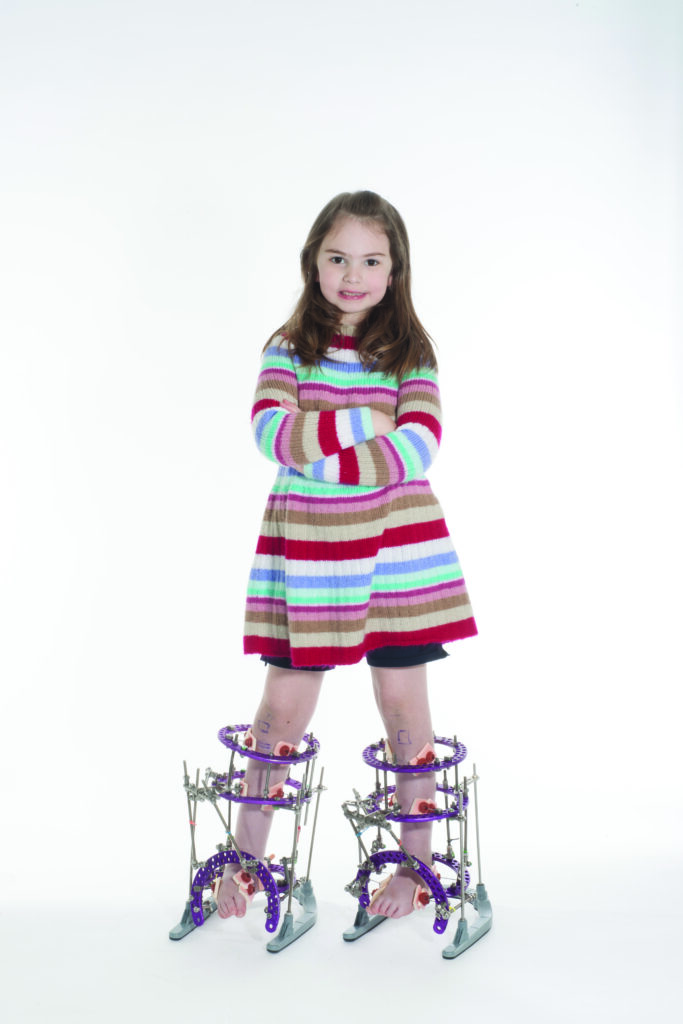
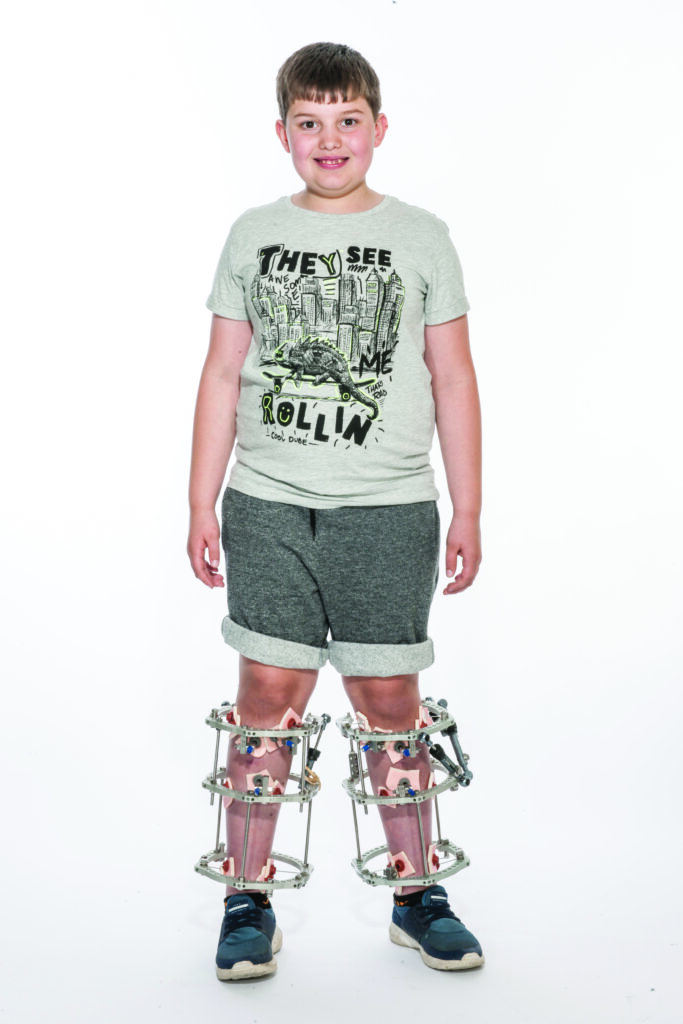
This information aims to help you and your family understand more about your treatment with a circular frame, and to provide you with guidance about coping with your frame from day-to-day.
You will be shown how to do your physiotherapy exercises and how to take care of your skin where the pins are.
The doctors, nurses, play specialist and physiotherapists looking after you will explain everything to you when they meet you. If you do not understand some of the words or phrases they use, please ask what it means. If you feel shy, you can write your questions down and hand them to the doctor.
We never mind how often you ask!
If you have a frame on due to an accident
If your frame is needed because you have had an accident and broken your leg, there will not be time for a pre-assessment but you and your family will still have an opportunity to talk about the frame and ask questions.
Preparing for planned surgery
Once you and your family have decided you want to have the operation, you will be invited to a pre-assessment clinic to make sure you are fit and well. The nurses will chat to you about your health and you may have some tests.
Before your operation, you might feel scared or not know what to expect. This is a normal reaction. If you feel worried about anything, you can let a nurse know and they can chat with you about this. The play specialist is also there for you to help you prepare for your operation.
Admission letter
You will receive a letter about 2 weeks before coming into hospital. This letter will inform you of where to go on the day of your operation.
The letter will ask you to ring the ward to check there is a bed for you and to ask your family to tell us you are fit and well for the operation. The letter will also tell you when you can have your last meal or drink before your operation. It is very important that you follow these instructions exactly or your operation maybe cancelled.
Back to topOperation day
On the day of your operation, your operation is explained to you again. Your doctors and nurses at the hospital will ask you questions, this is also a good time to ask any questions you might have. Your Mum or Dad can go with you to the operating theatre and stay with you until you go to sleep. When you wake up, they can come and see you.
After the operation
When you wake up on the ward after the operation, you will now have the frame on your leg. This might feel strange but that is normal. You will have a drip attached to you to give you medicine for pain, and a monitor to check your heart rate and oxygen level in your body. It is important that you tell the nurses or your mum or dad if you have pain so we can give you medicine to help take the pain away.
You may need to have paracetamol to help with the pain when you go home for the first few weeks. We ask you not to take Ibuprofen as this medicine can slow down bone healing. If you experience a new pain during your treatment, it is important that you let us know.
If you find yourself worrying about the operation
Some of these techniques below might help you
What can help me
- talk about your worries to somebody like your Mum and Dad, nurses, a teacher or psychologist about how you are feeling;
- take some deep, slow breaths;
- count backwards;
- put your headphones in and listening to music; and
- imagine you are in a relaxing place.
What will not help me?
- It is important to not avoid looking at your frame because looking at your frame can help you get used to it.
- If you feel worried or sad about having a frame on, bottling up your emotions will not help. This may make you feel worse in the long run.
- Smoking and exposure to smoke from cigarettes slows down bone healing and increases the risk of infection, which means you will have to have the frame on longer.
Swelling
All legs swell with a frame on, especially in the first few weeks. We encourage you to fully weight-bear and walk, whenever possible. This can increase swelling in the beginning so when you have had a walk, you can rest your leg on a stool with a pillow underneath to reduce any swelling.
Clothing
The frame is wide and you will need to make some changes to your clothes. You may like to cut some jeans up the sides and sew in some Velcro so that you can get them on and off, or cut some jeans up and make them into shorts; some patients like to cover their frames up. If you did want to cover your frame, you could make a funky cover!
Shoes
Initially, you will need to wear a special shoe with a band called a ‘Theraband’ around the shoe to support your foot. This will help you to walk after the operation. It is important that you do not put the Theraband next to your skin and always check your skin to make sure it does not get sore. Please ensure you wear the Theraband for 2 hours on and
1 hour off. You can practise your exercises when you take the Theraband off. Once the physiotherapists are happy that you are doing your exercises and you can walk well, you can wear your normal shoes.
Physio
It is very important that you do your physiotherapy exercises.
The physiotherapist will show you how to bend and stretch your knee, and flex and extend your foot. It will be hard at first but it will get easier the more you practise. You will need to keep doing these exercises when you get home. It is normal to feel some discomfort around the pin sites when you are doing your exercises.
If your frame is in place to lengthen your leg, it is even more important to do your stretches and exercises as the muscles will become tight – they have to lengthen as well as the bone!
Place a towel around your foot keeping your knee straight. Pull your foot towards you until you feel a stretch at the back of your calf.
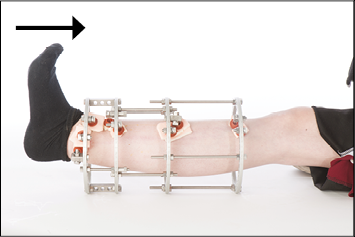
Hold this for 30 seconds and repeat 3 times.
Stand with your affected leg on a step. Keep both feet facing forwards and both heels in contact with the floor.
Slowly take your weight over onto your affected leg. Feel the stretch down the back of your calf.
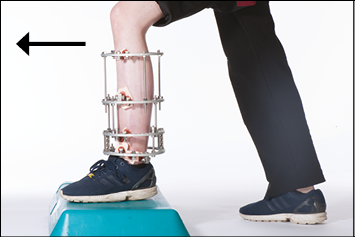
Hold this for 30 seconds and repeat 3 times.
Sit with your affected leg out straight in front of you. Pull your foot towards you as far as you can.
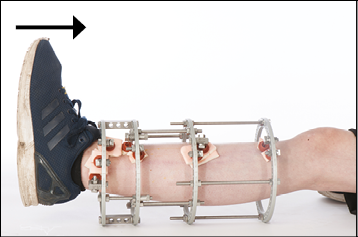
Hold for 5 seconds, relax and then repeat 10 times.
Sit with your affected leg out straight in front of you. Push your toes away from you as far as you can.

Hold for 5 seconds, relax and then repeat 10 times.
Sit with your affected leg straight out in front of you. Pull your foot out to the side as far as you can, leading with your big toe.

Hold for 5 seconds, relax and then repeat 10 times.
Sit with your affected leg straight out in front of you. Pull your foot out to the side as far as you can, leading with your little toe.
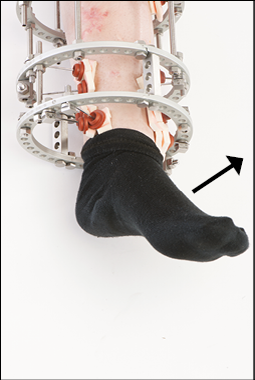
Hold for 5 seconds, relax and then repeat 10 times.
Sit with your affected leg out straight in front of you. Pull your foot towards you so your toes are pointing upwards. Try to push your knee down to get it as straight as possible.
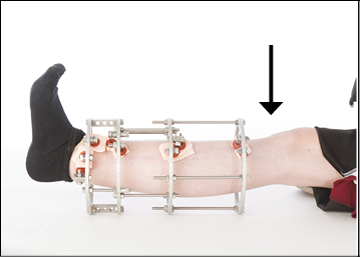
Hold for 10 seconds and repeat 10 times.
Sit with your affected leg out straight in front of you. Pull your foot towards you so your toes are pointing upwards. Slowly lift your leg off the bed no more than 5 inches – keeping it straight throughout.
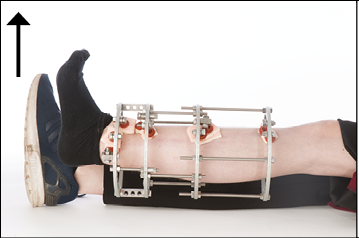
Hold this for 10 seconds, slowly lower and then repeat 10 times.
Sit with your affected leg out straight in front of you with your toes pointing upwards. Point your toes so that you are pushing against the red theraband.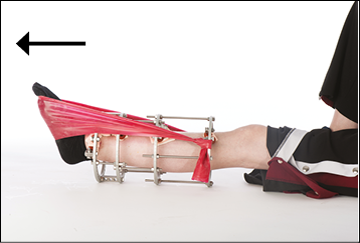
Push and hold for 5 seconds, then slowly return to the start position. Repeat this 10 times.
Sit on a chair with your knees bent at around 90 degrees.
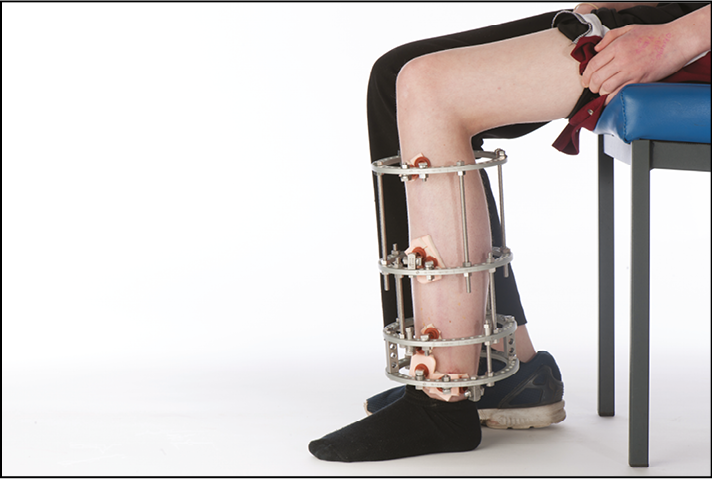
Slowly straighten out your affected leg (as shown below).
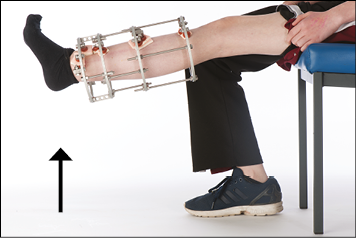
Hold this for 10 seconds. Then, slowly lower your leg back down to the starting position. Repeat this 10 times.
We strongly recommend that you carry out your exercises at least three times per day. Your physiotherapist will advise you if you need to them do more or less often.
If you have any problems or queries, do not hesitate to contact your physiotherapist or nurse specialist.
Problems with wires
The wires are connected to the rings at the time of the operation. Very occasionally, the wires can snap or come away from the ring.
Please do not worry as this is not an emergency and rarely causes pain.
If this does happen, stop walking on that leg and contact us as we can have a look at the frame to see if we need to do anything.
Adjustments to the frame
If you have a planned frame and you need to do turns on the struts, it is important that you follow the instructions on either the printed programmes you will be given, or use the
Special App which you can scan and download onto your parents phone. This can help you to remember when to do the turns as it reminds you on your phone.
Doing the turns should not hurt too much as the corrections are done very slowly, about 1 mm per day. If your struts or rods get stuck, then you can use 10 mm spanners to do the turns. If you have a problem, please ring the specialist nurse for help. Sometimes, we do adjustments in clinic but this does not hurt.
Pin sites
The pin sites are where the wires go through the skin and bone. It is really important to look after the pin sites to stop infection.
You will have special dressings on when you come back from the operating theatre. The first time we clean the pin sites is 2 days after your operation. We can show you and your family how to clean the pins sites before you go home but the community nurses will also help you to do them to when you go home.
After the first pin site dressing change, we ask you to keep the pin sites covered at all times and to change the dressings once per week. This can be combined with having a shower but it is important that the frame and the pin sites are dry before placing the new dressings on.
If the pin sites are sore or oozing, you may have to change them more often. Sometimes, dry crusts can form around the wires. These are natural and can protect against infection. Although it is tempting to remove them, please do not as this can make them bleed and cause infection. Sometimes, the crusts will fall off when you are cleaning the pin sites. This is not a problem.
If you get a pin site infection, please make an appointment with your GP and ask for a course of antibiotics. If you cannot get an appointment at the doctors, please ring the nurse specialist who will be able to help you.
Back to topShowering
When you are more confident, and have got used to your frame and all your wounds are healed, you can have a shower once per week. It is best to do this on the day you have your pin sites cleaned. Before you have a shower, remove all your old dressings. After your shower, make sure the frame and skin is completely dry. You can then carry out your pin site care and apply your new dressings. Remember, a clean frame helps prevent infection.
Equipment needed to clean the pin sites
- Dressing pack.
- Pink sponge sticks.
- Cleaning solution: 0.5% Chlorhexidine (Hydrex) / saline or cooled boiled water.
- Allevyn dressings and clean scissors.
How to clean the pin sites
- Wash your hands with soap and water.
- Open dressing pack and pink foam sticks.
- Pour the cleaning solution into the plastic tray.
- Cut the Allevyn sheet into 2 cm squares with a slit cut into the centre (like shorts)
- Pull the plastic bungs or clips up from the wire or pin.
- Remove and discard old dressings.
- Wash your hands again.
- Clean the pin sites individually using the pink sponge sticks soaked in the cleaning solution.
- Do not remove the crusts.
- Ensure all the pin sites are dry.
- Cover each pin site with a double layer of Allevyn (white side to the skin, pink side up).
- Push down the bungs or clips with enough pressure to hold the dressings in place but not too firmly.
- Dispose of all dirty dressings.
Despite the best care, when looking after your pin sites, about one third of patients have a pin site infection. This can usually be treated with antibiotics.
Signs of infection
Pain – around a particular pin site or sites. This in some cases affects ankle or knee movement.
Redness around the pin site, which may spread.
Swelling and the skin feeling warm.
Finding walking more difficult.
There may be some pus or thick fluid oozing from the pin site. A small amount of clear or straw coloured fluid is often nothing to worry about.
If you feel unwell with a temperature.
Unless you are unwell, this is not an emergency but it is best to see the GP within 24 hours or ring the nurse specialist for advice. We do not recommend taking routine microbiology swabs. Flucloxacillin for 7 days is the standard antibiotic used if there is no allergy; otherwise, clarithromycin is used. It is best to clean your pin site(s) more frequently when you have an infection, taking care to use a new stick to clean each infected wire. This prevents the infection spreading to other wires.
Back to topSkin irritation
Sometimes, the skin can develop a rash on the leg around the pin sites. This is different to an infection. If this happens, we suggest that you stop using the Hydrex (Chlorhexidine) and use cooled, boiled water or saline and using gauze squares instead of Allevyn. Only use creams if prescribed by the GP or the doctors in clinic.
Useful telephone numbers
If for any reason you do not receive an appointment, please ring the children’s orthopaedic nurse specialist or secretary.

