
This leaflet has been designed to help you prepare for skin surgery procedures by answering a few commonly asked questions.
What will happen?
We have many highly skilled Doctors and Nurses Practitioners performing surgery within the department. The Doctor/Nurse Practitioner will describe the procedure fully and answer your questions in the privacy of the procedure room. You will be asked to sign the consent form, once you have been fully informed of the risks and benefits of the procedure, and wish to continue.
Why is the procedure needed?
In order to diagnose your skin condition so that the dermatology team can offer you the best treatment and / or remove a skin lesion.
Do I need to fast (not eat)?
You do NOT need to fast and may eat normally. All procedures are done following an injection of local anaesthetic. If you have reacted to a local anaesthetic before it is important to inform us. The injection will sting but the skin quickly becomes numb. Following the injection, you will not feel pain but you will be aware of both touch and pressure. We will ensure that the local anaesthetic is working before we start your procedure. You will be awake throughout the procedure.
I regularly take aspirin or warfarin (or other medication such as Clopidogrel or Apixaban) to thin my blood. Should I tell the dermatology team?
Yes. It is essential to know when you take tablets or have a known bleeding disorder that may make you bleed more than normal. Please let us know before the date of your surgery if you have not already done so.
Warfarin
If you take warfarin, you should have been provided with separate information regarding having your blood checked, 3 days’ prior to the procedure.
Implantable devices
Please let us know if you have any implantable or metallic devices fitted before your surgical procedure.
Practical Matters
You will be asked to lie down on a procedure couch for your procedure – this may involve you lying completely flat. Please let us know if you foresee any issues with this.
Please let the department know if you have any planned holidays close to your procedure date once a date has been given to you.
Contact details can be found at the back of this leaflet.
Please be aware that it may not be possible for you to drive home after your appointment. We therefore advise that you make alternative arrangements for travel on the day of your procedure.
Care after procedure
A dressing is normally applied to the surgical site and this should be left on for at least 48 hours. You will be advised regarding removal of any stitches that may have been used and given wound care advice with written information on how to care best for your wound.
This will be confirmed on the day of your procedure where you will be given advice specific to your needs and based on the procedure you have had.
You may be asked to rest for a short period of recovery time depending on the nature of your procedure. This will be explained to you on the day.
We generally recommend no strenuous exercise for a minimum of 2 weeks after the majority of our procedures.
Your results
A member of the team will inform you of your procedure results either by letter, phone call or by appointment to attend clinic. Please be aware that this may take between 6 – 8 weeks.
Common diagnostic test and procedures include the following:
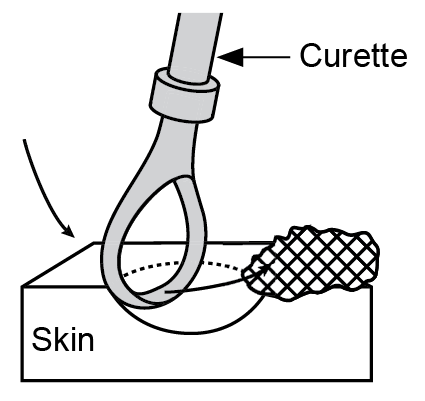
Curettage
An instrument called a curette is used to scrape away the lesion, this leaves a cut surface, like a graze.
Shave biopsy
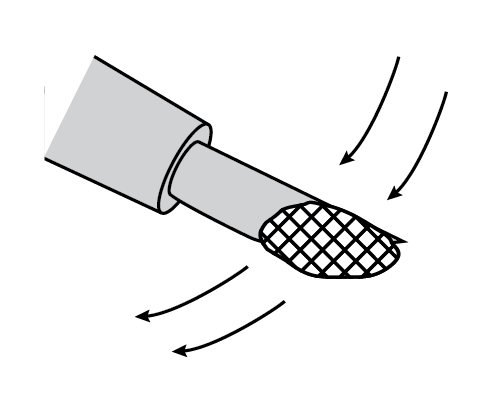
The skin around and under the lesion is injected with local anaesthetic, this will raise and firm the skin. A sharp scalpel blade is used to precisely remove or take a diagnostic sample from the lesion, leaving a shallow cut surface.
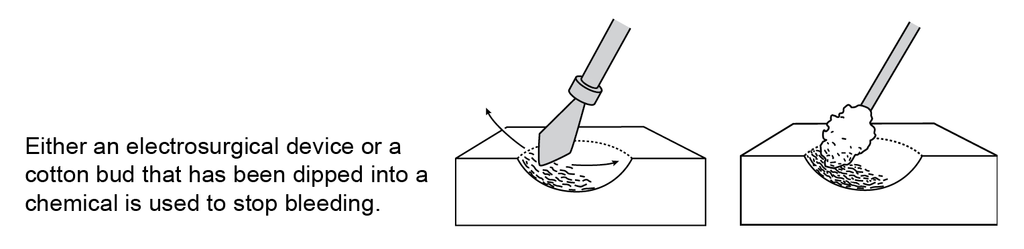
Following either ‘curettage’ or ‘shave’, an electrosurgical device or chemical is used to stop the bleeding. You may see a dark area of burnt skin. This will flake away naturally as the skin heals. Both of the above procedures may cause scarring, there is a risk of bleeding.
Punch biopsy
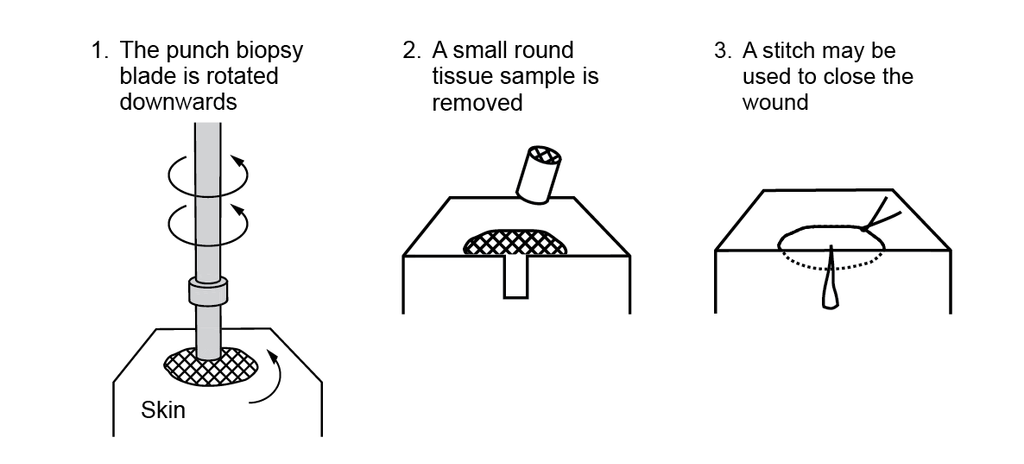
A punch biopsy blade is used to take a small round core of tissue ranging from 2mm – 7mm in diameter. 4 mm is the more usual size. This allows the pathologist to investigate a full thickness view of the skin. The wound may be closed with a stitch, there is a risk of bleeding and infection. A scar may be seen following the procedure.
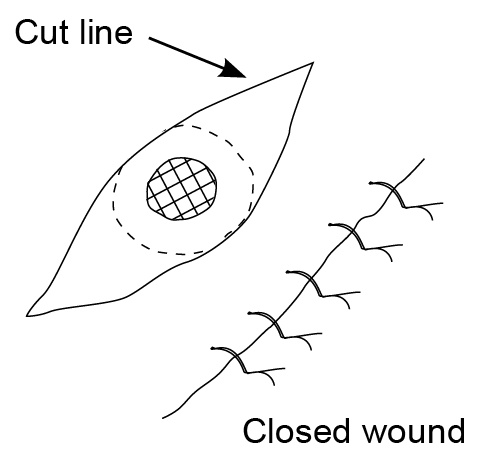
Elliptical excision
An ellipse shape is cut around the lesion and it is cut away in a way that enables a flush closure without puckering. Often, the resulting scar is a line. In younger patients, because of natural ‘tug’ of the elastic skin, the scar may be more noticeable – a stretched scar.
Some people can develop a thicker scar called a keloid scar. This is a slight risk but one that is impossible to predict. There is a small risk of bleeding or infection. There are different ways of closing the wound if external stitches are used, they will be often removed in 5 – 14 days.
Dermatology Department opening hours
Monday – Friday, 8:00 am – 5:00 pm (except Bank Holidays)
- An appointment system operates.
- Please allow between 30 – 60 minutes for the procedure.
- Allow two hours for parking.
Getting in touch
Dermatology Surgical and Laser Unit (Ward C4)
Telephone lines are open:
Monday to Thursday, 8am to 4pm
Friday, 8am to 1pm

Parking
There is a ‘Pay and Display’ car park at Chapel Allerton Hospital. Payment is by card or Pay by Phone App in the pay and display machines at Chapel Allerton Hospital.