
We think that your child is well enough to go home now.
If you become more worried than when you previously sought advice, or you are concerned that you are unable to look after your child at home, you should seek advice.
For example you may be worried because:
- your child’s health gets worse
- your child has a fit
- your child develops a rash that does not disappear with pressure (see the ‘Rashes and the tumbler test’ section)
- the fever lasts longer than five days
- you are concerned your child is dehydrated (see section below)
For further advice phone the following numbers:
CAT unit: 0113 392 8929
(if within 24 hours after discharge from CAT unit) or
Dial 111 (after the 24 hour period has elapsed)
or in an emergency dial for an ambulance (999).
What to do when your child has a fever
- offer your child regular drinks (if you are breastfeeding then breast milk is best).
- check for signs that your child may be dehydrated (reduced wet nappies, dry mouth, no tears, sunken eyes, sunken fontanelle – the soft spot on a baby’s head). If you notice any of these signs seek further advice (see section above).
- check your child for rashes and know how to look for and identify a non-blanching rash (a rash that does not disappear with pressure) as that could be a sign of serious illness (see ‘tumbler test’ section).
- check on your child during the night.
- do not use medicines to try to reduce your child’s fever, but do use medicines if your child is distressed or uncomfortable (see Fever and Medicines section).
- keep your child away from school or nursery while they have a fever and notify them of your child’s absence.
- return a urine sample if one has been requested, ideally within 24 hours.
Fever and Medicines
Fever is a natural and healthy response to infection, so do not try to reduce your child’s fever by over or under dressing them, or by sponging them with water.
Although it is not necessary to treat fever, there are two medicines that can be used to treat distress caused by fever and being unwell. These are ibuprofen and paracetamol and they may make your child feel better. They are both effective, so always start with one and only use the other if the first has not worked.
Read the instructions carefully as these medicines come in different strengths, and they may also be contained in other products that your pharmacist sells. If you have any doubt you should tell the pharmacist what you are currently using. Although both are very safe when used correctly, they may be harmful if too large a dose is given or if given too often.
Rashes and the tumbler test
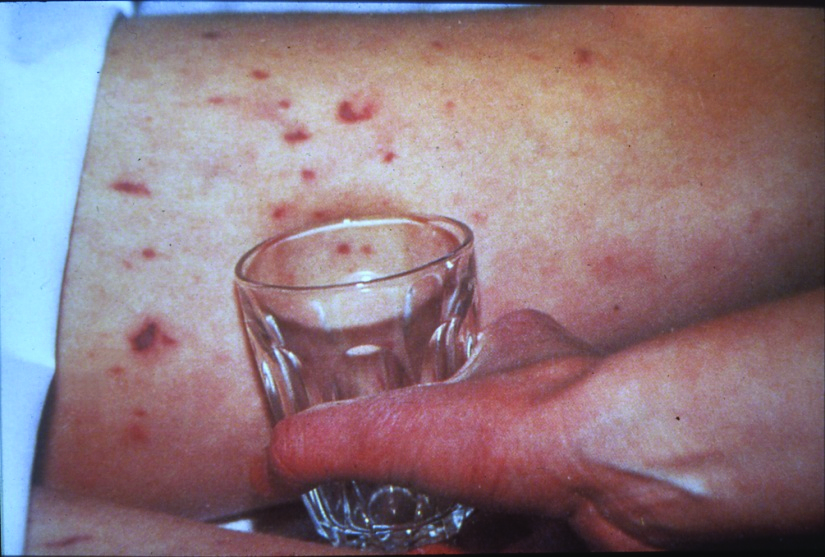
Do the ‘tumbler test’ if your child has a rash. Press a glass tumbler firmly against the rash. If you can see the spots through the glass and they do not fade this is called a ‘non-blanching rash’. If this rash is present seek medical advice immediately.
If the spots fade when the glass is rolled over them, the rash is probably not serious, but keep checking, it can develop into a rash that does not fade.
Rashes are harder to see on dark skin so look for rashes on paler areas, such as palms of the hands, soles of the feet and tummy.
If you are worried that your child’s health is getting worse, seek further medical advice: do not wait for a rash to appear.
(Photo above courtesy of the Meningitis Research Foundation)
Leaflet based on information given by the National Institute for Health and Care
This leaflet is under review and has been approved for a temporary print run from 20/03/2026 MIS:20260311_011/EP
Back to top