
You have been given this leaflet because you are going to have treatment that might affect your fertility (ability to have a baby) in the future. It explains the option of testicular tissue freezing that could increase the possibility of having a baby in the future when this might not be possible naturally.
Please ask your nurse specialist or doctor any questions. We are here to help.
What is fertility?
Fertility is the ability to have children. Sometimes the condition or the treatment of an illness can mean that the testicles are damaged and sperm production may never begin or may not be normal.
As boys grow up they develop and change. Part of this process (puberty) includes the ability to make sperm. Sperm are made in the testicle.
Your sperm are important as they contain half of the building blocks, or genetic material needed to develop into a baby. The sperm needs to join with a woman’s egg to complete the building blocks that are needed to create a baby.
Your doctors are concerned that your condition or treatment may mean that your testicles and fertility are at risk of damage. It may not be possible for you to have a baby naturally when the time might be right for you. We are here to talk to you about your options to try and protect your fertility.
What is fertility preservation?
It can be really hard to know which boys will have problems having a baby. This depends on the condition you have, your age and what treatments you need to have.
Leeds Centre for Reproductive Medicine can offer you treatment to try to protect your chances of having a baby in the future. This leaflet is about the freezing of testicular tissue.
Freezing testicular tissue
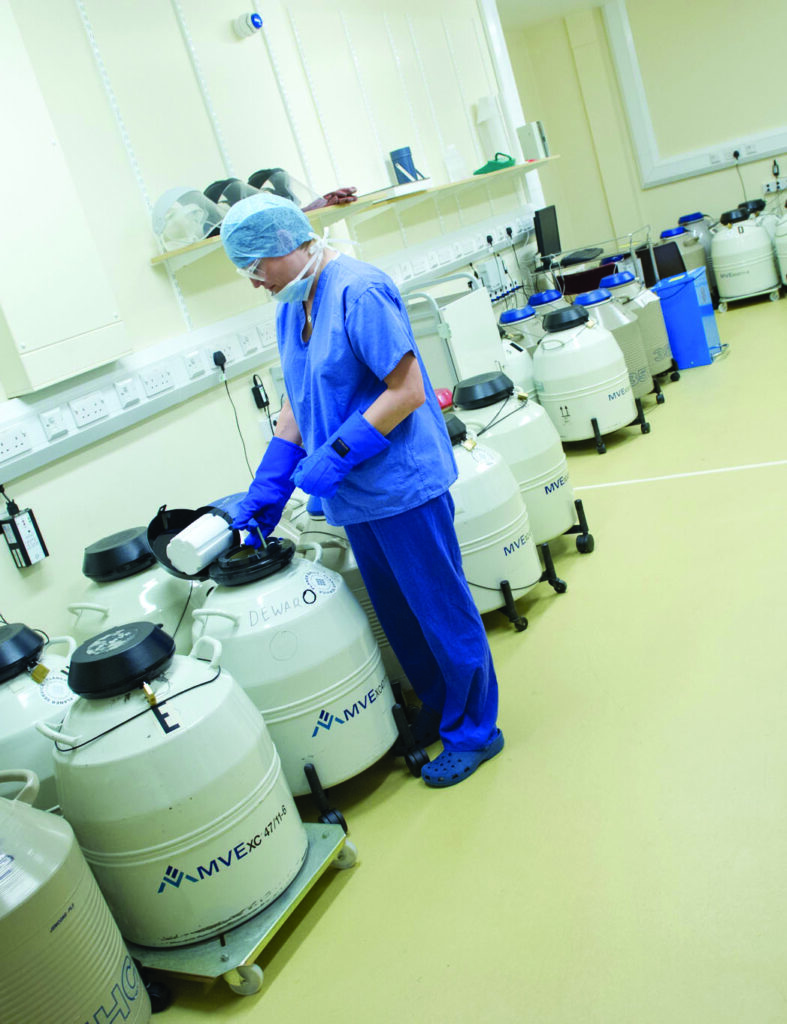
Sperm start to be made in the testicle during puberty. Because of your young age, we can’t store sperm but we can try to store some of the tissue that makes them. This will hopefully protect the tissue from damage by the other treatments you need to have.
Freezing part or all of one testicle
It is possible to remove part of one testicle before any treatment that could damage your fertility is started. In very young children the testilcles are very small and a whole one may need to be removed because it is not possible to remove less. The other one will stay behind. This is done with an operation under a general anaesthetic (asleep). The tissue containing the sperm-producing cells is then frozen and stored. After your other treatment has been completed, and you have recovered you may decide to try to have a baby. This could be many years later.
At the moment, (2020’s) the best way to use the tissue is still being investigated. The pieces of testicle may be put back into your body where they could begin to make your sperm.
This could mean that you can have a baby with your characteristics (genetics). In the future it may become possible to produce sperm with your characteristics from your tissue in the laboratory. These sperm could then be used to fertilise an egg in order to create a pregnancy for you and your partner.
What are the risks?
Unfortunately there are no guarantees that everything will go according to plan. Problems can occur along the way. These could include:
Problems with getting testicle tissue out
- Complications of surgery – testicle tissue collection is usually safe and straight-forward but occasionally infection, bleeding or damage to nearby structures can happen.
Problems with the storage and thawing of the testicular tissue
- The tissue may not recover from the freezing and thawing process.
Problems with using the samples
There are many steps between thawing the tissue and having a baby.
- It is not possible to be sure that the tissue will produce sperm at all.
- The transplanted tissue may not attach properly to be able to produce hormones and mature sperm.
- For patients who have recovered from cancer, extra tests will be done on the tissue to be as sure as we can that it is free of any cancer cells before you have it transplanted back inside you.
- You and your partner are likely to need treatment to have a baby.
- Separate information about fertility treatment (IVF) is available online at:
www.carefertility.com/treatments-services/fertility-treatments/ivf/
What are the chances that the treatment will work?
Testicular tissue freezing is still new and the techniques are being improved all the time. This opportunity offers hope but it is important to be realistic about the chances of success. At the moment it is impossible to say. This is new science and we expect to be able to understand, and be able to do more over the next 10 years and more.
What happens after the storage process is complete?
Maintaining contact
When your treatment is over, you will be sent an appointment to come and see us to talk about the sample you have in storage, how and when we might assess your natural fertility going forward and any issues that have arisen since your diagnosis and during your treatment. When you are ready to talk about possibly using your testicular tissue, we will explain the options, risks and chances of success as far as is possible.
We will keep in touch with you over the coming years to make sure that we are doing the correct thing by keeping your piece of testicle in storage. We will confirm that:
- You still want it to be kept.
- It still needs to be kept.
- There is funding available to keep it.
- We are still legally allowed to keep it.
The clinic storing your tissue is the guardian of your stored testicular tissue. The next section explains the responsibilities of the Clinic, your responsibilities and where both parties stand legally under a variety of circumstances.
Whilst these details may not seem important now, they are extremely important as time goes by, to make sure that the Clinic is able to give you accurate advice about the safe,
long-term and legal storage of your samples.
Please note
When you are approaching your 18th birthday, we will invite you for an appointment to change your consent forms to your own signature as you take on legal responsibility for your own stored tissue.
What happens if I don’t want to store any testicular tissue?
This is your decision to make with the support of your family and our Team if needed. Nothing will change in your main treatment if you decide not to store anything.
We can still see you after treatment if you want to know whether the treatment had affected your fertility.
Is there anyone else I can talk to?
We know there is a lot of information to take in and this is a difficult time. Some people find it helpful to talk to someone who is not a close family member, friend or doctor / nurse involved in their treatment about how they feel and the decisions they are being asked to take.
You can ask to see someone by yourself or bring anyone else with you, if you prefer. Please ask if you would like to know more.

General legal information about how the clinic storing your tissue is regulated and conducts its work
The Human Tissue Act and the Human tissue authority regulate the storage and use of testicular tissue.
The HFEA issues the Code of Practice that we work by and it inspects us regularly to ensure standards are maintained. All UK clinic results are reported to them and are publicly available (www.hfea.gov.uk).
Important
The storage of testicular tissue is regulated by the Human Tissue Authority under the Human Tissue Act (2004) and The Human Tissue (Quality and Safety for Human Application) Regulations 2007 (as amended).
This requires establishments storing tissue or cells intended for human use to do so under the authority of an HTA licence. (www.hta.gov.uk).
Summary
Fertility is your chance of having a baby. Some diseases and treatments can reduce your fertility. You are being asked to think about options to help protect your fertility and give you choices in the future.
There can be problems with these options so there are no guarantees that it will work. This is an area which is progressing fast and is likely to get even better in the future. We are here to support you to make the right choice for you.
Informed consent
This leaflet is provided to supplement verbal information that will be given to you by your healthcare provider (Doctor/ Surgeon/ Nurse) as part of the consent process prior to your procedure. Information sharing between you and the clinician is essential to ensure that your decision to consent is fully informed.
Please ask questions if you don’t fully understand or have any concerns about what is proposed. You have a right to be involved in these decisions and should feel supported to do so. Please take the time to consider what is important to you to ensure the information you receive is specific and individualised.
Useful resources
Contact us
Leeds Centre for Reproductive Medicine (LCRM)
Monday – Friday 08.00-17.00. For general queries.

