

Your child’s consultant has recommended an operation called Epiphysiodesis to completely stop the growth of your child’s leg or temporarily stop the growth using eight-plates or two screws.
This information explains the planned procedure and aims to answer some of the questions you may have. If you have any questions or would like more information, please speak to a member of your child’s healthcare team.
What is Epiphysiodesis?
Epiphysiodesis is the name given to surgery that is performed on the growth plate (growing part) of the bone to stop it growing permanently.
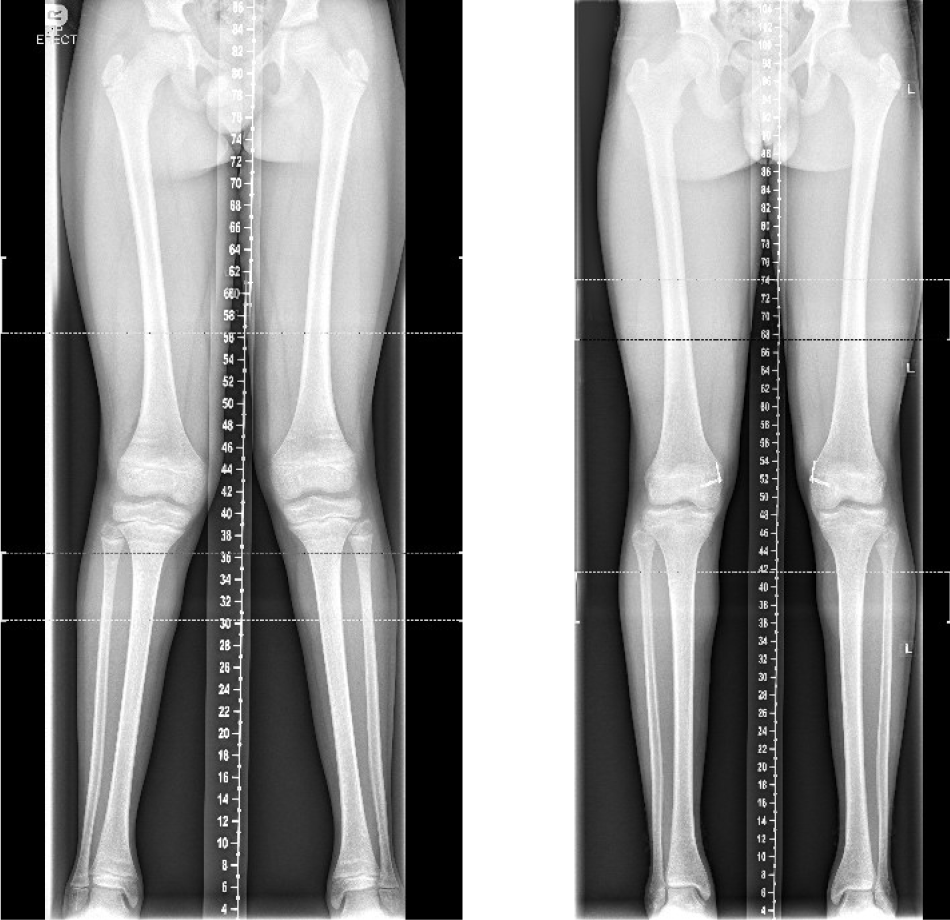
This is often done with the insertion of eight-plates (called eight-plates because they are shaped like a number “8”) or two screws into the growth plate, guiding growth of the limbs until they are straight.
This surgery is often performed when one leg is shorter than the other, to stop the growth of the longer leg, allowing the other leg to catch up over time and ‘even up’ the legs. Epiphysiodesis may also be used to correct an angular deformity of the leg; for example, knock knees. The timing of each procedure is crucial and is calculated to allow the shorter leg to catch up by the time your child’s growth stops.
The operation
You will be asked to bring your child into hospital on the day of their operation, or in some cases, the day before. Usually, children go home on the same day but occasionally need to stay in hospital, one night after the operation. The surgeon will discuss the operation with you and your child. Your child will need a general anaesthetic (medicine to make them go to sleep) for this operation. After the operation, there may be one or two scars at the top of the shin bone (just below the knee) and at the end of the thigh bone (just above the knee). There will be a bandage over the wounds. The stitches won’t need to be removed as they are dissolvable. You may need crutches initially after surgery but should be able to fully weight bear without any restrictions.
Back to topAftercare
The bandage will be removed the day after the operation to leave a small dressing.
The wounds will be checked by your child’s GP practice nurse. They will need to be kept dry for 5 to 7 days. You should encourage your child to move the knee normally after the operation.
When will my child be able to go back to school?
Your child will be able to go back to school when they feel comfortable, usually a few days after the operation.
Follow-up
Your child will be seen regularly in the clinic to check leg length difference or the bend in the legs with x-rays. If eight-plates or screws have been used and your child is still growing, they will need to have another operation to remove them under a general anaesthetic. If an x-ray shows that there is no more growth left, then the plates can remain in.
What will happen if my child does not have the operation?
If the operation is not done, the length of your child’s legs will remain different, or the angle deformity will remain or worsen over time.
Possible complications
Your child’s healthcare team will ensure their stay in hospital and the treatment they receive is as safe as possible; however, all medical procedures carry some risk and there is a possibility that complications might arise. You should ask the healthcare team if you would like any more information about complications or if there is anything you do not understand.
Complications from general anaesthetic
Your child’s anaesthetist will discuss this with you before the operation.
General complications of surgery
- Pain: pain-relieving medicine will be given as prescribed.
- Bleeding: this can happen during or after surgery.
- Scarring: there may be scarring as a result of the surgical cut.
- Infection: if the surgical wound becomes infected, antibiotics will be given but if infection occurs, this may sometimes require further surgery.
- Altered feeling: there may be altered feeling at the operation site, this may be temporary or permanent.
Specific complications of surgery
- If the operation is performed too late, the leg length difference may reduce but some difference in length may remain. If the operation is carried out too early, the length difference may be corrected but more surgery may then be required if the other leg continues to grow.
- Very occasionally, the eight-plates can move and may need replacing. Incomplete correction or deformity in the other direction may happen. This depends on the timing of surgery. Follow-up is essential to avoid these possibilities.
How may I feel before my operation?
You may be feeling worried about your operation and this is normal. You may feel upset or tearful or have a feeling of ‘butterflies’ in your tummy.
Here are some ideas, which may help these difficult feelings:
- remind yourself it is very normal to have feelings such as worry or sadness about your operation;
- you may find it helpful to talk to your mum, dad or other family about how you are feeling and any worries you have. You can also ask anyone from your medical team like the nurse or doctor. If you find it easier, you can write any worries or questions down and give them to the nurse or doctor, who will be able to help talk about them with you; and
- practice these calming techniques: Try taking some slow, deep breaths breathing in through your nose and out of your mouth. Close your eyes and imagine you are in the place where you feel most relaxed. It may be helpful to put on headphones and listen to your favourite music.
How may I feel after my operation?
It is normal to feel worried about standing on your treated leg after your operation. The doctors will only ask you to stand on your leg once it is okay to do so.
You will have support from the nursing team, physiotherapists and occupational therapists to help you do this in your own time. There is also special medicine, which may be given to help reduce your pain. Let someone who is looking after you know if you have pain.
You may feel upset by new scars and this is normal. Talk about any feelings you have about them to someone you are close to, talking about our feelings may help us to feel better. Try touching your scars with them when you have clean hands and once your doctor has said it is okay to do so.
You may feel frustrated or upset that you are missing doing the things that you enjoy such as going to school and seeing your friends. We encourage you to go back to school as soon as you can and your team can talk to you, your family and your school about what can be helpful in supporting you going back to school.
Clinical psychology
You may find it helpful to talk to someone else about how you are feeling. Clinical psychologists work with your medical team and are able to help people talk about their feelings. They can be very understanding and help you feel with difficult thoughts and feelings. We can see you and your family before your operation or after your operation, depending on what would be most helpful. Please ask a member of your medical team about this service.
Back to top
