
Your doctor has recommended that you have a Colonoscopy. This information will explain the procedure and what to expect on the day of your test. If you have further questions, please telephone the department or discuss them with a member of staff on the day of your procedure.
What is a Colonoscopy?
A colonoscopy is a test that examines your large bowel (colon). A long flexible tube with a camera on the end is used for this procedure and is passed through the back passage, and around the whole of your large bowel. Pictures from this camera are seen on a television screen by the endoscopist. The test takes 30 – 40 minutes minutes or more, depending on how difficult it is to pass the camera around the bends in your bowel. You can expect to be in the Endoscopy Unit for 2 – 4 hours.
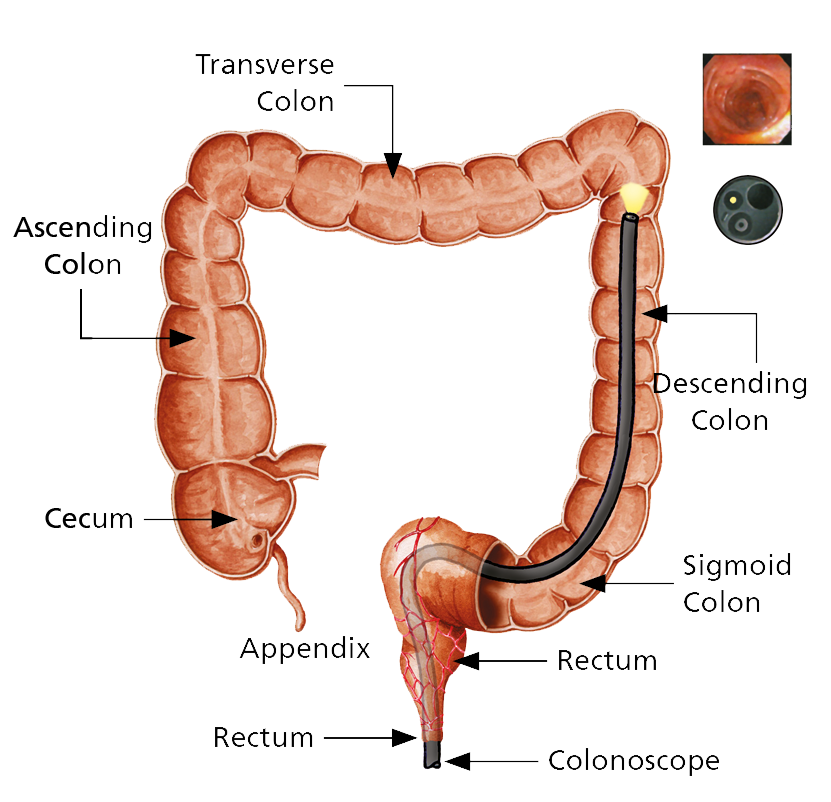
Why am I having a colonoscopy?
Your doctor has referred you for a colonoscopy to investigate symptoms you have been having; for example, a change in bowel habit, rectal bleeding or anaemia.
Your doctor may want a review of a chronic condition such as
colitis or check for recurrence of polyps. During your colonoscopy, the endoscopist (doctor or nurse practitioner) may take a small piece of tissue (biopsy) to aid diagnosis. It may also be necessary to remove polyps from the bowel wall. Both removing polyps and
taking biopsies is painless, and is achieved by passing special equipment down the inside of the camera – you will not feel this. All tissue samples have to be sent away to the laboratory so the results will not be available straightaway. You will be able to discuss the results of your biopsies with the doctor who referred you.
What are the benefits to having a colonoscopy?
A colonoscopy provides detailed information of the appearances of the lining of the bowel. The information gained during your test may reveal a cause for your symptoms and will assist your doctor in your further treatment. If you prefer not to have a colonoscopy, we would advise you to discuss the implications with your doctor.
What are the alternatives to having a colonoscopy?
The other method of examining the colon is a CT scan. Although this test offers valuable information, it provides less information about the lining of your bowel and does not allow biopsies to be taken or procedures such as the removal of polyps.
Back to topWhat are the risks of having a colonoscopy?
The risks associated with your test are detailed on your consent form and below. Please read this. If you have any questions, speak to the nurse or endoscopist on the day, or alternatively, ring the endoscopy pre-assessment nurses.
Complications are rare but it is important that you are aware of them before the test begins. As with any medical procedure, the risk must be compared to the benefit of having the procedure carried out.
Having a colonoscopy carries a small risk of making a hole in the bowel wall (a perforation). This occurs in 1: 1500 examinations. Perforations usually need to be repaired with an operation and might require a temporary stoma (a constructed opening that permits the passage of waste).
If the endoscopist removes a polyp, then the risk of perforation does increase. The risk can be as low as 1: 500 or as high as 1: 20, depending on the size of the polyp, where it is located and how difficult it is to remove.
The average risk of bleeding after a polyp has been removed is 1: 100 but the risk increases with the size of the polyp.
Bleeding from the back passage can occur after the test, especially if biopsies are taken. Bleeding is more common after a polyp has been removed. Bleeding usually stops without any treatment; however, occasionally, treatment may be needed to stop this. If you notice a large amount of bleeding or persistent bleeding after your test, please seek medical attention.
Using sedation can affect your breathing. To reduce this risk, we monitor your pulse and oxygen level. The endoscopist may give you minimal sedation if he / she feels that you at high risk of breathing difficulties during the test. This often applies to patients with heart disease and breathing problems such as Asthma and Chronic Obstructive Pulmonary Disease (COPD).
Despite sedation, some patients experience abdominal discomfort or pain due to the air put in the bowel. This should decrease when the test has ended and will be helped by passing wind.
What preparation will I need for my colonoscopy?
For the endoscopist to see the bowel wall clearly, it is essential that the bowel is completely empty. The doctor requesting the test will have considered if it is safe for you to have bowel preparation. The bowel preparation that has been sent to you works as a powerful laxative and makes your bowel clean. Your bowel preparation medicine and instruction sheet will have been sent to you. Please follow the instruction sheet carefully. It is very important that this preparation works, failure to follow these instructions may result in an unsuccessful procedure. Please contact the endoscopy pre-assessment nurses if you are experiencing any problems taking your bowel preparation (telephone number on back page).
Do I keep taking my tablets?
- If you are taking iron tablets (ferrous sulphate), please stop them 5 days before your test.
- If you are taking Codeine, Loperamide (Immodium) or
Co-phenotrope (Lomotil), please stop 3 days before the start of your procedure. - Please telephone the Endoscopy Unit if you are diabetic and have not received an information sheet, have sleep apnoea or are taking tablets that prevent blood clots. Examples of blood thinning tablets are Warfarin, Apixaban, Rivaroxaban, Dabigatran, Edoxaban, Aspirin, Clopidogrel (Plavix), Dipyridamole (Persantin), Prasugrel (Efient), Ticegralor (Brilligue) or Acenocoumarol (Sinthrome).
- Women taking the oral contraceptive pill should be aware that taking bowel preparation might prevent the absorption of the pill. Additional contraceptive precautions should be taken until the next menstrual period begins.
Please continue to take all your other medication as normal.
Back to topWhat should I bring on the day?
You may wish to bring your dressing gown and slippers. You will be asked to change into a hospital gown that is open at the back before your test.
Please bring a list of medication that you take and also any medication that you may require, whilst in the department such as GTN spray, inhalers and insulin. Please do not bring any valuables to the department or wear lots of jewellery. Please can you also ensure that you remove nail varnish as this interferes with the signal we receive from our monitors about your oxygen levels.
What pain relief is available?
It is important that you are comfortable during the procedure to ensure that the endoscopist can perform the procedure successfully.
For colonoscopy you have two choices of pain control.
On the day of your procedure or during your pre-assessment appointment, the nurse will discuss these options with you. Please note that all patients requesting sedation will be assessed if they are medically fit for the administration of sedation.
What will happen on the day of the test?
When you arrive at reception in the Endoscopy Unit, your personal details will be checked. The assessment nurse will collect you and take your medical history, discuss your choice of pain relief, explain the test and take your blood pressure and pulse.
You will be able to ask any questions and discuss any worries that you have about the test. You will be asked for your consent form (supplied with this leaflet).
This will be attached to your notes and taken to the procedure room. Please make sure that you have read this through before you come for the test as when you sign this form, you are agreeing that this is the test you want. Remember, you can change your mind about having this procedure at any time. The endoscopist will discuss the consent form with you.
Please note: every effort will be made to see you at your appointment time; however, due to hospital inpatient emergencies, delays may occur. The endoscopy staff will keep you informed of any delays.
What happens in the procedure room?
You will be greeted by two nurses who will remain with you during the test. The nurses and endoscopist will complete a checklist to ensure all your information is correct.
A cannula will be placed in your vein so that sedation can be administered and you will be given oxygen through a small plastic tube in your nose. If you are having Entonox, you will be shown how to use the mouthpiece that delivers the gas. You will then be asked to lie on a trolley on your left-hand side with your knees slightly bent towards your chest.
Your pulse and oxygen levels are monitored by a probe placed on your finger during the test, the sedation will then be given. The endoscopist will initially examine your back passage with a finger to make sure it is safe to pass the camera and then introduce the endoscope into your back passage, and guide it around your bowel.
During the procedure, the endoscopist introduces air into the bowel. You may experience bloating from the air and cramp like pain as the camera goes around bends in the bowel. Air can be relieved by passing wind (this is normal and you must not be embarrassed as the endoscopist will expect you to do this). If you are finding the procedure more uncomfortable than you would like, please let the nurse know and you may be given more sedation or a painkiller. If you are using Entonox and you feel that this is not giving you adequate pain relief, sedation can be administered as long as you have someone with you to take you home and to look after you, when you get home.
You may also be asked to change position during the test
e.g. roll onto your back to make the procedure easier and more comfortable. If the test continues to be uncomfortable, a decision may be made to end the test. A colonoscopy usually takes 30 minutes but can differ, depending on how difficult it is to pass the camera around the bends of your bowel.
Please note: all hospitals in the trust are teaching hospitals and it may be that a trainee endoscopist performs your procedure under the direct supervision of a consultant, registrar or nurse practitioner.
What happens if a polyp is found?
One of the aims of colonoscopy is to detect polyps. Polyps are growths that can occur on the bowel wall that can range in size. Some are perfectly innocent but others can slowly develop into bowel cancer if they are not removed. Removing polyps is a simple and painless procedure, this is termed a polypectomy. Some polyps are removed straight away; however, sometimes, people with larger polyps have to come back for another procedure with an endoscopist who specialises in the removal of large polyps.
What happens after the test?
You will be transferred to the recovery room after your test. The length of your stay is dependant on the pain relief method you have chosen. The nurse in the recovery room will monitor you during this period.
Remember: if you have sedation, you will need an escort with you, transport home and someone to look after you for 24 hours after the test.
The recovery nurse will prepare you for discharge to go home and give you after-care instructions. You may experience some stomach cramps and feel bloated due to the air left in your bowel. This is normal and should clear within 24 – 48 hours.
When will I get my results?
A full report will be sent to your referring doctor and your GP. The endoscopist or nursing staff will usually have the opportunity to speak to you after your test regarding the results. Some patients will receive their test results via letter, or if appropriate, some may receive a clinic appointment through the post. Any enquires regarding your outpatient appointment should be directed to your consultant’s secretary. If you feel that you are waiting a long time for an appointment to discuss your results, please contact your GP who will also have a copy of your results.
This information has been complied as a general guide to your test. If after reading this you have any questions that you feel have not been answered, please contact the Endoscopy department on the numbers below. When contacting the unit, it is useful if possible to have your NHS number.
Contacts
Administration Team:
Administration Team:
For any enquiry about your appointment including re-arranging the date or cancelling the appointment altogether. Also, contact this number if you require an interpreter or transport.


Endoscopy Pre-assessment Nurse:
Please contact this number if you would like advice on your medication, your bowel preparation or any other medical question or worry.