
What do we mean by heavy periods?
Normal menstrual bleeding happens once a month but may be every 3-5 weeks. Bleeding usually lasts 3-5 days. It can be difficult to know if your periods are ‘normal’ or ‘heavy’, compared to what others are experiencing.
Bleeding can change from month to month and also change at different times of life. Heavy periods tend to be more common after the age of 40 years. However, some teenagers may also experience heavy and painful periods.
How do I know if I have heavy periods?
Menstrual bleeding which affects your daily activities over many months can be considered heavy.
You may:
- Bleed for more than seven days;
- Pass blood clots which vary in size from a 10p piece to larger than your palm;
- Have ‘flooding’ and need to change tampons or sanitary pads every hour or need to use tampons and pads together;
- Have ‘accidents’ such as bleeding which soaks through your clothes or bed sheets;
- Severe tiredness and feeling drained throughout the period;
- Have been told you have anaemia (low blood count);
- Have bleeding that affects your ability to work or carry out tasks in normal daily life.
You can use this self-assessment to check if you have heavy periods.
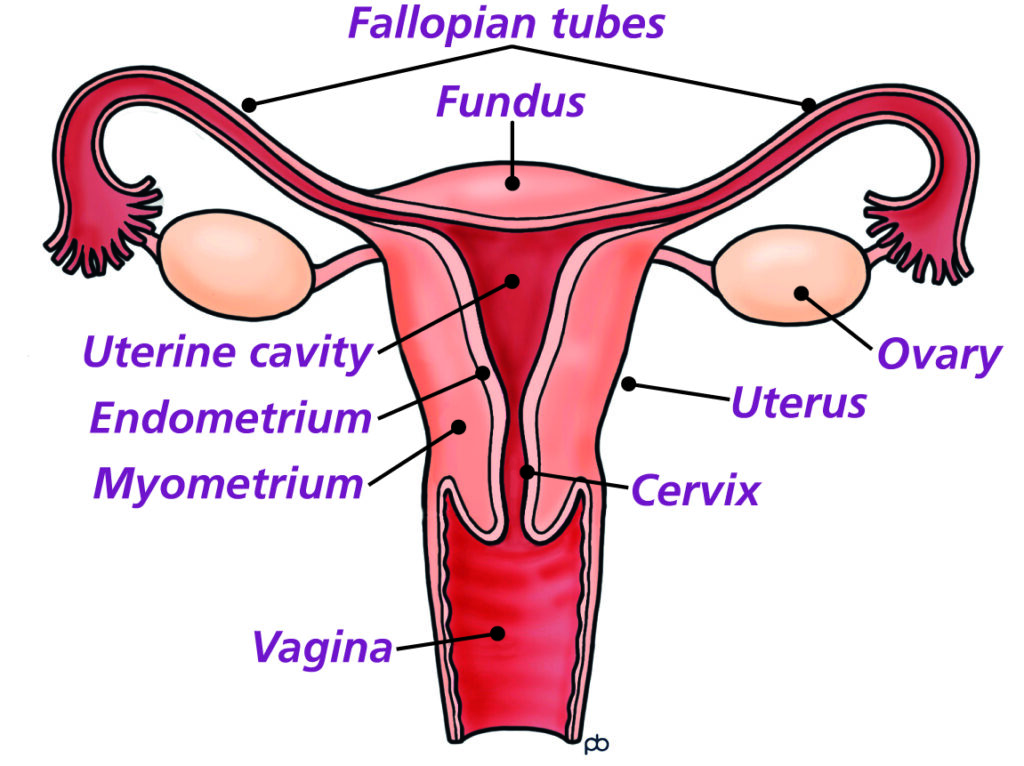
When you have a period it is the lining of the womb or endometrium which is shed.
What causes heavy periods?
There may not be an obvious cause for your heavy periods. However, the following may cause heavy bleeding.
Fibroids
Fibroids are benign (non-cancerous) growths in the muscle of the womb (uterus). Fibroids are often only diagnosed on an ultrasound scan of the pelvis.
Unless they are very large, they do not always require treatment. Those that cause problems such as heavy menstrual bleeding are usually treated with hormonal medication or surgery.
Polyps
Polyps are small fleshy growths in the lining of the womb
(endometrial polyps). They often do not cause any problems, but can be responsible for heavy menstrual bleeding.
Copper coil (IUCD)
The copper coil used for contraception is known to cause heavier periods.
Chronic pelvic infections
Heavy menstrual bleeding can be a result of different pelvic infections, even if these have been treated in the past.
Endometriosis
The lining of the womb is called the endometrium. Sometimes, this lining grows outside the womb or into the muscle wall of the womb and causes a condition called endometriosis (or adenomyosis when it is in the womb muscle). This can cause painful and heavy periods, as well as painful sex and pelvic pain.
Hormonal problems
Your periods can be heavy and irregular in cycles where you have not ovulated (produced an egg). For example this is a common cause of heavy bleeding for patients with polycystic ovarian syndrome (PCOS). Heavy periods can also be caused by other conditions such as an underactive thyroid (hypothyroidism).
Blood clotting disorders
If you have a medical condition affecting your blood’s ability to clot normally, this may affect your periods too.
Medications
Medicines that thin the blood, or that prevent the blood from clotting may cause heavy periods. These medicines are used after a deep vein thrombosis (DVT) or for some people with heart problems or artificial heart valves.
Dysfunctional Uterine Bleeding (DUB)
In about half of all people who suffer with heavy periods, the womb and the ovaries are normal. DUB is more common in the first few years after starting periods and also in the later years, close to the menopause (when your periods completely stop). At these times, you may find your bleeding is heavy and has no regular pattern. If you are a teenager and have heavy periods, they should settle and improve as you get older.
Do I need to have any tests?
Investigations will start with a discussion with a healthcare professional in the clinic. More detailed information regarding your periods such as bleeding after sex or in-between your periods, medications, past medical problems and family history may be needed.
Physical examination
You may be offered a vaginal examination and the healthcare professional will explain what they are checking for. The examination often includes feeling your abdomen and doing an internal vaginal examination. An instrument called a vaginal speculum may be used to look at the neck of the womb (cervix).
Swabs may be taken from the vagina to check for infection. If you need a cervical smear test, this can be done at the same time. You will always have a chaperone (usually a nurse) during the examination.
If you prefer not to be examined, or have concerns about the examination, please tell the healthcare professional and/or the chaperone. All examinations that take place must be have your consent. If at any point you want the examination to pause or stop, tell the staff member performing the examination. You are not doing anything wrong, or inconveniencing staff – it is essential that you feel safe and comfortable.
Other tests will be arranged depending on what the assessment shows.
These may be:
- Blood tests to check for –
– anaemia (low iron level);
– normal thyroid gland function;
– normal blood clotting; - An ultrasound scan of the pelvis –
– this scan is done internally (vaginally) to check for polyps, fibroids and womb lining
thickness - A hysteroscopy examination –
– a ‘camera’ examination of the lining of the womb, with a biopsy (tissue sample) from
the womb lining; this is usually done in the outpatient clinic whilst you are awake.
It is not necessary to measure blood loss before starting any treatment. Apart from blood tests, the other tests will be done on a separate appointment.
What happens after the tests are completed?
After the tests are completed, you will be given your results and treatment options discussed with you. You do not need to have any treatment if you do not want it, and are reassured by the findings. However, it is important that you eat a healthy, unprocessed diet to reduce the chance of you becoming anaemic due to the heavy bleeding.
What treatments are available?
The treatment depends on the results of the tests.
Sometimes, the tests do not show an obvious cause for the heavy periods. In this case, treatment is aimed at reducing the blood loss.
Treatment can be with tablets, injections or surgery. Surgery is offered if or when other treatments have not worked well enough to reduce the heavy periods.
You do not need to have any treatment if you feel reassured by normal test results and if you are able to cope with the bleeding.
Non-surgical treatments
These include:
- Intrauterine system (LNG-IUS). The intrauterine system (LNG-IUS) is a type of ‘coil’ that is fitted inside the womb, like the intrauterine contraceptive device (IUCD). However, it contains the hormone levonorgestrel, which is a form of progesterone. The LNG-IUS works mainly by making the lining of the womb very thin. The device needs to be inserted into the womb through the vagina, by a healthcare professional. It then releases a small amount of the hormone each day into the womb lining. The LNG-IUS is changed every five years. In most users, bleeding becomes very light. In some, the bleeding can stop altogether within six months of insertion. Period pain usually improves as there is less lining to shed. Examples of this system include Mirena, Jydess and Kyleena.
- Tranexamic acid tablets. These tablets can reduce the heaviness of bleeding by almost half for most users. Tranexamic acid works by strengthening the blood clots in the womb lining, which then leads to less bleeding. You may still bleed for the same length of time and you may still feel period pain, but the period may also be shorter and easier to cope with. In general less bleeding results in less discomfort. You need to take a tablet up to three times a day, for 3-4 days during each period. Tranexamic acid is not recommended if you have had blood clotting problems in the past, such as a DVT or a pulmonary embolism (PE).
- Non-steroidal anti-inflammatory drugs (NSAIDs). These medicines reduce the blood loss by about a quarter in most users. They also ease period pain. NSAIDs such as ibuprofen and mefenamic acid work by reducing muscle spasm. You may take the tablets for as many days as you need during each period, but they should be taken with food. Do not take more than the recommended dose.
- The combined oral contraceptive (COC) pill. The COC pill can reduce bleeding by a third. It can also help with period pain. It is a useful treatment if you need contraception.
The combined contraceptive pill will not be offered if you:
- are over the age of 40 years
- smoke
- are overweight
- have high blood pressure
- suffer from migraines
- have had a blood clot in the leg or lungs.
- Long-acting progestogen contraceptive injections. The contraceptive injection, Depo Provera and the contraceptive implant both will usually reduce heavy periods. For example, up to half of those using the contraceptive injection have no periods after a year. These are useful treatments if you also need contraception.
- Progestogen tablets. A progestogen only pill (POP) can also be used to manage heavy periods, as for many women the POP will make periods very light or stop altogether. The POP also acts as contraception. Other progestogen tablets such as Norethisterone or Medroxyprogesterone Acetate are sometimes used on a short-term basis to stop heavy bleeding quickly, but they are not commonly used as long-term treatment and they do not provide contraception. Some women will experience side effects while taking progestogen tablets, which can including bloating and breast tenderness.
- GnRH Analogues and GnRH Antagonists. These are a group of medicines that can be used to put the body into a temporary ‘menopause’. These can be given by injection or tablets and can be useful for stopping heavy periods caused by fibroids when other options have failed, but they can also have side effects including typical menopausal symptoms such as hot flushes. Some of the newer tablet products contain a small amount of hormone replacement therapy to help prevent or manage any menopause symptoms. Some of these medications are only recommended in the short-term (up to six months), and others can be taken long-term.
There is a leaflet called ‘LN005643 – GnRH therapy for gynaecological conditions’.
Surgical treatments
Surgery may be discussed with you if medical treatments have been unable to reduce your bleeding, or if the cause of the bleeding is better suited to a surgical option.
The type of procedure or surgery will depend on the results of your investigations and your preferences and priorities, taking into account the risks, benefits and alternative treatment options.
Surgical treatments include:
- Endometrial ablation. This is a procedure which burns (ablates) the lining of the womb to reduce heavy bleeding. Sometimes, small fibroids may also be removed at the same time. The procedure does not aim to stop period bleeding completely, but feedback suggests bleeding is more manageable afterwards for most (about 80% of people). This procedure is often done under local anaesthetic in the Ambulatory Gynaecology Clinic. After endometrial ablation, scar tissue can form inside the uterus which can make investigations for abnormal bleeding more difficult (should this be needed in the future).
- Myomectomy. This operation is where a fibroid (or fibroids) is removed. The womb is not removed, although it will have a scar afterwards. The operation is usually done through a cut in the tummy. In some cases keyhole surgery may be possible or more suitable. A myomectomy may be recommended if you still wish to become pregnant in the future. However, there is a small but important risk of needing an emergency hysterectomy during a myomectomy. After a myomectomy, a caesarean section is sometimes recommended in future pregnancies.
- Hysterectomy. This operation is where your womb is removed, often together with the cervix and both the fallopian tubes. Your ovaries do not need to be removed at the same time. There are different approaches to the removal of the womb, depending on its size and any past operations you have had, such as caesarean sections. This may be keyhole (laparoscopic, vaginal, or occasionally via an open operation (bigger cut in your abdomen).
- Uterine Artery Embolisation (UAE), also known as fibroid embolisation. Uterine Artery Embolisation (UAE), also known as fibroid embolisation. UAE is another option for the treatment of heavy periods due to large fibroids. The blood supply to the uterus is blocked by the injection of tiny particles or beads into the blood vessels that supply the uterus. This procedure is done using local anaesthetic via the groin. After the procedure, fibroids slowly reduce in size and periods become lighter. UAE is performed by Interventional Radiologists (specialists in medical imaging), rather than Gynaecologists, so in order to be considered for this treatment you need to be referred to and assessed by them.
- Radiofrequency Treatment of Uterine Fibroids (SONATA). SONATA or SONography-guided Transcervical fibroid Ablation is a keyhole treatment that leaves no cuts or scars for women with fibroid(s) causing symptoms who wish to preserve their womb (uterus). It is normally performed during a clinic appointment allowing women to return to normal activities quickly. A device that can fit inside the womb is used to locate individual fibroids. Radiofrequency energy is then delivered directly to the fibroid(s) from the device. The treated fibroids shrink over time, to relieve symptoms. Half of all women return to normal activities within a day or two. 90% have less bleeding within three months and 95% have less bleeding within 12 months.
Is there anything I can do to help myself?
Eating foods which are rich in iron and vitamin C, can help to treat and prevent anaemia. Iron is found in red meat, fish, eggs, pulses and beans, leafy green vegetables such as spinach and curly kale and fortified breakfast cereals. Iron supplements can be bought in chemists and vitamin C is found naturally in citrus fruits and berries, tomatoes and green vegetables.
You may ask for a blood test at your health centre to check for anaemia if you continue to experience tiredness and feel drained later on after trying to help yourself with simple solutions.
Informed consent
This leaflet is provided to supplement verbal information that will be given to you by your healthcare provider (Doctor/ Surgeon/Nurse) as part of the consent process prior to your procedure. Information sharing between you and the clinician is essential to ensure that your decision to consent is fully informed. Please ask questions if you don’t fully understand or have any concerns about what is proposed. You have a right to be involved in these decisions and should feel supported to do so. Please take the time to consider what is important to you to ensure the information you receive is specific and individualised.
Further information
If you wish to consider treatment, then the NICE guideline: www.nice.org.uk/guidance/ng88 provides useful information for management of heavy menstrual bleeding.
Written information can be provided for you about the following:
- The LNG-IUS
- Endometrial ablation
- Myomectomy
- Hysterectomy
- Uterine artery
Is there anything I can do to help myself?
Having heavy periods can seriously disrupt your daily life and for some will cause a decline in mental health and quality of life. If you feel your mental health is suffering as a result of your heavy periods please discuss this with your GP or gynaecologist during your appointments so that we can offer you the right support.
Useful resources
The Leeds Teaching Hospitals has health information online on fibroids, hysterectomy, uterine artery embolisation, hysteroscopy and the ambulatory Gynaecology service.
- Visit Leeds Teaching Hospitals NHS Trust patient information website for related information.
- NHS Heavy periods
- Heavy menstrual bleeding: assessment and management
NICE is the National Institute for Health and Care Excellence. This organisation provides national guidance and advice to improve health and social care. - British Fibroid Trust
This is a charitable organisation providing information on fibroids and a platform to exchange views and experiences. - Uterine artery embolisation for fibroids
- The Royal College of Obstetricians and Gynaecologists
The Royal College provides information on a variety of female health conditions and investigations. - Women’s Health Concern
Women’s Health Concern (WHC) is the patient arm of the British Menopause society
(www.thebms.org.uk). WHC provides advice and education on gynaecological issues and sexual health.

