
This information provides about what to expect when you have an inguinal lymph node dissection.
What are lymph nodes?
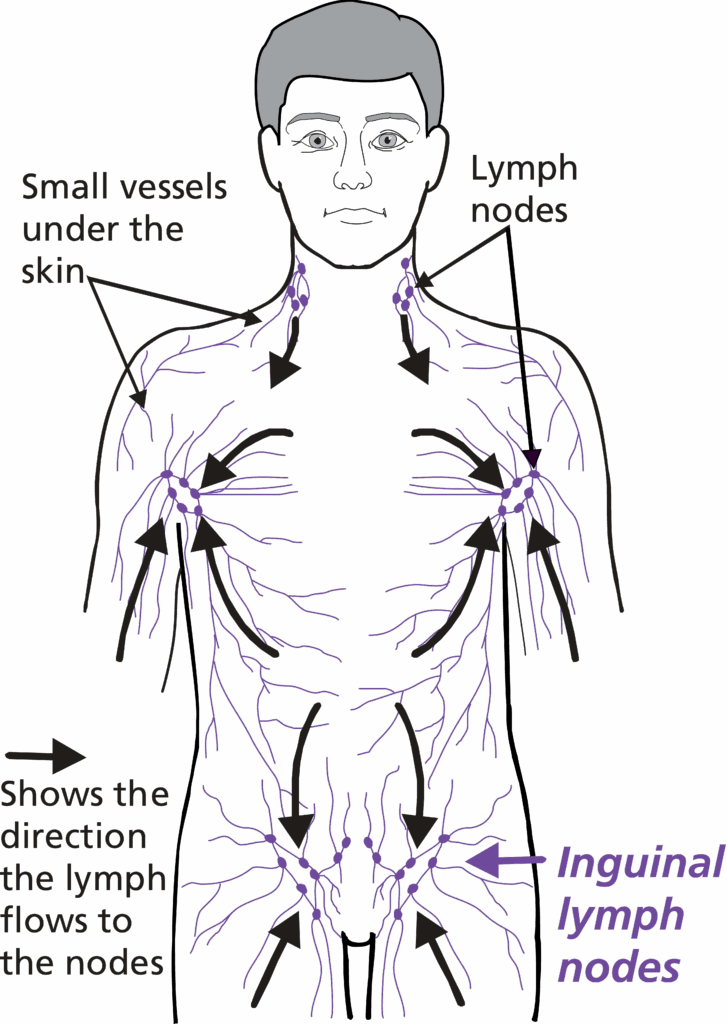
The lymphatic system is responsible for transporting tissue fluid from organs and other tissues. The lymphatic fluid travels along lymphatic channels and passes through structures called lymph nodes. The lymph nodes act as a filter and help to prevent infection by preventing the spread of bacteria.
The main groups of lymph nodes in the body lie in the neck, in the armpit and in the groins. The lymph nodes in the groins receive lymphatic fluid from the lower half of the body including the penis.
Some cancers spread through the lymphatic vessel. This is particularly true of cancer of the penis and in some men with penile cancer the tumour spreads from the penis into the lymph nodes of both groins.
Why do a lymph node dissection?
In those men in whom the cancer has spread from the penis to the groin lymph nodes, surgical removal of those lymph nodes is a potential way of curing the cancer.
In patients with cancer of the penis in whom it is thought that the cancer has spread, a sentinel lymph node biopsy will be performed. This is done to check whether the cancer has spread to the lymph nodes and if the sentinel lymph node biopsy confirms spread, then conventional treatment is that all the glands in that groin are removed. This operation is called an inguinal lymph node dissection.
Depending upon the results of the sentinel lymph node biopsy, it may be necessary to remove all the glands from either one or both groins.
Admission to hospital for your operation
Following your clinic appointment you will be placed on a waiting list for the proposed surgery. You will be sent an e-form to complete at home to screen your medical history/ medication.
Following this, you may be invited back to a face to face pre-assessment to run some additional tests such as ECG, bloods.
On the day of your operation you will be admitted to the admission lounge early in the morning, when you will have a further opportunity to talk to the surgeon and the anaesthetist about your procedure. The ward staff will familiarise you with the routine of the ward and show you where the facilities are.
Back to topThe operation of inguinal lymph node dissection
The anaesthetist will usually administer a general anaesthetic for this operation which typically takes 2-3 hours to perform. The surgeon will remove the glands in each groin through a cut in each groin. Each incision is around 6-12 cm in length and lies in the groin crease. All the glands in the groin are removed including those that are surrounding the main artery and vein to your leg.
The wound is closed with stitches or staples and a drain is then inserted into the space where the lymph nodes were, since there will continue to be some drainage of lymphatic fluid and blood for several days.
After your operation
When your surgery is finished you will be taken to the recovery area where you will be monitored until your condition is stable before going back to the ward. When you get to the ward you will be able to eat and drink that day. Painkillers will be offered to you on a regular basis and it is important that you ask for them if you feel that you are suffering any pain. You will likely have a catheter in place to drain urine. This will usually be removed when you become mobile enough to walk around.
Preparation for discharge
The ward staff will check your wound (s) regularly whilst you are on the ward and the doctors will do regular ward rounds to assess your progress. Most patients remain in hospital for 5-7 days.
You will be given painkillers as needed and will also be given painkillers to take home.
The catheter will be removed when you are mobile enough to walk. The staples will usually be removed 10 days after the operation.
The drains will remain in place until they stop draining.
- The usual volume of drainage from each groin can be significant, up to 250 mls of lymphatic fluid per day.
- It is usual for the drains to remain in place until the drainage is reliably less than 50 mls per day.
- The drains may need to remain in place for several weeks, although it will not be necessary for you to remain in hospital until they are removed. You will be taught to manage the drains at home, including how to empty them and to chart the amount that is being drained.
When you are discharged from the ward, we will arrange to see you at weekly intervals in the outpatient clinic to review the drainage within the drains and if necessary to remove the drains when the drainage has slowed down.
What can go wrong?
There are a number of both short and long-term complications associated with an inguinal lymph node dissection, which your nurse specialist will discuss with you. If you are in any doubt please contact your CNS team directly to discuss.
Back to topContact us:
St James’s University Hospital
The Leeds Teaching Hospitals NHS Trust switchboard.

Secretary
Mr Eardley / Mr Gordon / Mr Elmamoun

Urology Clinical Nurse Specialist
Victoria Washington
Telephone:
CNS secretary
Telephone:

Leeds Cancer Support
Leeds Cancer Support complements care provided by your clinical team. We offer access to information and a wide range of support, in a welcoming environment for you, your family and friends.
We can be found in the information lounges in Bexley Wing and also in the purpose built Robert Ogden Macmillan Centre.
The Sir Robert Ogden Macmillan Centre
The Centre is on the St James’s Hospital site and offers a variety of support services including counselling, support groups and complementary therapies. These therapies include Reiki, relaxation and visualisation, hand and foot massage and many others. You can just drop in for a coffee and a chat anytime. Open from 10:00am – 4:00pm Monday to Friday.
Back to topHealth Talk support service
Health talk is an online service where you can find information and support by seeing and hearing patients real life experiences.
In co-ordination with researchers from the Centre for Men’s Health at Leeds Metropolitan University spoke to 27 men in their own homes. You can explore what these people felt about issues such as symptoms, treatment, body image and sex. We hope you find the information helpful and reassuring.
www.healthtalk.org Back to topContact numbers for Leeds Cancer Support
Information Centre, Level 1 Outpatients Department
Information Lounge, Level 2 Radiotherapy Department
Sir Robert Ogden Macmillan Centre
All the above services can be emailed via the link below.
Leeds Cancer SupportWhere can I find more Information?
Macmillan Cancer Support
Freephone:
References
- Orchid male cancer support 2017. Partial Penectomy
- Orchid male cancer support 2017. Total Penectomy
- The Christie Patient Information Service May 2015. CHR/SUR/600/17.06.08 version 4