
This leaflet is to provide patients with information about intrathecal pumps.
Important
This leaflet has some very important information about intrathecal pumps and it is essential that you read and understand all this information before having an intrathecal pump implanted. If you have any questions, please discuss these further with the team (contact information included in this leaflet).
Information for patients
Please note
The section below is for patients.
The Leeds Teaching Hospitals Trust (LTHT) intrathecal service is a multidisciplinary service, which includes Consultants, Nurse Specialists, administrative team, Pharmacists and Physiotherapists. We work together to look after patients who are planned for or have an intrathecal pump.
What does a pump system consist of?
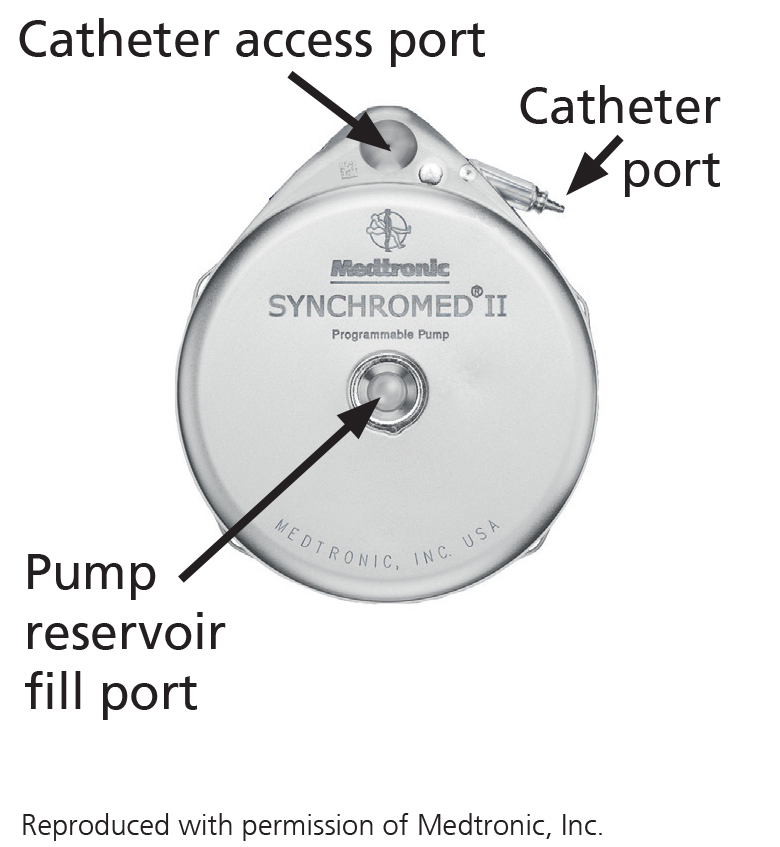
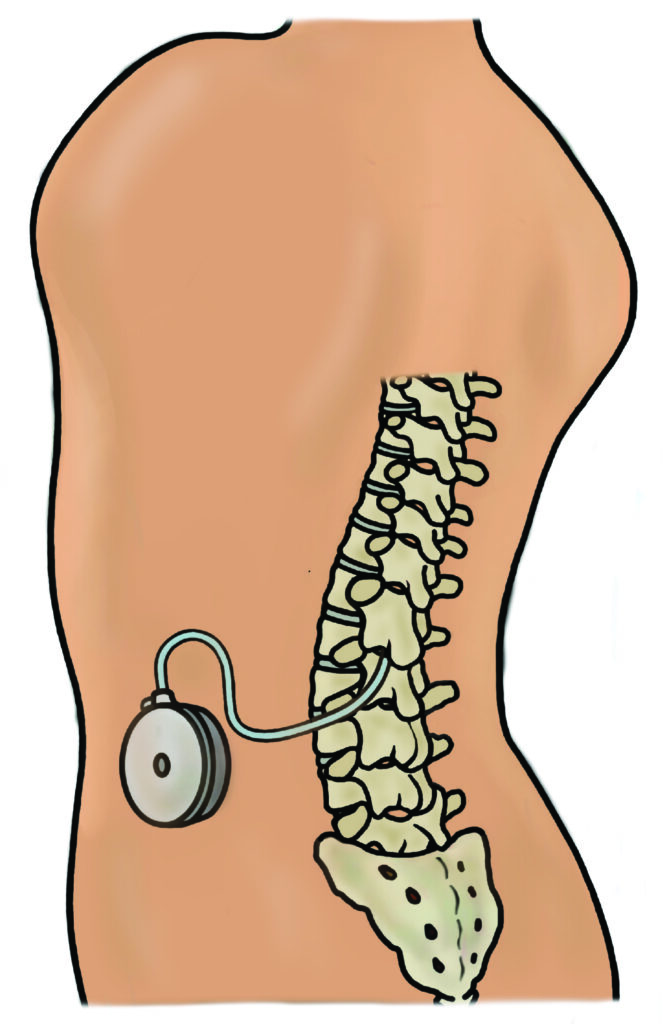
The internally implanted pump system consists of a pump and a catheter (below).
The reservoir in the pump stores the medications and the catheter connects the reservoir to CSF in the intrathecal space around the spinal cord.
There are two pump sizes available: one has a 20ml the other a 40ml reservoir. It is made of titanium and looks like a round metal disk 8.75cm (3.4 inches) in diameter. It has an expected battery life of approximately 5-7 years.
Who can I contact for routine advice?
Our nursing service is Monday-Friday 8am-4pm. We try to answer your calls as quickly as possible but due to clinical commitments at times we cannot answer the phone immediately so please leave us a message with your name and telephone number and brief information of why you are calling.
Please note
If you have any urgent problems with your pump (e.g. it is alarming or you have overdose/underdose symptoms) do not wait for us to get back to you, please go straight to Accident and Emergency or call an ambulance if you are unwell.
Contact numbers
The answerphone will usually be checked daily Monday – Friday but due to clinical commitments, this may not always be possible.

How is the pump implanted?
The pump is usually implanted under general anaesthetic in theatre. Sometimes the pump will be implanted using some light sedation and local anaesthetic (to numb the area). This will be discussed with you by the team in more detail prior to the procedure. The pump is placed under the skin usually in the abdomen and a catheter connects to this, the catheter is in the fluid-filled space around the spinal cord. The complete system once implanted remains under the skin.
The procedure, including being anaesthetised, the operation and time in the recovery room, can take approximately 2- 4 hours. The pump is filled with the prescribed drug in theatre and programmed to deliver an agreed prescribed dose. Once you are fully recovered from the anaesthetic you will return to a ward where you will be monitored.
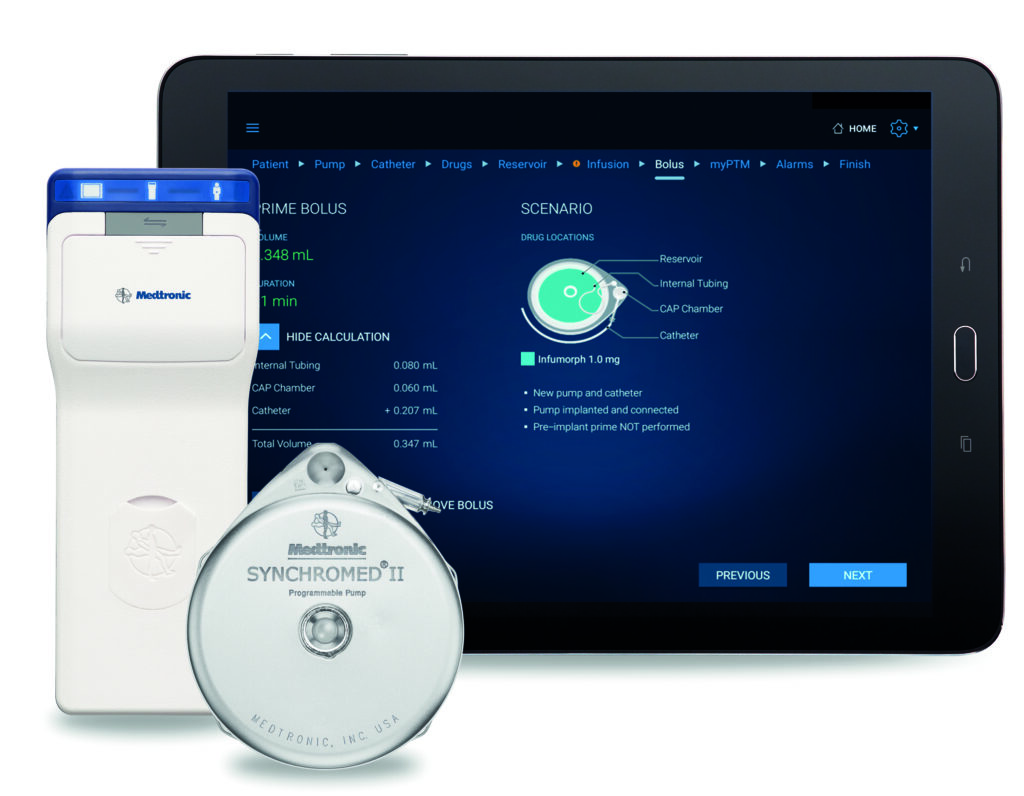
The pump is programmed using a tablet and wireless programmer.
Trial
A trial is a test dose of the drug(s) planned to be used in your intrathecal pump. A test dose can give an indication of likely response (both positive and negative) to treatment, however it should be remembered that this is only a one-off bolus. A lack of a beneficial effect from the test dose would suggest that the intrathecal therapy is unlikely to be of benefit. The test dose will also help guide decisions regarding the starting dose of the drug(s) when the pump is inserted and gives an opportunity to know how it feels to have the drugs given intrathecally.
The trial dose is given in theatre via a catheter. The catheter is inserted into your back using some local anaesthetic (an injection that numbs area).
The Refill Procedure
Once you have had your pump implanted, the pump will need to be refilled with new drug at regular intervals. This can vary from every few weeks to every 6 months, depending on the drug(s) you have in your pump and the dose of the drug(s).
The refill procedure normally takes around 30 minutes but you will usually be booked in for an hours appointment. The refill is carried out in a clinical room but sometimes in theatre or a recovery room. We may ask you to lay on a bed or a trolley so you are comfortable. We use a hand held computer to read the information stored on the pump.
To refill the pump, the skin surrounding the pump is cleaned, a sterile needle is then placed through your skin and into the pump. Using this needle the remainder of the old drug is withdrawn and replaced with the new fresh drug solution. The needle is then removed and a small dressing may be applied. The dressing only needs to stay on for a couple of hours and then you can remove this. There should not be any bleeding or fluid leakage from the site after the procedure. If there is, please contact the team immediately. If you are unable to or feel unwell, please attend A&E.
The information is then updated on the pump with the hand held computer. Finally we will arrange a date for your next pump refill. The pump calculates the volume of drug that will be used over the coming weeks.
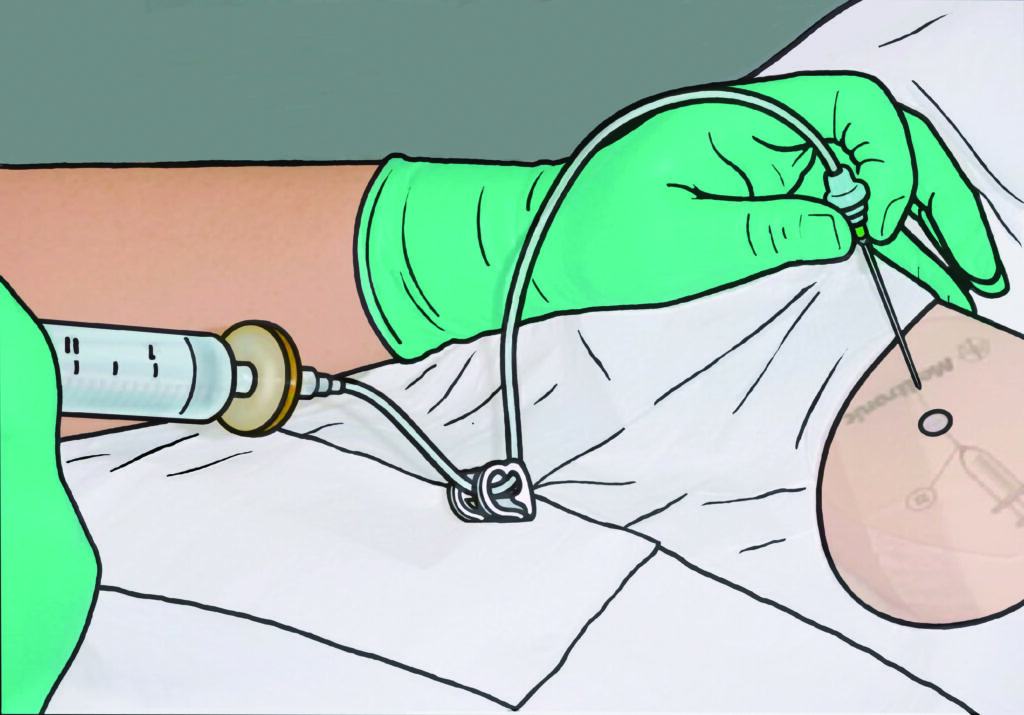
The refill is now complete.
After you have had a pump refill or adjustment, we will provide you with information about your pump alarm date and next refill date, location and time.
We would advise that you keep a record of the drugs in your pump and doses and take this information to medical appointments or to hospital if you are an in patient as this would allow others looking after you to be aware of your Intrathecal drug pump care.
Please note
After the Refill of your Intrathecal pump we suggest that you stay within the department for 30 minutes.
Where will I have my pump refilled?
We are primarily based at Leeds General Infirmary but also work at other hospital sites within the Leeds Teaching Hospitals NHS Trust.
We currently routinely refill intrathecal drug pumps at the following hospital sites:
- Leeds General Infirmary
- St James’s University Hospital
- Chapel Allerton Hospital
Please ensure you know which location your refill is planned for.
When can I attend for my pump refill?
The refill clinics currently usually run on Wednesdays and Thursdays. We will let you know your appointment date and time ideally at your refill appointment but if not possible, by telephone or letter. It is very important that you attend these appointments or, if there is an urgent problem and you are unable to, it is important that you contact us at the earliest opportunity.
Please note
Morning refill clinic: 9:00am – 12:00pm
Afternoon refill clinic: 1:00pm – 4:00pm
You will be given a time slot for your appointment, it is important you attend on time, we try our best to keep to appointment times but sometimes due to unforeseen circumstances we are unable to do so, we appreciate your patience.
We will try our very best to accommodate you for convenient dates and times for your refill, but we only have specific refill days and clinic slots and a specific timeframe to refill your pump (pump alarm date and drug expiry) so may not be able to accommodate specific requests.
Depending on the drug(s) and prescribed dose programmed into the pump, will depend on how regularly your pump will need to be refilled. Please ask the nurses for more information about this.
Please note
It is very important that your pump does not run out of drug as this can make you very unwell, so it is essential that you attend your refill appointment. Please make sure you know the name(s) of the drug(s) you have in your pump and the potential side effects of this/these drug(s).
Also what symptoms to look out for if you have too much of the drug (‘overdose’) or too little ‘underdose’/withdrawal). It is very rare for this to happen but important that you are aware of what symptoms to look out for and what to do if this happens. If you have any symptoms of overdose or underdose, it is very important to get immediate medical attention as this can make you very unwell.
Frequently asked questions
Will the response when the pump is implanted be the same as the trial?
Not necessarily. During the trial you will have received a relatively large, one-off dose of the medications to assess whether you respond to it. To administer the drug safely and effectively over time, smaller amounts are required and are delivered continuously at an hourly rate. It may therefore be at least a few days/weeks or possibly months before you feel the full benefit of the therapy but we are able to adjust the doses accordingly.
Are there any risks from the surgery?
Yes, there are risks with any surgical procedure but we always try to minimise these. You will be seen by the implanting doctor and anaesthetist before your operation to go through any specific risks for you and to sign a consent form which will document risks.
During your operation we often take X-rays to confirm the position of the catheter and sometimes inject contrast or dye to help with this. The use of all radiation is however kept to a minimum.
Some complications that you may experience with the implant surgery include:
- Infection
- Meningitis (infection of the lining of the brain and central nervous system)
- Spinal fluid leak (causing severe temporary headache)
- Paralysis
- Swelling
- Bleeding and bruising
- Nerve damage
These will be discussed with you by one of the team. Please ask if you do not understand or need further information. The serious risks are very rare but are still risks of the procedure.
Blood clots are more common after surgery or bed rest. To prevent this, you may receive a blood thinning injection of Low Molecular Weight Heparin (LMWH) starting usually the day after your operation if required.
Infection is something we work hard to avoid so following your surgery we ask that you do not remove your dressings or get them wet. You will be given advice about wound care and showering/bathing before your discharge, please ensure you follow this advice and seek immediate medical advice if there are any signs of infection (redness or leaking at wound sites, temperature, feeling generally unwell).
You can usually remove the dressing after 3 days (unless otherwise advised by the team). We tend to advise not to have a shower or bath during this time. If your wounds are healing well, after 3 days you are able to have a shower but please do not ‘scrub’ your wounds.
Important
Please do not have a bath or immerse your wounds in water for at least 6 weeks post implant.
What are the potential complications once the pump has been implanted?
Once the infusion system (the pump and the catheter) is implanted, device complications may occur that may require surgery to remove or replace the pump, such as damage or movement of the catheter.
Some of these device complications may impact the flow of medication delivered, which may cause symptoms of overdose or withdrawal.
Possible complications include:
- An internal component failure which may result in a loss of therapy, or an inability to program the pump.
- The pump, catheter or catheter fragment could migrate within the body or erode through the skin.
- Tissue or an inflammatory mass may form at the tip of the catheter in the intrathecal space and may cause a loss of therapy or neurological impairment including paralysis (Granuloma).
- The catheter could leak, tear or become disconnected resulting in delivery of medication into the area under the skin where the pump is implanted and/or along the catheter path.
- The catheter could kink or become blocked resulting in no delivery of medication.
- The pump could stop because the battery has run out or because of a problem with one or more of its inner parts.
- Errors in locating the pump during the refill procedure can result in symptoms of overdose or underdose that may be serious or life-threatening.
- Error in programming of the pump resulting in symptoms of overdose or underdose.
How can the dose of the drug in my pump be adjusted?
We can sometimes make adjustments to the dose in your pump. If you feel that you need a change in your drug dose please contact us. In order to adjust the dose, the team will connect the programmer to your pump and program in the new settings. This does not involve having to refill the pump unless a change to the drug(s) is required.
What is the pump alarm?
Your pump has two alarms. Please ask us to sound these alarms when you have had your pump implanted or if you are unsure of how they sound. It is very important that you seek immediate medical attention if your pump is alarming. There are 2 alarms, a critical alarm (double tone alarm every 10 minutes) this means the pump has stopped, and that you may be in drug withdrawal, this can make you very unwell. If this happens go straight to A&E and explain you have an Intrathecal pump and which drug(s) you have in your pump and contact the Nurse Specialists also (please remember our service is Monday – Friday 8am-4pm). There is always a Consultant on call who can be contacted by A&E. The non-critical alarm would sound every hour, this means there may be a problem with your pump and that it may stop running. You need to contact us if this occurs but please also attend A&E if you are unable to speak to us immediately. If you are unsure of what your alarm sounds like, please ask the nurse at your next visit.
How is the pump powered?
The Intrathecal pump has an internal non-rechargeable battery. The battery life is monitored at every refill or adjustment. The pump can last on average between five to seven years, dependent on how the pump is used. We will always use the correct treatment regime for you as an individual and replace the pump as it becomes necessary.
Can I go on holiday if I have an intrathecal pump?
If you have any holidays planned, please tell us as far in advance as possible, so that we can try to arrange refill dates around them. It will not be possible to be away from home longer than the time period between refills, as there will be a risk of your drug running out.
Will flying affect my pump?
Flying in commercial airlines will not generally affect the pump. However, talk to your doctor before long flights, or flights in a non-pressurized aircraft. You will also need to take your medical card and information about the drugs within your pump with you.
How does intrathecal medication work differently to oral medication?
Intrathecal pumps deliver medication(s) directly to the spinal cord, where pain signals are transmitted. In contrast oral medications have a ‘systemic effect’ (they work everywhere in your body).
This ‘systemic effect’ means that they ‘flood’ the whole body, rather than staying concentrated in one area. This often causes side effects, for example, sleepiness, confusion and nausea, which may prevent your doctor from prescribing greater amounts of oral pain medications. We aim to reduce or stop some of these side effects by using the intrathecal method of drug administration.
Can I stop taking other medication with my pump?
Many patients find that intrathecal drug delivery leads to a reduction in the use of other medications. However, to prevent any negative side effects, do not make any changes in your current medication unless you have been directed to do so by your Intrathecal pump specialist or GP.
Should I worry about drug addiction?
Drug addiction is extremely rare and very unlikely, due to the method of delivery and the levels of medication delivered.
Is the pump comfortable and will people notice it?
The pump is likely to be uncomfortable during the post-operative healing period. This may be for a few days or weeks post implant. Most people report that the pump is not uncomfortable or restrictive after this time, and does not interfere with their movements.
The pump is unlikely to be visible through your clothes, but has to be relatively close to your skin in order for us to be able to reprogram and refill the pump, so it may be visible under your skin or when you wear lighter clothing, you may be able to see the shape of the pump.
What happens if my pump runs out of medication?
If your pump runs out of medication, you may experience withdrawal symptoms. This can make you very unwell depending on the medications in your pump and it is important for you to know what the symptoms might be if your pump was to ‘run out’ or if there was a problem with your pump whereby it stops running.
How will I know when my pump needs to be replaced
We will be able to tell estimated battery life when we check the pump with the programmer during your regular refill appointments. In addition, the battery in the pump has a built-in alarm to let you know when it needs replacing. It will emit a soft, high-pitched beeping. We will ensure that your pump is replaced before it stops working.
Can I wash and shower with a pump?
Yes – it is okay to wash and shower with a pump in place once the wounds have healed. We usually advise not to shower or have a bath for at least 3 days until your dressings are removed and not to bath or immerse wounds in water for at least 6 weeks.
Will I be able to take hot baths or showers?
Most of the time, a hot bath, shower or sauna will not interfere with the pump’s operation. However, please let us know about other activities that may greatly affect the temperature or pressure of the pump, such as deep heat therapy or scuba diving.
Is there anything I should avoid doing
We would recommend avoiding extremes of movement to the spine, including stretching backwards (for example adopting the yoga ‘cobra’ position) and curling up (for example holding both knees to your chest or reaching down to touch your toes). Stretches to the lower back in which you lie with your knees bent and then rotate your legs to the side into a corkscrew position are also best avoided. This is because it is possible that, during extremes of spinal movement, the intrathecal system can become overstretched and potentially damaged.
Prolonged direct pressure over the pump and catheter (for example lying on your tummy or wearing tight fitting clothing), should also be avoided. Please ask your therapy team to review any wheelchair lap-straps, hoist slings and transfer aids (if applicable) to ensure they are compatible with the intrathecal system. Power plates (Vibrogym) should not be used and please seek further advice from the team if you scuba dive or go for hyperbaric oxygen therapy.
What safety precautions should I follow with the pump?
You can safely use most common household appliances including microwave ovens, televisions, radios, remote controls and video games. However, magnets can affect the pump. For this reason it is recommended that you do not use strong magnetic devices. A magnetic field, depending on strength, could interact with the pump. In addition, various medical procedures and equipment may affect the function of the pump.
These include magnetic resonance imaging (MRI), radiation therapy and diathermy (used in surgical procedures). Always consult your doctor before scheduling any additional therapies, diagnostic tests or surgery.
Is it okay to have sex with a pump in place?
Yes – some people have expressed concern that the pump may be displaced or damaged during sexual intercourse. However, the pump is placed in a deep pocket in the abdomen, so it is well protected.
Is it possible to be cremated with a pump?
If you plan to be cremated please note that the pump needs to be removed by the funeral directors prior to the cremation. The removal of medical devices is regular practice for undertakers so they will be used to doing this.
Can I have an MRI scan with an intrathecal pump?
You are normally able to have an MRI scan with an Intrathecal Pump but there are certain safety checks that need to be done first and there needs to be a trained person at the MRI scan. If you are told you require an MRI scan, you should contact the Nurse Specialists for further advice.
What happens if I need surgery when I have a pump?
If you require any surgery after having a pump implanted, it is important that you let the surgeon or team know prior to the surgery that you have an intrathecal pump as there are certain precautions that may need to be taken during the procedure (e.g. using a piece of equipment called diathermy) or the surgical team may need to ask advice if the planned surgery is near to either your catheter or pump itself.
What are my responsibilities?
Before discharge from hospital, you will have received advice regarding pump management from the team. You will also receive written information to take home with you.
It is your responsibility to:
- Contact the hospital if you feel there is a problem with the pump.
- Know the signs of overdose and underdose (withdrawal).
- Know the correct contact procedure for non-urgent problems.
- Know the emergency contact procedure.
- Attend the department as scheduled for refills and clinical reviews.
Information for healthcare professionals
Please note
This section of the leaflet is for healthcare professionals.
The holder of this file has an implanted intrathecal drug delivery system (ITDD) for pain and/or spasticity management.
The pump component is normally located in a subcutaneous pocket in the abdomen and delivers medication via a catheter directly into the cerebro-spinal fluid. Drugs used, infusion rates and alarm dates are recorded on PPM+ hospital system (this may not be accessible to out of Leeds areas) and the patient is given a letter. Drugs used in LTHT in intrathecal pumps include: Hydromorphone, Morphine, Clonidine, Bupivicaine, Levobupivicaine, Ziconitide and Baclofen. These may be in combinations. Some patients will just have a simple continuous dose of the drugs, some will have a patient therapy manager (where they are able to self-administer intrathecal drug boluses according to pre-set parameters). Additionally, the pumps have the ability to give ‘flex doses
24 hour period.
If you have access to this system
Information about the drugs, doses and regimes are available on LTHT PPM+, usually recorded under:
‘Intrathecal Refill Assessment’ and ‘Intrathecal Refill Report’
If not, the patient should have information about the drugs in their pump. The intrathecal drug delivery systems used within LTHT are Medtronic Synchromed pumps. Drug delivery can only be stopped / adjusted by a specific Medtronic programmer.
These devices are stored in a case, containing relevant documentation and emergency stop procedures. There is one stored in the Pain Nurses office, D floor Martin Wing, Leeds General Infirmary. Brachytherapy Theatres at St James’s Hospital, and Mr Sivakumar (Neurosurgeon) has access to one at LGI. These can only be used by trained personnel.
Stopping a pump infusion should only be considered after discussion with a Pain Management/Specialist Consultant and only if drug overdose is suspected. Severe withdrawal symptoms may be precipitated. Cases of pump malfunction are rare and cases of collapse are more likely to be due to another clinical problem.
Please note if a pump is stopped, it may not be possible to restart it. The pumps can be programmed to a minimum rate if needed.
Advice
Advice may be sought from the Chronic Pain Nurse Specialists 8am to 4pm Monday to Friday. The Chronic Pain Management Consultants can be contacted via hospital switchboard or the On-call Neurosurgeon can be contacted via hospital switchboard.
There is a LTHT Intrathecal Drug Delivery guideline and an Emergency/urgent Intrathecal Pump Problems SOP on the Trust intranet page via Leeds Health pathways.
MRI Scanning and Implantable Pumps
MRI will cause the motor in the pump to stall during the scan, it should automatically restart but there should be a trained person at the scan to check the pump. The referring clinician and radiologist for every case must check individual pump and MRI compatibility. The magnetic field may still affect compatible pumps, which need to be checked afterwards to ensure they are running correctly. CT scanning is safe.
To arrange a post scan check please contact the CNS Pain Nurse Specialists (Monday to Friday 8am – 4pm).
Please note due to clinical commitments and service hours, this may not be possible with short notice or for out of Leeds scans.
If infection, particularly meningitis, is suspected, urgent advice must be sought from Neurosurgical team or On-Call Chronic Pain Consultant.
Medtronic
Further information may be sought from the Medtronic.
Pain Consultants
- Dr Titterington – Specialist in IT pumps
- Dr Black – Specialist in IT pumps
- Dr Baranidharan
- Dr Whelan
- Dr Montgomery
Neuro Rehabilitation Consultants
- Dr Devinuwara – Specialist in IT baclofen pumps
- Dr O’Connor
Neurosurgery Consultant
- Mr Sivakumar – Specialist in IT baclofen pumps
Clinical Nurse Specialist Team (Monday – Friday 8am-4pm)
- Team Leader – Jenny Jennings
LTHT Switchboard
The Medtronic Synchromed II pump has 2 alarms:
Critical alarm – 2 tone alarm every 10 minutes – If this is alarming the pump has stopped and urgent attention to the pump is required
Non-critical alarm – single tone alarm usually set every hour – If this is alarming the pump may still be running but likely to stop if the problem is not resolved.