
This information leaflet is for men who have been referred by their doctor for a Magnetic Resonance Imaging (MRI) scan of their prostate gland. It will tell you about the scan, how to prepare and what you can expect during and after the scan.
What is an MRI scan?
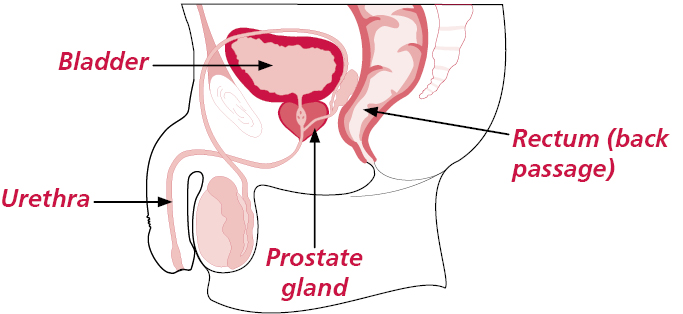
MRI stands for magnetic resonance imaging. It is a special type of imaging test that uses a strong magnet, radio waves and a computer to produce detailed pictures of your prostate gland and pelvis. The scan is performed by a Radiographer (professional trained to carry out MRI scans and other imaging). A specialist doctor (Radiologist) will use the scan to help diagnose the cause of your symptoms. MRI scans are particularly good for looking at the prostate gland.
Why am I being referred for a scan?
There are many reasons that your doctor may have referred you for a scan of your prostate. The most common reasons are an abnormal examination finding or a raised blood test (prostate specific antigen).
The prostate specific antigen (PSA) blood test can be abnormal due to a urine infection, inflammation in your prostate gland, or due to prostate cancer. The MRI scan can help to identify if your prostate gland has any suspicious changes that might indicate underlying cancer. However, further tests such as a prostate biopsy are often required to confirm the diagnosis.
What will the scan involve?
The scan itself can take anywhere between 30 to 50 minutes. Before you have your scan you will be asked to remove any metallic items. If your clothing around the pelvis has a lot of metal fastening you may be asked to change into a gown.
A radiographer will be able to explain the scan to you in detail once you are in the department.
Before entering the scan room you will be asked to fill out a safety questionnaire. You will also have a cannula inserted into your hand or arm (this is a small plastic tube that is placed into a vein using a small needle).
Once you are inside the MRI room you will be asked to lie flat on the scan couch and the radiographer will inject a drug called Buscopan. This helps reduce bowel movement and improves the quality of the images. You may notice some blurred vision and a dry mouth – this is normal. You should be ok to drive afterwards as the effects are short lived; we ask you to make sure your eyes have returned to normal before setting off.
You will then have a piece of equipment called a coil placed over your pelvis and moved into the middle of the MRI machine; the scanner is open at both ends. It is very important to stay still during the scan as it improves the quality of the images.
The radiographers will leave whilst the scan takes place but they will be able to see you from the control room. If you feel uncomfortable or need to urgently contact the radiographer you have an emergency buzzer. The MRI scanner will make loud noises when it is taking pictures, but you will be able to wear headphones and listen to music during the scan.
Sometimes you may be given an injection of a contrast dye into a vein via the cannula so that we get more information about your prostate gland. The radiographers will need to ask you if you are allergic to anything including any medications or if you have any medical conditions. You should tell a member of staff immediately if you start to feel unwell during the injection or afterwards.
Back to topIs an MRI scan safe?
MRI scans are a safe test.
However, there are certain people who cannot have an MRI scan because they have metal in their body or have had certain types of surgery.
Examples of metal that would make MRI scans unsafe include:
- Cochlear implants – used to treat deafness.
- Certain types of cardiac pacemakers or implantable cardiac defibrillators – some models are safe in MRI scanners. If you have a cardiac device and you have been told you can have MRI scans, you need to contact MRI prior to your appointment as these devices often require a team present to ensure safety.
- Surgical clips, stents, pins, plates or joint replacements – these are usually not a problem if they were implanted more than six weeks ago. The radiographer needs to be aware of all implants as sometimes their presence require scan settings to be altered. If you are unsure please speak to the radiographer or team looking after you.
- Metallic foreign bodies in your eyes – For example if you work in the metalwork, engineering or automotive industry. If you have had a previous eye injury or are concerned that you may have a metal shard in your eye, let us know as soon as possible so an x-ray can be arranged.
You will be asked to fill out a questionnaire before the scan to identify whether you have any metal in your body that would make it unsafe for you to have the MRI scan.
If you think you have any metal in your body, please tell the radiographer and they will decide if you are safe to have an MRI scan.
Most patients tolerate MRI scans very well but some patients may feel claustrophobic inside the scanner. If you think you might feel this way, you can discuss this with your doctor. Our radiographers and assistants will try to make you as comfortable as possible in the MRI scanner. Please note the radiographers cannot offer sedation.
The contrast agents used in MRI are well tolerated but as with all medications some patients can suffer an allergic reaction. If you feel unwell after the contrast injection please let the radiographer know.
What happens after my scan?
Most people will be able to leave shortly after having their MRI once the radiographer ensures that you are feeling well and you can resume normal daily activities. Your scan will be reported by a radiology doctor and will be available for your hospital doctor who will contact you to discuss the results.
Who can I contact if I have any questions about my scan?
You can contact our radiology department if you have any questions related to your scan or if you think you might not be able to attend your appointment. The contact details will be on your appointment letter.