
This information is for patients who may experience a condition called Malignant Spinal Cord Compression (MSCC), at some point in the future.
The following advice explains what symptoms to look out for and who to contact if you think you have developed any of these symptoms.
The Spinal Cord
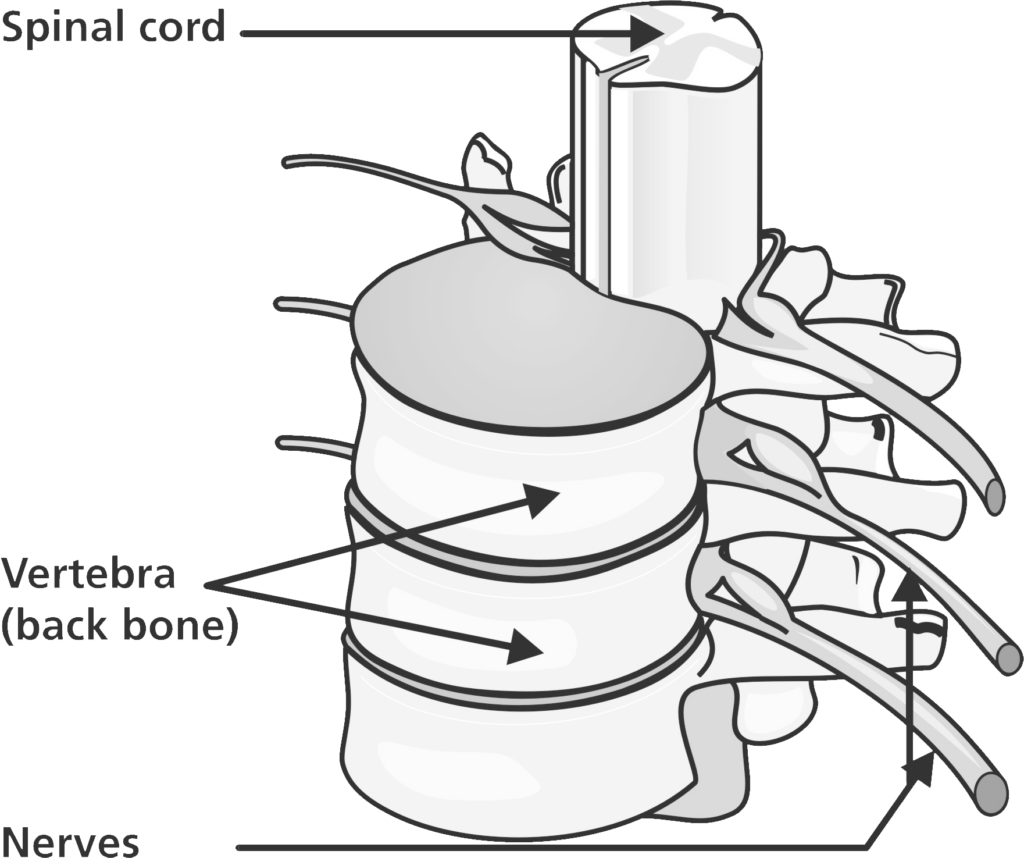
The spinal cord is the chain of nerves that sits within the back- bone (spine/vertebrae). The nerves for all parts of the body, including the legs, arms, bladder and bowel branch from the spinal cord.
What are the early signs and symptoms of MSCC?
Listed below are some of the most common signs and symptoms of MSCC. Please note: if you are suffering with any of the following, it doesn’t necessarily mean that you have a cord-compression. However, early diagnosis is key to stop further problems.
- Persistent severe pain in the back which you have not experienced before, that is getting worse especially when coughing, sneezing or straining. You may also have some shooting pains down your arms or legs.
- A band of pain around the chest or abdomen.
- Feeling unsteady on your feet (perhaps legs giving way as you stand).
- Finding it difficult to walk.
- Numbness, heaviness or ‘pins and needles’ in any of your limbs (arms/legs), your fingers, toes or buttocks.
- Problems controlling your bladder; loss of control, or passing small amounts of or no urine at all.
- Constipation or problems controlling your bowels.
THIS REQUIRES URGENT MEDICAL ATTENTION
What to do next
Please contact your specialist nurse/Macmillan nurse/key worker on the telephone number provided in the between 9:00 until 5:00pm, Monday to Friday .
If you cannot get hold of anyone please follow the advice below.
Out of normal working hours
- Your oncology ward’s emergency contact number.
- If you are a Leeds patient – the Oncology bleepholder Tel: 0113 243 3144 – ask for the Oncology Patient Bleepholder.
- Out of Hours GP.
- Emergency Department – please take leaflet (LN002462) with you.
When you contact us, please try to give us the following information:
- Hospital/NHS number
- Diagnosis
- Current medications
Testing for MSCC
- Current medications
- History and clinical examination by a member of the team
- Bloods
- Magnetic Resonance Imaging (MRI) scan
If you are not suitable for an MRI scan, we will use a different scan.
Some patients are admitted so please bring an overnight bag and your medications in case you need to stay at the hospital.
If you do have MSCC
- You will be given steroids (Dexamethasone) to take.
- You may be given painkillers if required.
- If you are not in St James’s Hospital Leeds already, you will be transferred to the Leeds Radiotherapy Department on Level -2, Bexley Wing, Leeds Cancer Centre (LS9 7TF) for treatment.
What are the treatment options for MSCC?
Usually MSCC will be treated with radiotherapy and/or surgery, or steroids alone.
Radiotherapy
Radiotherapy is the use of high energy x-rays with the aim of shrinking (or stopping any further growth) of your cancer.
Urgent radiotherapy treatment is often given to stop any further growth of the tumour which is pushing against your spinal cord. This treatment aims to stop your symptoms getting worse and to help relieve the pain.
Surgery
Less commonly, surgery can be used as well as or instead of Radiotherapy.
Further support
If the information in this leaflet has caused you any anxiety you may want to speak to somebody about this. This could be your Clinical Nurse Specialist (CNS) or Key Worker or you can contact any of the support services listed below. The Palliative Care Team, CNS or Key Worker details are for non-urgent advice and support.
The Sir Robert Ogden Macmillan Centre
The Centre is on the St James’s Hospital site, behind the Thackray Medical Museum. It offers a variety of support services including complementary and supportive therapies.



Maggie’s Centre
If you or someone you love has cancer you may have lots of questions. Maggie’s is a warm, welcoming place where you can meet people who are experiencing similar things to you.
You may also be able to find support groups specific to your needs and get advice and information from their professional staff. You don’t need an appointment and all support is free.

Community Palliative Care Team at St Gemma’s Hospice
Community Palliative Care Team at St Wheatfields Hospice
Macmillan Cancer Support
A textphone service for deaf and hard of hearing people.

OUTpatients
A cancer support and advocacy charity for LGBTIQ+ community.