This is a specialised procedure that allows the accurate and precise removal of skin cancer. It was initially developed by Dr Frederic Mohs.
The procedure involves the removal of skin cancer in stages. Each time the specimen removed is analysed under the microscope to check for complete skin cancer removal (on the same day).
Mohs surgery provides the highest cure rate for certain skin cancers such as basal cell carcinomas.
The surgery focuses on the removal of skin cancer helping to preserve as much of the surrounding normal healthy skin as possible. This may help with repairing the wound and subsequent scar.
This leaflet is designed to support the detailed discussion about Mohs surgery that you will have in clinic before having the surgery.
Why Mohs Surgery?
Mohs surgery is not used for all skin cancers. It can be helpful for certain selected skin cancers. For example those skin cancers that may be larger than they appear on the surface of the skin or those that may have recurred after previous treatment. Using a microscope to guide skin cancer removal can help to ensure that the skin cancer is completely treated whilst limiting the removal of healthy skin. This is helpful for areas where it may be important to try to preserve as much normal healthy skin as possible such as around the eyes, nose, lips and ears.
On the day of surgery
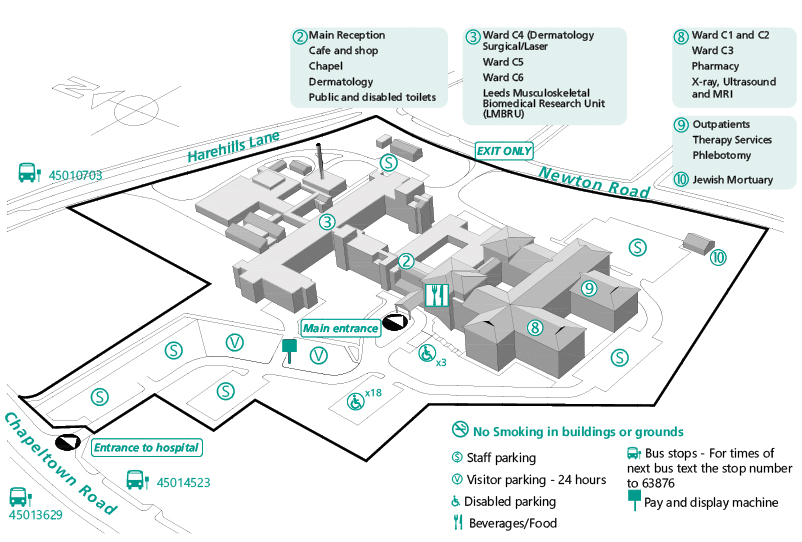
You will be given a time to attend for surgery. Please report to the reception desk on C4, Dermatology Surgery & Laser Unit, on the 1st Floor at Chapel Allerton Hospital. The Receptionist will show you to the recovery room where you will wait to be called by one of the Mohs nurses. We have very limited recovery space; therefore, we ask that you attend alone on the day. Attending with a relative / carer will need prior approval.
What to expect
Your appointment will be for the morning but you are likely to need to stay for several hours and you should plan for spending the entire day with us. We would recommend that you bring something to read or listen to, as much of this time will be spent waiting while the skin cancer that has been removed is processed in our specialised laboratory.
You are allowed to eat as usual and we would advise that you eat breakfast before your surgery. Lunch is NOT provided however you can bring food with you or a friend/relative/carer can go to the shop for you. Please be prepared for the day as you will not be able to leave the Surgical Unit until you have been discharged by the surgeon.
Please wear some comfortable clothes that button up at the front or easy to take off. This is so you do not have to pull it over your head and affect the dressing throughout the day.
Please be prepared to have a large pressure dressing applied after the procedure. This is vital to reduce the risk of bleeding and swelling after the surgery.
You will not be able to drive yourself home after the surgery. We would therefore recommend making alternative transport arrangements such as arranging for someone to drive you home. We would strongly advise having someone at home with you for at least 24-48hours after the surgery whilst you recover.
Who will be in theatre?
In theatre you will meet the Mohs surgeon and two nurses who will be assisting with the procedure. Sometimes a student nurse, medical student or trainee doctor may also be present.
The Mohs procedure (skin cancer removal)
- The visible margins of the skin cancer are identified and marked with a pen.
- Local anaesthetic is then injected into the area. This can sting for a short time but makes the rest of the procedure comfortable.
- The skin cancer is meticulously removed with a narrow margin of nearby skin. A temporary dressing is then placed on the wound.
- The removed sample is taken to the laboratory and is then prepared for analysis. A ‘map’ is drawn in the notes so that the skin removed can be accurately marked for any remaining tumour.
- The process of preparation and analysis can take around 90 minutes, although sometimes maybe longer.
- If after looking at the skin sample under the microscope there is still skin cancer remaining, then a further area of skin will need to be removed from that area.
- That means coming back into theatre and having a second sample removed in a similar way to before (including local anaesthetic injection) and taken to the laboratory.
- This precise, staged removal of the skin cancer is repeated until the skin cancer has been completely removed.
- It is not possible to say how many stages will be required to clear the skin cancer, but in almost all cases this is achieved the same day.

Repair of wound after skin cancer removal
Following Mohs surgery, there will be a wound. The Mohs surgeon will discuss the options for managing the wound on the day of the surgery. This may include:
- Allowing the wound to heal naturally with the aid of dressings.
- Closing the edges of the wound directly with stitches.
- Moving skin adjacent to the wound and stitching together (known as a flap) – occasionally this may need to be done in two visits, three weeks apart.
- Taking skin from another part of the body and stitching onto the wound (known as a skin graft).
Sometimes the wound is repaired by our colleagues at a different department (such as a plastic surgeon, maxillofacial surgeon, oculoplastic surgeon). In this case the wound is usually repaired 1-2 days after the Mohs surgery.
Very rarely the wound may be larger than expected and the planned repair is then best performed on another day. Should this occur, arrangements will then be made for repair with our colleagues as above, sometimes under a general anaesthetic.
After the surgery you will have a dressing. This is often quite a large pressure dressing that helps to protect the wound.
It is important to keep this dry. Specific instructions on looking after the wound will be provided at the time of surgery. You will be given the leaflet ‘Post-operative wound care – Information for Dermatology Patients.’
All skin cancer surgery will result in a scar. This is an unavoidable consequence of surgery. However, your surgeon will discuss what to expect and try to answer any questions you may have.
After Surgery
Once the local anaesthetic has worn off, the treated area may be painful. Paracetamol may be helpful for this (we would advise two 500mg Paracetamol tablets every 6 hours – maximum of eight tablets in 24 hours). If you take medications containing paracetamol (e.g. Co-codamol, Co-dydramol) then no further paracetamol should be taken. Please avoid aspirin or ibuprofen based products, unless prescribed as a regular medication by your GP. Always read your medication instructions. If you are unsure, speak to your Pharmacist or GP.
It is also likely that you will get some bruising and swelling. This should begin to settle within a few days.
Most patients will have stitches in the wound. We will either arrange for you to come back the following week to have the stitches removed and to check the wound or to have this undertaken with the Practice Nurse at your GP surgery.
We will give you further detailed advice on how to look after your wound at the time of surgery.
If you have any problems with the wound after surgery, please follow the contact advice given (below):
Contacts
Mohs surgery appointment queries
Monday to Friday between 8.30am – 16.00pm

Queries after your surgery
C4 Reception
Monday – Thursday 8am to 5pm, Friday 8am to 1.30pm
Useful information
Chapel Allerton Hospital
Chapel Allerton Hospital switchboard

Car Parking Information
Payment is by card or Pay by Phone App in the pay and display machines at Chapel Allerton Hospital.
Beverage and food facilities
Food and beverages are available from the cafe and shop. Vending machines are available in the main reception 24 hours a day, seven days a week.
Please note you will not be able to leave C4 on the day of surgery – a friend/relative/carer can get food and beverages for you from the above.
Map of hospital location
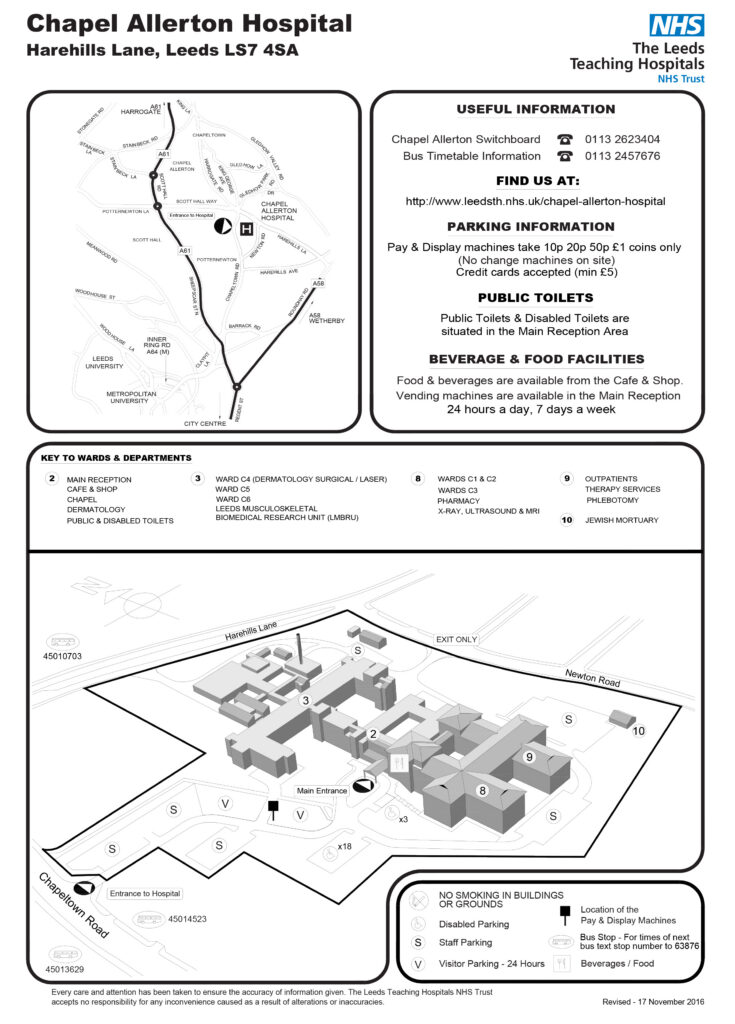
Site plan for Chapel Allerton Hospital