
This leaflet will explain about your pelvic floor muscles, where they are, what they do and why it is important to exercise them.
Pelvic Floor Muscles
These muscles sit at the bottom of your pelvis.
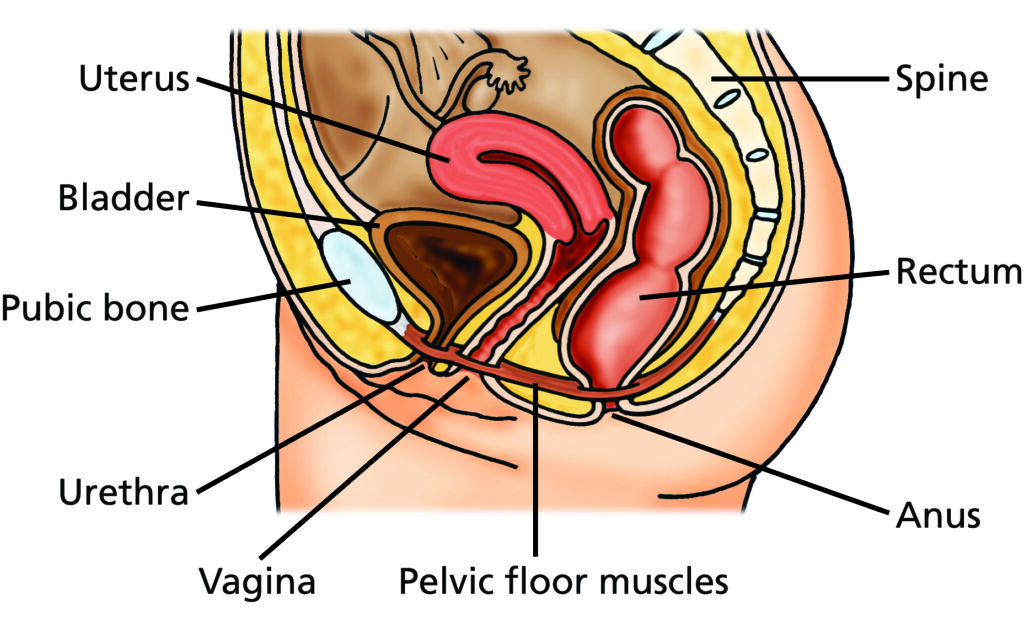
What do the Pelvic Floor Muscles do?
- They help to support the bladder, womb and bowels, and the front passage (urethra), vagina and back passage (anus). This support helps to prevent incontinence (accidental passing of urine, wind or stools) or prolapse. In addition good support from the pelvic floor can increase pleasure for both partners during sexual intercourse.
- The pelvic floor muscles also support the pelvic bones and work with the deep abdominal muscles to help protect the spine.
What can weaken the Pelvic Floor Muscles?
- Pregnancy and childbirth
- Being overweight
- Constipation – repeated or continual straining
- Repeated heavy lifting or carrying
- Prolonged standing – e.g. doing 2 hours ironing
- Chronic cough
- Hormone changes after the menopause and pre-menstrually
- Repeated high impact exercise
The above can also make a prolapse worse.
Doing Pelvic Floor Muscle exercises
There are two different exercises to improve pelvic floor muscle tone, it is recommended you do both.
Type I – this can be done in any position. It is easier to start in a lying or sitting position and progress to a standing position
- Squeeze around the back passage as if trying to stop wind escaping, at the same time squeeze your front passage as if trying to stop the flow of urine.
- You should feel a squeeze and lift, a drawing up feeling inside – this is a pelvic floor muscle contraction.
- Hold this squeeze and lift for a few seconds (up to 10), then relax and repeat a few times (up to 10).
Type II – Quick contractions
- Do the same squeeze and lift but relax immediately. Repeat up to 10 times.
- Allow a few seconds for the muscles to completely relax in-between contractions.
- When completing pelvic floor exercises try and keep all other muscles relaxed including your bottom muscles and abdominals. Try not to hold your breath.
- Stopping the flow of urine in midstream can be used to check you are exercising the correct muscles but it is not recommended to continue to do this as long term it can cause bladder problems.
Your Individual Exercise programme
- How long can you hold the contraction? (up to 10 secs)
- How many times can you repeat it? (up to 10 secs)
- How many quick ones can you do? (up to 10 secs)
- Do this 3-4 times a day.
- Do not exercise by stopping the flow of urine in midstream, this can affect the normal working of the bladder.
How to remember
Put a sticker in a place to catch your eye to remind you. Link it to a regular activity e.g. stop at red light, waiting for kettle to boil, put a reminder on your computer or phone. Apps are available for smartphones e.g. Squeezy or Kegel Kat.
Using your Pelvic Floor Muscles to help prevent a leak of urine
Tighten and pull up your pelvic floor muscles:
- Before you lift, cough, sneeze, etc
- If trying to hold on to reach the toilet
Bladder advice
Do you have:
- Difficulty holding on to reach the toilet in time?
- Feeling the urge to empty your bladder frequently?
You can help control the urge by:
- Gently tightening your pelvic floor muscles and holding
- Go up and down on your toes
- Cross your legs
- Sit on something firm – the edge of a seat or rolled up towel between your legs.
Press against the opening of your bladder. Aim to empty your bladder no more than eight times during the day and once at night. Avoid going to the toilet ‘‘just in case’’.
Are you:
- Dribbling urine immediately after getting up from the toilet?
- Feeling you haven’t completely emptied your bladder?
What you can do:
- Stand up, sit down and try again.
- Lean forwards and rock but avoid straining to empty your bladder.
- Try tapping over your lower abdomen / bladder.
- Wait a bit longer.
- Tighten up your pelvic floor muscles before you stand up.
Advice on drinks
- For your kidneys to work well do not restrict your drinks.
- Drink at least six drinks each day (1½ – 2 litres), still water is best.
- Avoid too much caffeine in coffee, tea, green tea or cola / fizzy drinks as this can irritate your bladder.
- If the urge to go wakes you more than once in the night, try having your last drink at least two hours before bedtime.
Please remember
It can take six weeks before you start to see an improvement and progress will continue for at least six months.
If you require any further input regarding pelvic floor muscle training, are unsure of your technique or are experiencing any incontinence symptoms please speak to your midwife or GP for a referral to our urogynaecology physiotherapy services.