
The aim of this information is to help you and your family understand more about your radiotherapy treatment.
It will be given to you in addition to the information you will receive from your clinical oncologist (a specialist doctor in cancer treatment). Their team will be caring for you during your treatment. This team will include radiographers and nurses, but may also include other specialist health professionals.
The information describes radiotherapy planning and treatment. It also explains the side-effects that you may experience during and after treatment.
Each person’s treatment will vary, so the information given is a general guide. The healthcare team looking after you will explain your treatment and the side-effects in detail. If you have any questions after reading this leaflet, please speak to the team looking after you or ring the numbers at the end of this leaflet. Staff will make every effort to meet your individual needs or will direct you to the person who can help.
Radiotherapy Department
All your radiotherapy planning and treatment will take place in the Radiotherapy Department. Please contact the Radiotherapy Reception using the telephone number below.


What is MSCC?
The spinal cord is the chain of nerves that sits within the backbone (spine/vertebrae). The nerves for all parts of the body, including the legs, arms, bladder and bowel branch from the spinal cord.
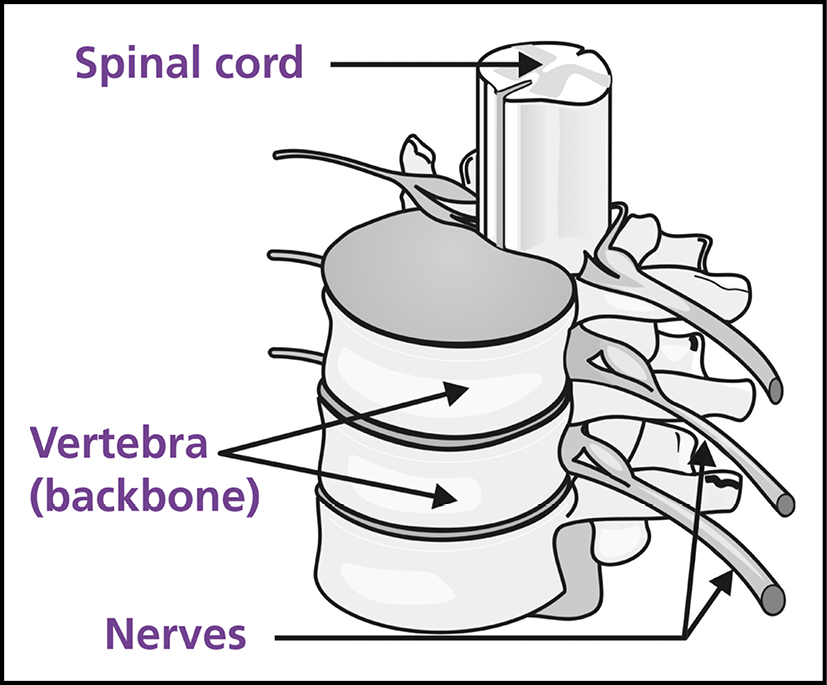
MSCC occurs when cancer grows in or near the spine and presses on the spinal cord and nerves. This can result in muscle weakness, altered sensation, or bladder and bowel disturbance. Your doctor is concerned that you have MSCC or are at risk of developing this condition. Radiotherapy treatment is recommended for this.
What is radiotherapy?
Radiotherapy is the use of high energy X-rays to treat cancer. Radiotherapy causes damage to the cancer cells in the treated area. Although normal cells are also affected, they can repair themselves and are able to recover. Radiotherapy is a local treatment. This means it only affects the part of the body that is treated.
When you are having your radiotherapy you do not feel anything and it does not make you radioactive. You may hear a buzzing noise when the machine is switched on.
It is perfectly safe for you to be with other people, including children and anyone who may be pregnant throughout your treatment.
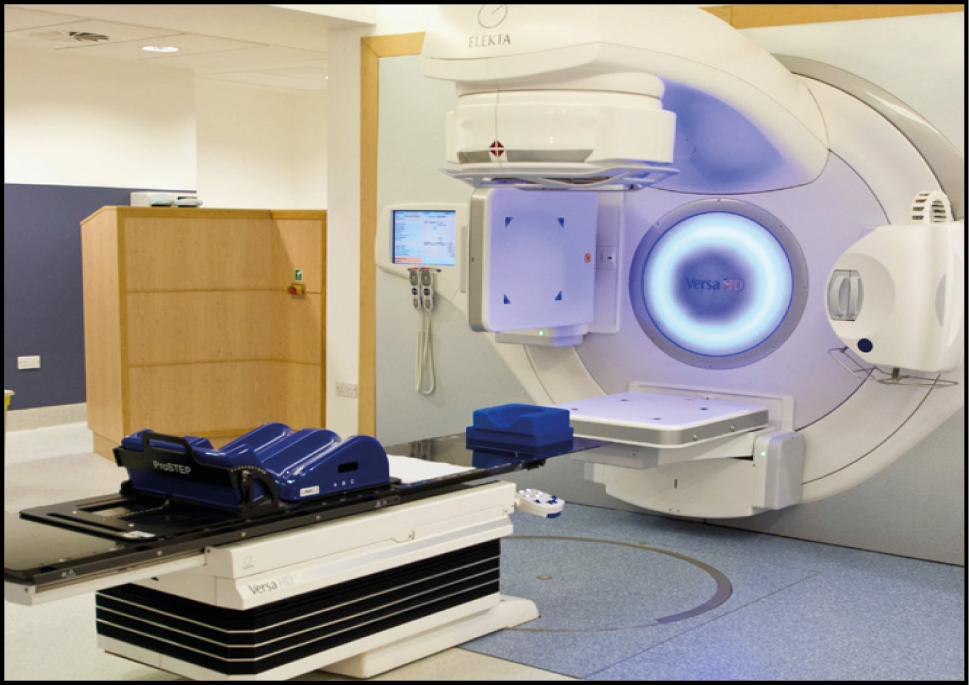
You will have your treatment on a machine called a Linear Accelerator, pictured below.
Who will I meet?
Back to topImportant advice before your treatment
Pregnancy
It is very important that patients who could become pregnant, are not pregnant at the start of their radiotherapy course. Also, patients should not become pregnant during their radiotherapy treatment, as this can have an effect on the unborn child. Use an effective form of contraception, for example condoms, coil, depo injection or contraceptive pill.
What to bring with you:
- a list of all the questions you may have;
- an up-to-date list of all the medications you are taking (including inhalers, sprays, vitamins or herbal products);
- any medication that you may need during your visit, including painkillers and over the counter medicines you are taking;
- something to eat and drink and something to occupy yourself with (you may be with us for much of the day).
- If lying still or flat is painful for you please bring painkillers with you. Take them before you have your scan.
Planning Your Treatment
Mould Room
If your cord compression is in the top of your spine a radiotherapy mask may be made. This is to make sure you stay still during your treatment, and to ensure accuracy of treatment.
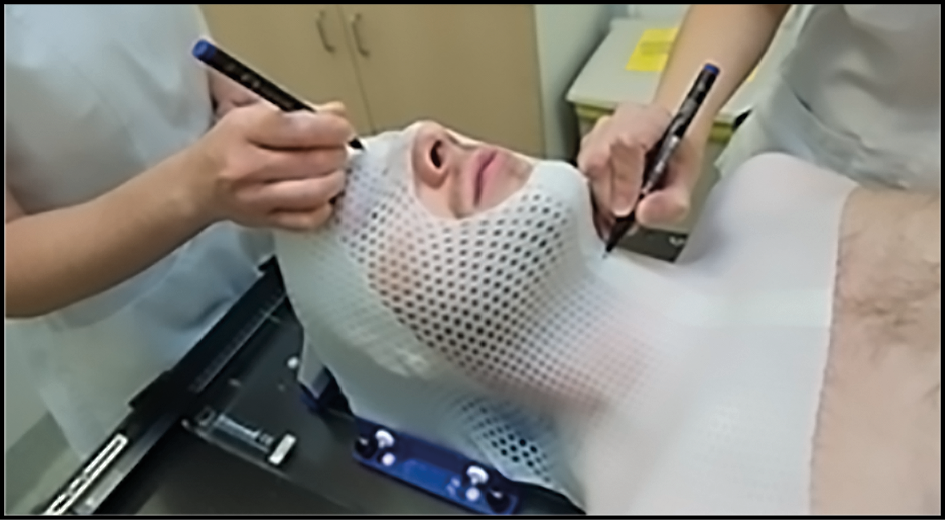
If you are having treatment to a different part of your body, a mask is not needed.
Your Planning Scan
In order to plan your treatment you will have a planning CT scan.
This is done on a machine called a CT Scanner as shown here in the photo.
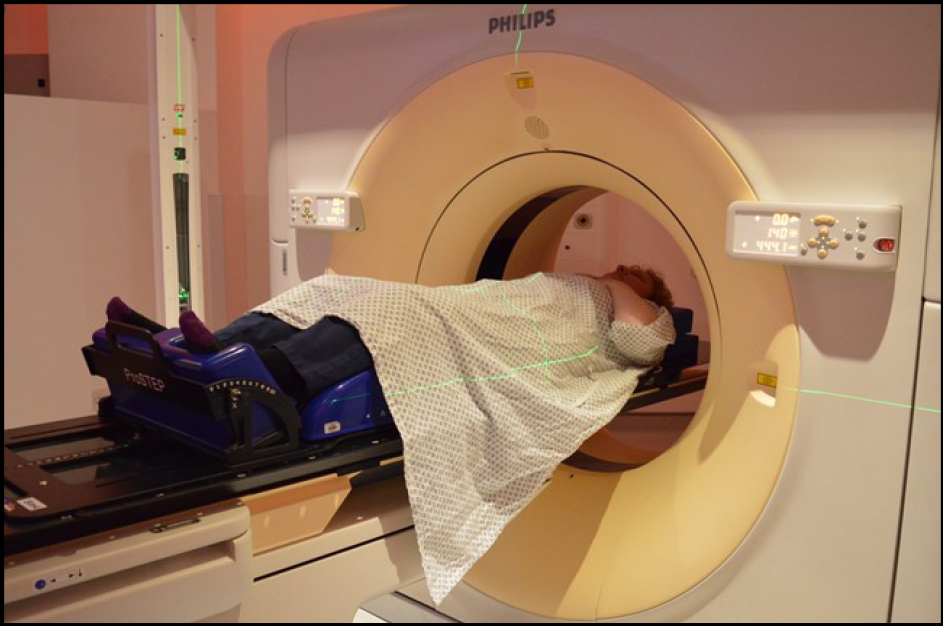
It allows the images from the scan to be sent to the radiotherapy computer planning system.
There will be several members of staff present at your scan. These will include therapeutic radiographers, and possibly a mould room technician.
Planning scans are not diagnostic examinations and will not be reported on as such.
The scan will be taken with you lying in the same position as for your treatment. The radiographers will draw some marks on your skin, to be used as a reference for your treatment.
The scan will only take a few minutes, and it is important for you to stay as still as you can. Please ask if you need extra painkillers.
You will then be scanned. This will only take a few minutes. At the end of the scan the skin mark will be replaced by a small permanent mark (tattoo).
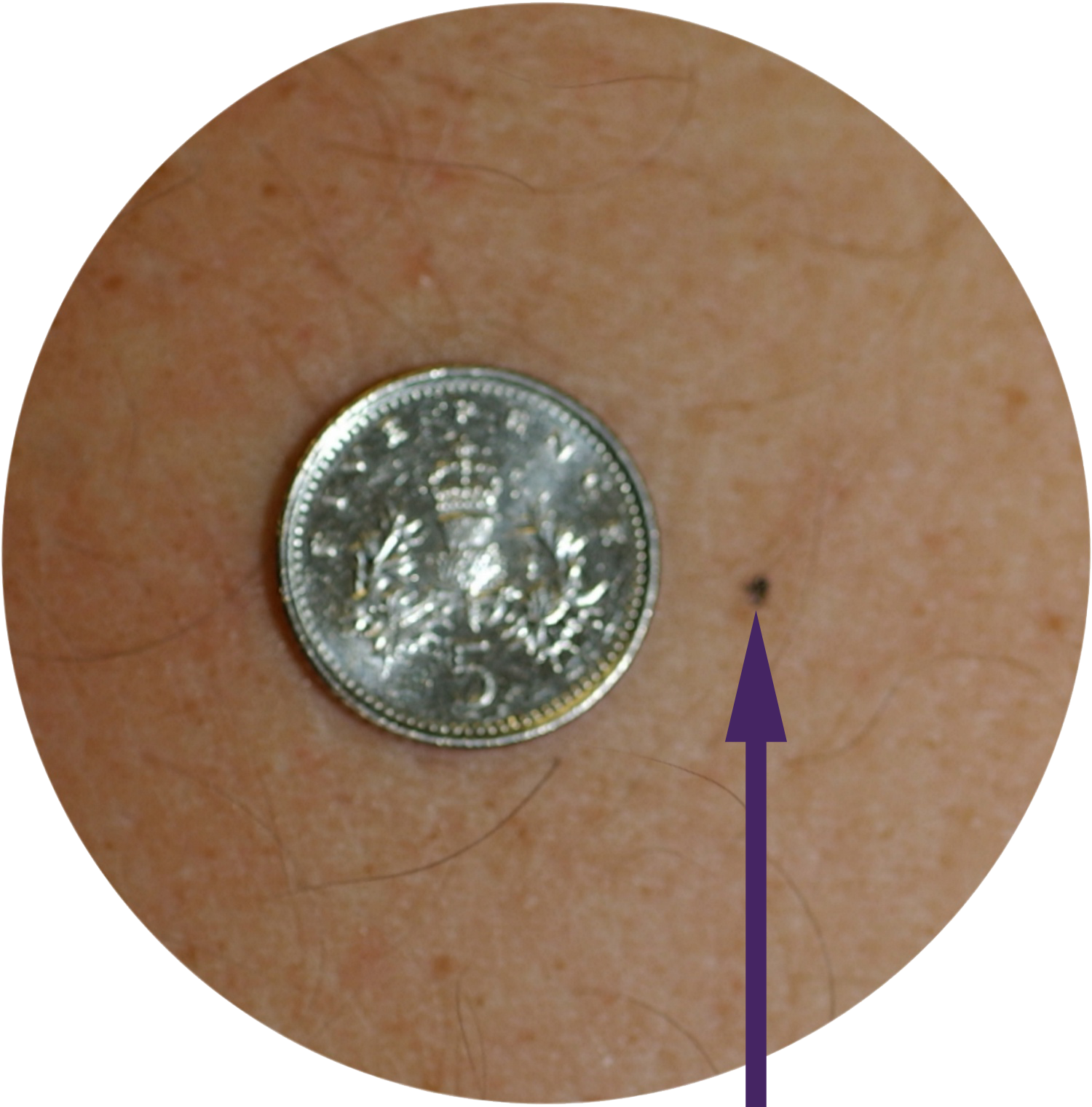
These marks will be used for your treatment. They help us to set you up and deliver your treatment with accuracy.
Back to topHaving your treatment
You will usually have treatment on the same day as your planning scan. There is a break in between the planning scan and your treatment. This is to enable us to plan your treatment accurately and safely. Whilst we are planning your treatment, you may spend some time on a ward where the nursing team can assist you. Depending on your needs, you may be able to stay in our department.
When it is time for you to have your treatment, the radiographers will position you on the treatment couch in the same position as you were in for your planning scan.
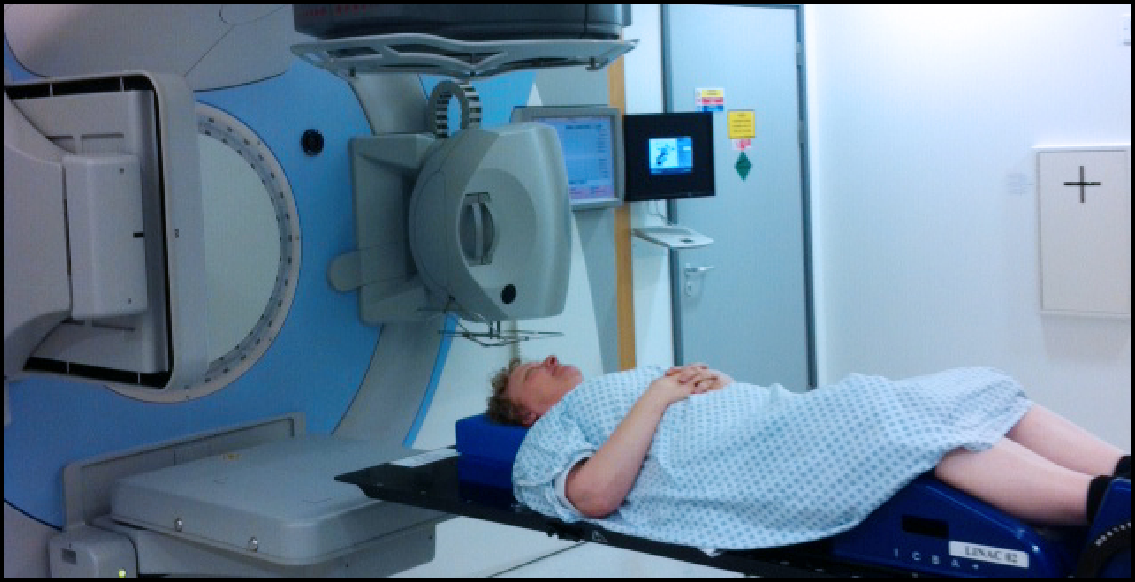
You will be asked to stay as still as possible during your treatment. Please take or ask for painkillers if necessary. You should breathe and swallow normally.
The radiographers will leave the room to switch on the machine, but are watching you on closed circuit TV (CCTV) monitors. The CCTV camera is not recording or saving any images. There is also an intercom system so the radiographers can talk to you.
The treatment only takes a few minutes but you will be in the treatment room for about 10-20 minutes. The machine stops automatically after your prescribed dose of treatment has been given. The radiographers can stop the machine at any time if needed. The treatment machine makes a buzzing sound when switched on. You do not feel anything.
The radiographers may need to come in and out part way through each treatment.
After the treatment is complete the radiographers will come back into the room and help you off the couch.
Side-effects of Radiotherapy
General side-effects
Site specific side effects (depending on where you are being treated)
What will happen after my radiotherapy?
Your ongoing care and discharge plans may continue at a hospital nearer to your home, where planning about your future care will continue.
What can I expect?
The aim of radiotherapy is to help control your symptoms and to prevent further deterioration in your neurological (nerve) symptoms. MSCC affects each patient differently. Your recovery following radiotherapy will depend on your level of fitness before MSCC. Some people need a level of assistance with mobility after treatment. Your healthcare team aims to help you become as independent as possible and will discuss this with you.
Back to topCould MSCC happen again?
Unfortunately, for some patients MSCC can happen again. This may be in the same area again, or in a different part of the spine. If your symptoms return or worsen, you will need to contact your oncology team immediately.
It may be appropriate for you to have further radiotherapy.
Contact:
- Your oncology ward’s emergency contact number.
- If you are a Leeds patient – the Oncology bleep holder
Telephone: 0113 2433144 – ask for the Oncology Patient Bleep holder. - Out of Hours GP
- Emergency Department – please take this leaflet with you.
Further support
If the information in this leaflet has caused you any anxiety you may want to speak to somebody about this. This could be your Clinical Nurse Specialist (CNS) or Key Worker or you can contact any of the support services listed below. The Palliative Care Team, CNS or Key Worker details are for non-urgent advice and support.
Chaplaincy
A chaplain is available for patients who need support, to answer questions about faith, or simply need to talk to someone about the experience of being in hospital. Chaplains are available from a number of church and faith traditions and are supported by a team of volunteers.
You can see a chaplain at any time, please ask a member of staff to contact the Chaplaincy Team.
The Faith Centre
Open 24 hours a day. There is a Multi-Faith Prayer Room where regular services are held. Messages for the Chaplains can be left at the Faith Centre, or by calling:
Other support services – local and national
Contact:
The Sir Robert Ogden Macmillan Centre,
The Centre is on the St James’s Hospital site and offers a variety of support services including complementary and supportive therapies.
Community Palliative Care Team at St Gemma’s Hospice
Community Palliative Care Team at Wheatfields Hospice
Macmillan Cancer Support
Freephone from 8:00am to 8:00pm seven days a week, along with a textphone service for deaf and hard of hearing people.

Maggie’s Centre
If you or someone you love has cancer you may have lots of questions. Maggie’s is a warm, welcoming place where you can meet people who are experiencing similar things to you.
You may also be able to find support groups specific to your needs and get advice and information from their professional staff.
You don’t need an appointment and all support is free.
Maggie’s Centre

Car Parking
When you are coming for radiotherapy planning and treatment your parking is free in the on-site multi-storey car park. Please ask for more information at the radiotherapy main reception desk.
Refreshments
On level 0 there is a restaurant which is open in the week (Monday to Friday). There is also a coffee shop which is open daily. They serve drinks, light snacks and hot meals. Vending machines are also available in the main radiotherapy waiting room and Level 0. There is also a shop on Level 0 with books, papers and snacks.
How to find us
The City of Leeds
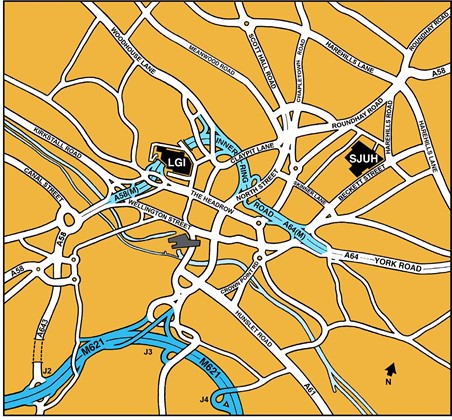

St James’s University Hospital
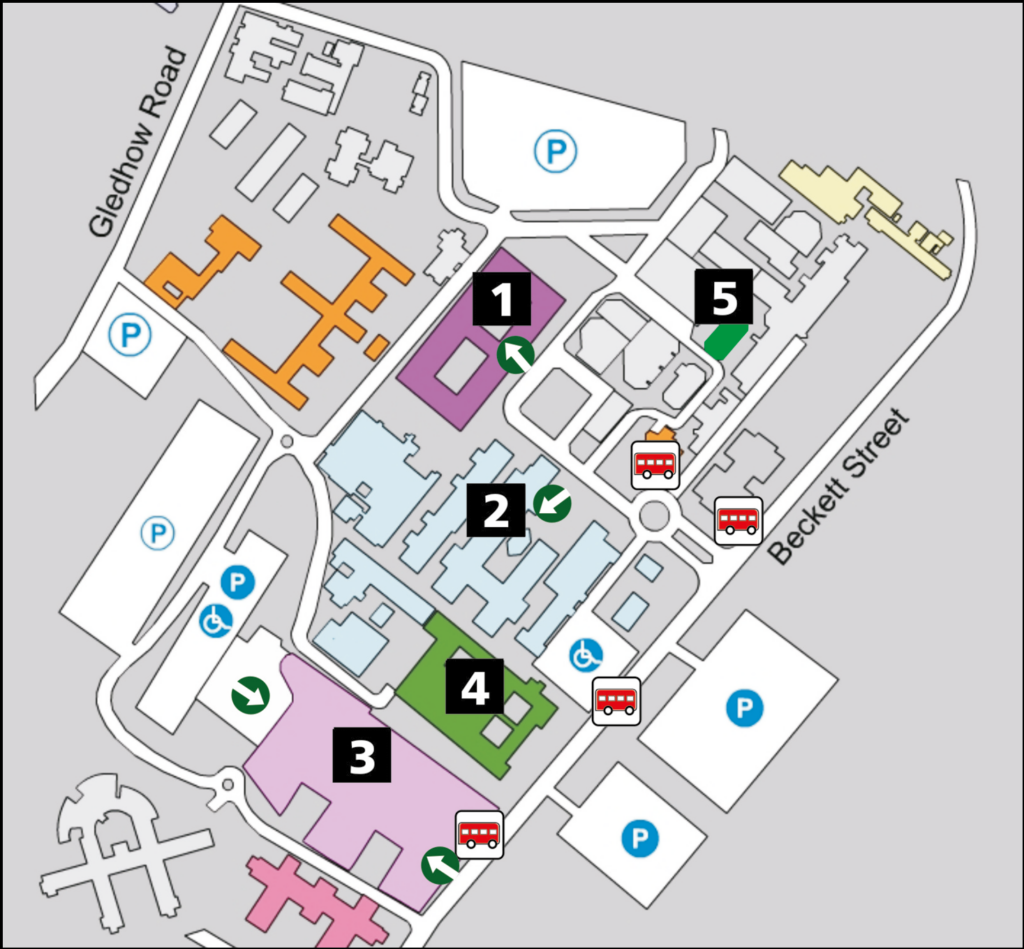
| KEY | ||
| 1. Gledhow Wing |  | Entrances |
| 2. Lincoln Wing |  | Visitor Parking |
| 3. Bexley Wing |  | Disabled Parking |
| 4. Chancellors Wing |  | Staff Parking |
| 5. Robert Ogden Centre |  | Bus Stops |