
It will be given to you in addition to the information you will receive from your Clinical Oncologist (who is a specialist doctor in cancer treatment). Their team will be caring for you during your treatment. Whilst it doesn’t cover all issues, it is intended as a guide to help you understand more about this particular treatment and the procedure involved. It also explains the side-effects which you may experience during and after treatment.
You will have the opportunity to discuss your treatment beforehand with your consultant.
Each person’s treatment will vary, so the information given is a general guide. The healthcare team looking after you will explain your treatment and the side-effects in detail. If you have any questions after reading this leaflet, please speak to the team looking after you or ring the numbers at the end of leaflet. Staff will make every effort to meet your individual needs or will direct you to the person who can help.
Please do not bring any valuables into hospital with you as the Trust cannot accept liability for loss or theft.
What is brachytherapy?
Brachytherapy uses a small radioactive source which can be placed close to or within the tumour using a special applicator. The treatment area receives a high dose of radiation whilst the dose to surrounding normal tissue is lower.
It may be necessary to give the treatment once or twice and is usually given following a course of radiotherapy or in combination with surgery.
Your consultant will explain which treatment is best for you.
What does the treatment involve?
At your clinic appointment we will organise you to have a blood test and ECG (heart tracing).
It you are taking any medication to thin your blood, (anti-coagulants) you will be advised as to when to stop taking these before the procedure.
The day before your first treatment you will be invited to have a camera scope test (colonoscopy) to look at your rectum.
This takes place in Radiology (X-Ray Department) who will give you an appointment time and the relevant information for this procedure,
During this procedure we will place a couple of small metal clips into the wall of your rectum. This helps us to accurately position the treatment applicator prior to your brachytherapy treatment.
Brachytherapy treatment
The brachytherapy radiographers will have also contacted you to let you know your treatment dates. They will also check the dates you have been given to stop any medication and discuss fasting instructions with you.
For you to have this treatment it will be necessary for you to have a spinal anaesthetic. This allows the clinician to accurately position the applicator in the rectum and ensures that you remain comfortable and relaxed as possible until the applicator is removed after your treatment.
Fasting Instructions before each treatment
You should have a light evening meal and drink clear, still, unflavoured water up to two hours before your procedure.
At 6.00am you should drink 250mls unflavoured water.
Solids and drinks containing milk should not be consumed from midnight on the day of your procedure.
You will be asked to arrive in the Brachytherapy Department, Level -1 (minus 1) for 7.30am on the morning of the procedure. You will be admitted by the theatre staff into the department and will be seen by an anaesthetist.
Theatre
You will lay on your back on the theatre table, with your legs elevated in leg rests. A catheter will be placed in your bladder. A mobile X-Ray unit will be used to ensure that the treatment applicator is positioned correctly. Once in place the applicator will be secured so it doesn’t move.
You will then be transferred on a trolley to our recovery room. You will be laid on your back and will not be able to move around as this could result in the tube moving. The catheter will drain any urine from your bladder.
Once you are comfortable, you will be taken on a trolley to our radiotherapy department, where you will have a CT scan; this enables us to accurately plan your treatment.
Whilst the treatment plan is being carried out and verified, you will be transferred back to the theatre recovery area, where you will be cared for by theatre staff.
Once planning has been completed and verified, you will be moved to the treatment room. The radiographers will explain the procedure and treatment time.
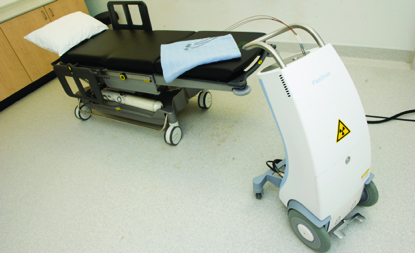
Treatment Room
The treatment will take approximately ten minutes. Whilst your treatment is being given, you will be in the room, alone, but the brachytherapy radiographers will monitor you using a closed circuit TV. (CCTV). This CCTV is not recording or saving any images. There is also a two-way intercom system so the radiographers can talk to you and you can talk to them.
The treatment only takes a few minutes but you will be in the treatment room for about 15-30 minutes. The machine stops automatically after your prescribed dose of treatment has been given. The radiographers can stop the machine at any time if needed. You do not feel anything.
Once your treatment is complete, the radiographers will remove the applicator, and depending on how much feeling you have in your legs, your catheter may be removed, otherwise it will be removed by the recovery nurse. You will then be taken back to the recovery room where you can have something to eat and drink.
You will be discharged home once you have regained feeling in your legs and feet, can walk unaided and have passed urine. You will need to have an adult to be with you overnight, and you cannot drive for 24 hours after your procedure.
Side-effects
Side-effects can be divided into short term (acute) effects that happen during or soon after treatment and long term effects occurring months or years later. Some side-effects are common, whilst others are rare. The area and amount of treatment given to you will affect which side-effects are most likely to happen to you. Your oncologist will discuss this with you. If you develop any radiotherapy side-effects you will be given advice and support by your healthcare team.
You may expect to have a discharge and/or slight bleeding from your rectum for a few days after the treatment. This might not start straight away and can continue for 4 to 6 weeks. You are highly likely to experience pain and soreness inside your rectum, especially during/after a bowel movement. You can take painkillers for this. You may experience loose or more frequent bowel movements (diarrhoea) after your treatment. If this becomes a problem for you, sometimes a medication such as loperamide (also called Imodium) can be helpful.
Good hygiene around your rectum is very important. You should take a daily bath where possible, gently washing the area. Sometimes, bathing the area with a mild solution of sodium bicarbonate (half a teaspoon to a pint of warm water) may be soothing.
When will I see the doctor again?
The doctor will want to see you about 6 to 8 weeks after the treatment has finished. An appointment will be posted to you.
Student radiographers
The radiotherapy department is a training centre for male and female therapeutic radiographers. They are supervised at all times. If you do not wish students to be present, please speak to a member of staff. This will not affect your treatment or care.
Contact numbers
Hotel Bexley Wing
The hotel is located on the 8th floor of Bexley wing and offers single and double rooms each with an en-suite, tea and coffee making facilities and digital television. Single rooms with wheel chair access are also available. 23 Patients are able to stay free of charge. There is a charge for relatives if they are staying in their own room. For further details please contact the Hotel Co-ordinator on 0113 206 7687. Out of hours please contact the Non-surgical Oncology Nurse Practitioner through main switch board on 0113 243 3144.
Car Parking Parking for radiotherapy planning and treatment is free.
On entering the car park take a ticket and park as usual (disabled parking spaces are on Level 0). When exiting use the left hand lane next to the ticket office.
Take your parking ticket and appointment letter to the attendant.
They will process your ticket so that when you insert it at the barrier no charge will be made.
If you need assistance or are unable to leave your car please press the button on the barrier.
Research at Leeds Cancer Centre
The Institute of Oncology at Leeds Cancer Centre is a major centre for cancer research. You may be asked if you would like to help with some of the clinical studies. You are under no obligation to take part in any trials, and your treatment will not be affected in any way if you do not wish to take part.
If you do take part in a clinical trial you may meet a research nurse or radiographer who will be helping to run the trial.
Further information and support
If you have any questions please ask your hospital team. We all have our own ways of coping with difficulties.
Some people have a close network of family and friends who provide emotional support. Others would rather seek help from people who are not involved with their illness.
The following are also available as sources of information and support that you may wish to use.
Local Support Services
Leeds Cancer Support
Leeds Cancer Support complements care provided by your clinical team. We offer access to information and a wide range of support, in a welcoming environment for you, your family and friends.
We can be found in the information lounges in Bexley Wing and also in the purpose-built Sir Robert Ogden Macmillan Centre (behind the Thackray Medical Museum).
The Sir Robert Ogden Macmillan Centre
This centre offers a variety of free health & wellbeing and supportive therapies for patients, their family members, and carers. These include hypnotherapy, mindfulness coaching, acupuncture (for hot flushes) and pilates.
Live Through This
A cancer support and advocacy charity for the LGBTIQ+ community.
Email: [email protected]
Website: https://outpatients.org.uk/
Maggie’s Centre
If you or someone you love has cancer you may have lots of questions. Maggie’s is a warm, welcoming place where you can meet people who are experiencing similar things to you.
You may also be able to find support groups specific to your needs and get advice and information from their professional staff.
You don’t need an appointment and all support is free.
Open Monday to Friday 9.00am – 5.00pm. Telephone: (0113) 457 8364
Address: St James’s Hospital (next to the multi storey car park), Alma Street, Leeds LS9 7BE
Email: [email protected]
Website: maggiescentres.org
National Support Organisations
Macmillan Cancer Support
Freephone: 0808 808 0000, 8.00am to 8.00pm seven days a week.
A textphone service for deaf and hard of hearing people is also available.
Textphone: 18001 0808 808 0000
Website: http://www.macmillan.org.uk
Stopping smoking
NHS Free Smoking Helpline: 0300 123 1044
Monday to Friday 9am to 8pm, Saturday and Sunday 11am to 5pm.
Website: http://www.nhs.uk/smokefree
Back to top