This leaflet will be given in addition to the information you will receive from your clinical oncologist (who is a specialist doctor in cancer treatment). Their team will be caring for you during your treatment. This team will include radiographers and clinical nurse specialist, but may also include other specialist health care professionals.
The leaflet describes radiotherapy planning and treatment. It also explains the side-effects which you may experience during and after treatment.
Each person’s treatment will vary, so the information given is a general guide. The healthcare team looking after you will explain your treatment and the side-effects in detail. If you have any questions after reading this leaflet, please speak to the team looking after you or ring the numbers at the end of leaflet. Staff will make every effort to meet your individual needs or will direct you to the person who can help.
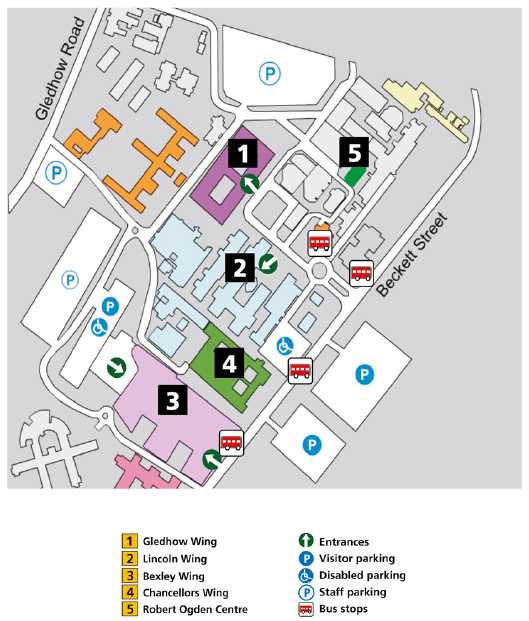
All your radiotherapy planning and treatment will take place in the Radiotherapy Department on Level -2, Bexley Wing, Leeds Cancer Centre (LS9 7TF).
Radiotherapy reception

Important
Please do not bring any valuables into hospital with you as the Trust cannot accept liability for loss or theft.
What is Stereotactic Ablative Radiotherapy?
Stereotactic Ablative Radiotherapy is the precise delivery of a high dose of radiotherapy to a tumour. It is delivered in a small number of treatments. For pancreatic tumours, patients will usually receive a total of five treatments, delivered over 2 ½ to 4 weeks. Treatment is not given during the weekends, and it will usually be given to you as an outpatient.
Treatment appointment times are approximately 45 minutes long.
Radiotherapy is the use of carefully controlled high energy X- rays to treat cancer. Treatment is given in such a way that it destroys cancer cells while doing as little harm as possible to normal cells. When you have your radiotherapy you do not feel anything and it does not make you radioactive.
It is perfectly safe for you to be with other people, including children and pregnant people, during the course of your treatment.
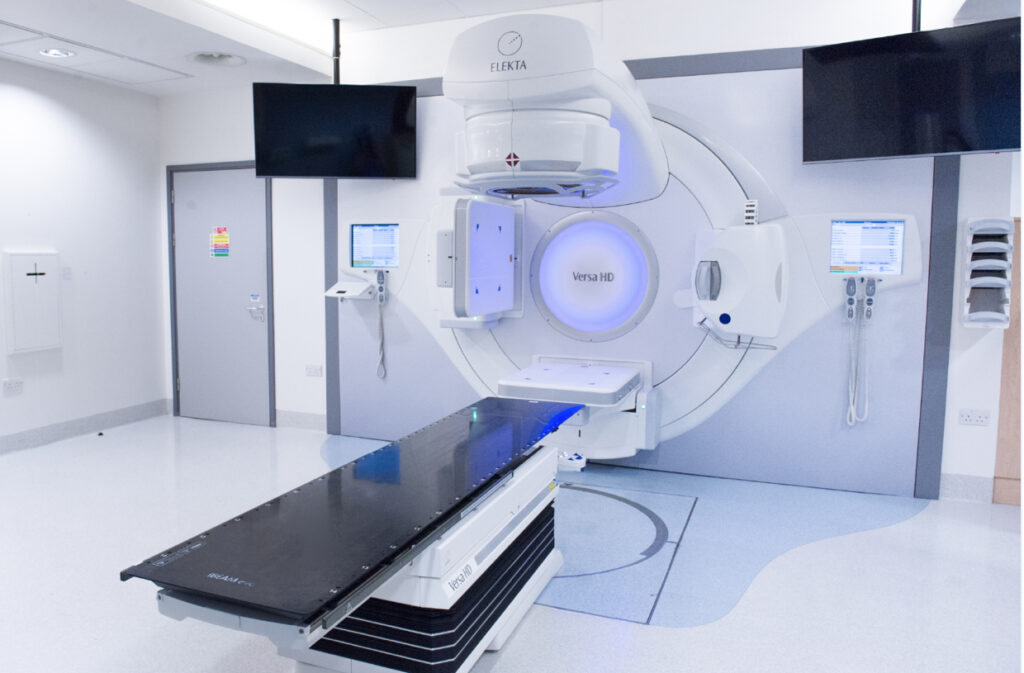
You will have your radiotherapy on a treatment machine called a linear accelerator as shown here in the photograph.
Visiting us before your treatment
If you would like to visit the radiotherapy department before starting treatment, please call 0113 206 7603. This visit can be very useful as you can find out more information about radiotherapy.
Patient quote:
“I was so pleased to see the machines before my treatment and the staff were so helpful and really put my mind at rest.”
Who will I meet?
Therapeutic radiographers
Radiotherapy is given by therapeutic radiographers of any gender. They are highly trained in the accurate planning and delivery of radiotherapy treatment. You will see your radiographers at each treatment session and they will be happy to answer any questions you may have.
Student radiographers
The radiotherapy department is a training centre for therapeutic radiographers. They are supervised at all times. If you do not wish students to be present during your treatment please speak to a member of staff. This will not affect your treatment or care.
Others involved in your care
You may meet other staff while you are coming for radiotherapy. Everyone you meet will introduce themselves, tell you their job title and explain the role they have in your care.
Important advice before your treatment
Pregnancy
It is very important that patients who could become pregnant, are not pregnant at the start of their radiotherapy course. Also, patients should not become pregnant during their radiotherapy treatment, as this can have an effect on the unborn child.
Use an effective form of contraception, for example condoms, coil, depo injection or contraceptive pill.
For more information see the ‘Contraception and pregnancy during cancer treatment’ (LN003721) leaflet.
Please do not hesitate to ask your doctor or nurse if you have any questions or concerns about these issues.
Your first appointment
Your clinical oncologist or a member of their team will discuss your proposed treatment and will give you written information.
Contact details for the Clinical Nurse Specialist (CNS) team will be provided.
Your treatment will be explained and you will be asked to sign a consent form for radiotherapy treatment. This could be at the first appointment, or during a visit afterwards if other tests or results are needed.
What to bring with you:
- A list of all questions you may have.
- An up-to-date list of all the medications you are taking (including inhalers, sprays, vitamins or herbal products).
- Any medication that you may need during your visit.
If you need any additional medications to take during radiotherapy this will be explained, for example: tablets to prevent nausea (feeling sick) or to protect the stomach/bowel lining.
Some patients may need a ‘Dimercaptosuccinic Acid’ (DMSA) scan to assess kidney function. The Nuclear Medicine department will contact you with details of this appointment if it is needed.
Planning your treatment
Your case will have been discussed at a Specialist Multi-Disciplinary Team meeting. This is to ensure that radiotherapy is the best treatment option for you.
Planning your treatment is a lengthy process. You will have to attend several appointments. This includes one or two ‘preparation’ visits which include Magnetic Resonance Imaging (MRI) and Computed Tomography (CT) scans used to plan your treatment. Occasionally they are on the same day, and you will be in the hospital for several hours.
Sometimes the doctors may decide to only perform the CT planning scan if this will provide enough information, or if you are unable to have an MRI scan.
We will contact you by phone with an appointment for your planning session. Directions to the hospital and transport arrangements will be discussed with you at this point.
Please do not eat or drink for two hours before your planning scans unless there is a medical reason not to.
What to bring with you:
- Any medication that you may need during your visit.
- Something to eat and drink and something to occupy yourself with as this first visit can be quite lengthy (may be several hours).
Deciding the most suitable position for your treatment
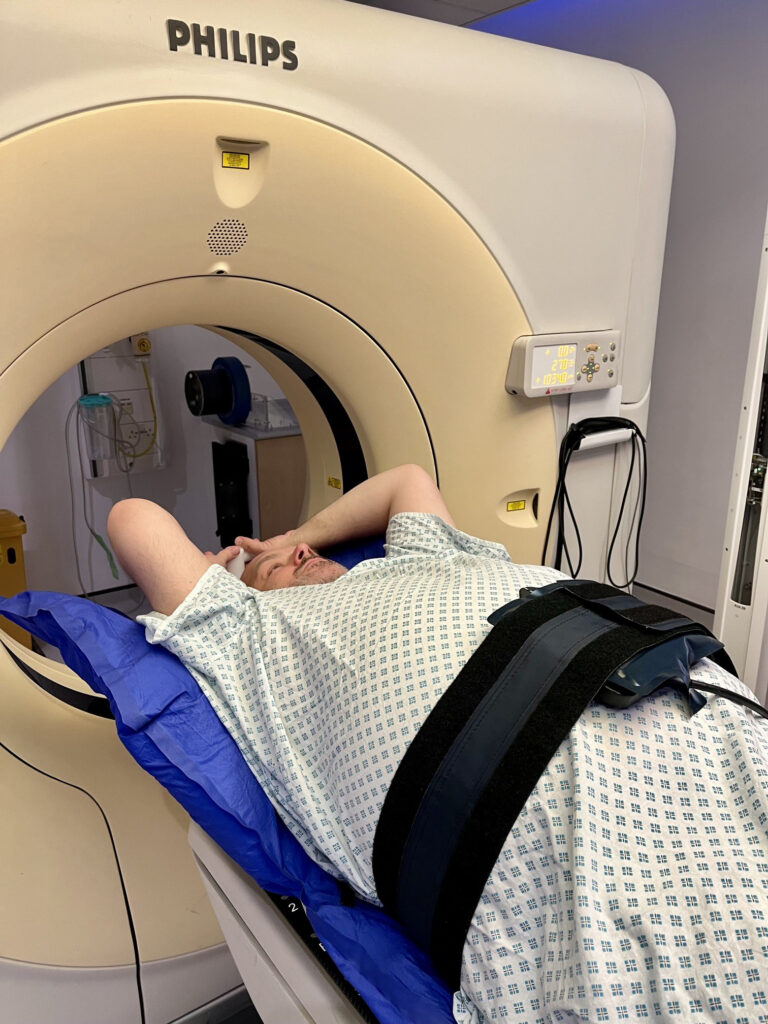
To deliver treatment accurately you will be carefully positioned for treatment. This position must be comfortable enough to enable you to stay in position for up to an hour at a time. Usually, patients will lie on their back, with arms above their head, in a custom-made support. The photo below shows a patient in this position, in front of a CT scanner. (Please note: you will need to remove all clothing above the waist for scans and treatment). If you think you may have difficulty keeping your arms above your head, please discuss this with your clinical oncologist.
Taking painkillers 30 minutes to one hour before each treatment can help. Your clinical oncologist can prescribe these if needed.
Another device may be required for scanning and treatment called an ‘Abdominal Compression belt‘. This is used to reduce the amount your tummy and pancreas moves during your normal breathing. It is not painful to position and if suitable will be used for every treatment. All planning scans and treatment are performed in the same custom made support.
MRI planning scan
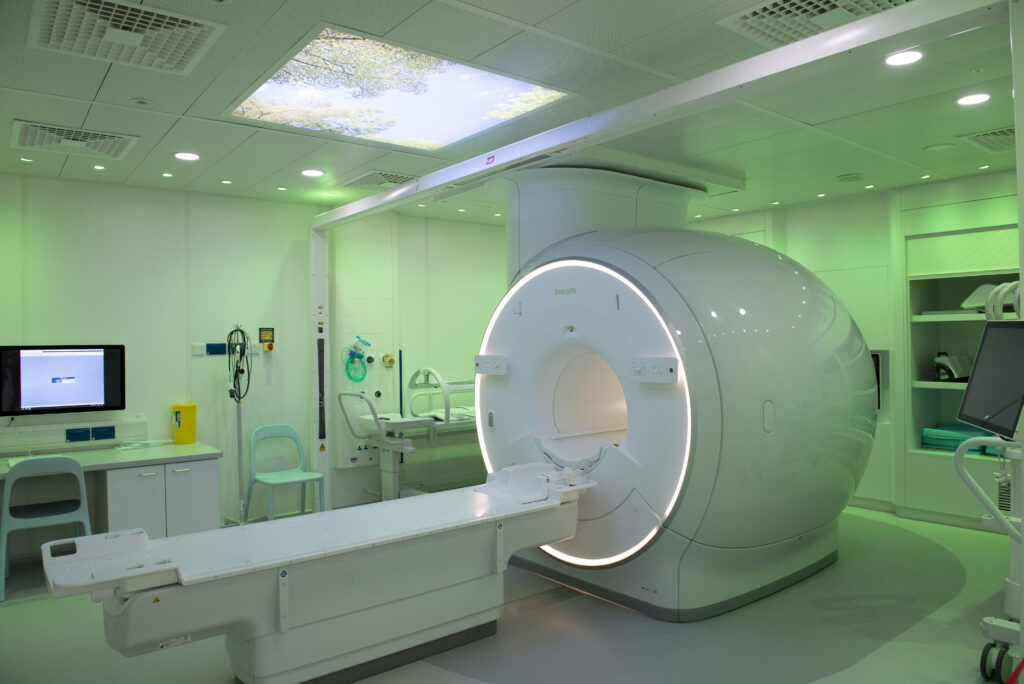
Before you enter the MRI scanner room, we need to make sure it is safe for you. This is because the MRI scanner (see photo below) contains a large magnet. You will need to remove any items that contain metal for the scan. You will lie in the same position that you will have your treatment in. We will give you some earplugs and headphones to wear as the scanner can be quite noisy. The MRI scan can take up to an hour.
During your scans, you will be asked to do special types of breathing. This includes a ‘breath hold’ procedure where you will be asked to stop breathing for short periods of time. In most cases it means holding your breath on the OUT breath. The radiographers will coach you in this and explain the process. You will not need to breath hold when having treatment, only during the planning process. This technique is used to give the best quality images to show where to target/ deliver your radiotherapy treatment.
Some of the scans may be taken while you are asked to breathe gently. If this is the case, a belt to measure your breathing will be fastened loosely around you. This is to ensure the scanner can take the scans at the right time.
Planning scans are for planning your radiotherapy treatment only. They are not reported on like other scans you may have had. Therefore you will not be given the results of your planning scans.
MRI contrast (dye)
A contrast agent, often called a dye, will be used. The dye makes it easier for the doctor to plan your treatment.
The dye is given through a very small plastic tube called a ‘cannula’ into a vein in your arm. The dye may be given before you are in the MRI scanner room, or sometimes while you are on the scanner bed.
CT planning scan
For your radiotherapy CT planning scan you will be positioned exactly as before.
You will be asked to follow the same breath hold and breathing process as for you did for your MRI scan. We will give you advice on how to manage this.
The radiographer will use a skin marker to mark your skin. This will help getting you in the right position for your scans.
Once your final scan is finished, the radiographers will use these pen marks to create up to four permanent skin marks.
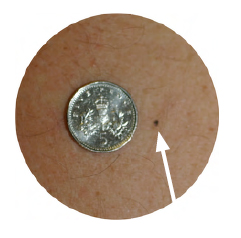
These marks are no bigger than a freckle. The permanent marks help us to ensure that you are in the same position each day. It also means that you can wash without worrying about your marks coming off.
CT Contrast (dye)
A special contrast agent, often called a dye, will be used for your CT scan. It makes specific organs, blood vessels and/or tissue types ‘stand out’. This can make it easier for the doctor to plan your treatment.
The dye is given through a very small plastic tube called a ‘cannula’ into a vein in your arm. You should tell the radiographer if you have any allergies, but they will go over this before they use any dye. The radiographers will advise you about drinking plenty of fluid after your injection.
Effects of the CT contrast
You may notice a warm feeling throughout your body and have a metallic taste in your mouth. You may also feel as if you have passed urine. This will pass very quickly. There is a small risk of an allergic reaction to the injection, such as a skin rash, but this very rarely leads to other complications.
The staff in the radiotherapy department are highly trained to manage any complications. You will be able to drive your car or go to work after your scan.
Your treatment appointments will be confirmed when you attend for your radiotherapy planning scan.
Having your treatment
When you arrive for your treatment you should go to the radiotherapy main reception desk at the entrance of the radiotherapy department. On the first occasion you will be given a list of all your appointments and be escorted to the waiting area for your machine. The radiographers will explain what will happen and answer any questions that you may have.
You will need to fast two hours before every treatment and may need to drink a cup of water just before your treatment starts. A team of radiographers work together in the treatment room. You will hear them giving each other instructions and information relating to your treatment.
The radiographers will position you in the same way as during the planning appointments. One or more ‘scans’ will also be taken in the treatment room. You will notice the machine rotating around you several times for these scans and for treatment. It will pass close to you, but will never touch you.
The scan images generally do not monitor your condition but are purely for treatment accuracy.
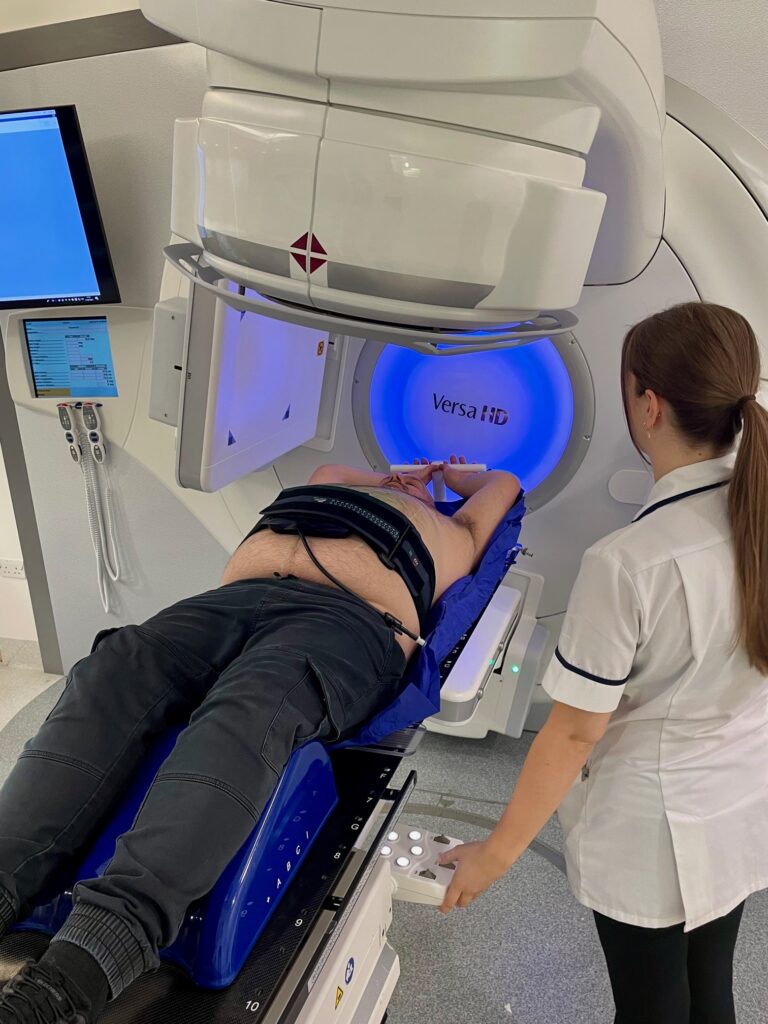
It is important that you stay as still as possible and continue to breathe normally. The radiographers will leave the room whilst you are having the scans and treatment, but will be monitoring you on the closed circuit TV (CCTV) monitors.
The machine stops automatically after your prescribed dose of treatment has been given. The radiographers can stop the machine at any time if needed. The treatment machine makes a buzzing sound when switched on. You do not feel anything.
There is an intercom system so the radiographers can talk to you when you are being treated. Some patients find this reassuring. Please let us know if you would like us to do this.
The radiographers may need to come in and out part way through each treatment. After the treatment is complete the radiographers will come back into the room.
Please note:
There may be occasions where the team decides that treatment cannot be safely delivered. This is not uncommon, and happens due to day to day changes in the internal position of your organs. This is nothing to be concerned about. Sometimes this happens on the first day when the radiographers start the session by taking a couple of ‘check’ scans. The scans may show that the radiotherapy plan needs adjusting. In this case you will be told when to attend for your next treatment appointment.
Your last day of treatment may be flexible or subject to change. It is therefore important that you check with the radiotherapy team before booking a holiday following your treatment.
The radiographers will monitor your side-effects throughout your treatment course and arrange for you to see a doctor in clinic if needed.
On some days the radiotherapy department may be busy and there may be a delay before your treatment. We will keep you informed of any delays of over 30 minutes. Please see the delay boards in the waiting areas.
Your treatments will generally be on the same machine, although there may be days when this machine is being serviced. In that case your treatment will be in a different room.
Please note
It is very important that you do not miss treatment days as it may affect the efficacy of your treatment. If you feel you are unable to attend for any reason please telephone us so that we can discuss this with you.
Radiotherapy reception
For appointment queries please telephone the radiotherapy reception desk for further advice.
Your end of treatment follow-up
One to two weeks after treatment
You will receive a telephone call from a member of the Clinical Nurse Specialist team.
Four to six weeks after treatment
You will have an outpatient appointment at Level 1, Bexley wing (St James’s Hospital) or a telephone appointment with your Oncologist. This is to discuss any side effects and
follow-up scans.
CT scan
You will have a CT scan followed by an out-patient appointment once the results are available. Your doctor will advise you how soon after treatment your scan is needed. The first CT scan is often arranged approximately three months after finishing treatment.
Creon: If you are taking a pancreatic enzyme such as Creon we would advise you to stay on these indefinitely.
Acid-reducing medications: If you are taking an acid reducing medication (such as lansoprazole, omeprazole or other equivalent medications), please continue to take this for a minimum of three to six months after you have completed your treatment.
Blood sugar monitoring: We recommend you see your GP to monitor your blood sugars. This is because there is a risk of developing diabetes or having more erratic blood sugar control if you are already a diabetic.
If you are not known to have diabetes we would recommend you have a glucose blood test approximately every three to four months following radiotherapy.
If you are concerned about side-effects or new symptoms, please contact the CNS team on the number provided.
Side-effects of treatment
Side-effects can be divided into short term (acute) effects, that happen during or soon after treatment, and long term effects occurring months or years later. Some side-effects are common, whilst others are rare.
Your oncologist will discuss which side effects are most likely to happen to you. If you develop any radiotherapy side-effects you will be given advice and support by your healthcare team.
Early Side-effects include:
Skin reaction
The skin in the treated area may become inflamed and/or sore from the second week of treatment. It may become dry and itchy.
Skin reactions are unusual with the use of modern radiotherapy techniques to treat pancreatic cancer.
Avoid hair removal where possible, including shaving, waxing, cream and lasers unless advised otherwise by your consultant, nurse or radiographer.
Before you start your treatment, a radiographer will explain what could happen to your skin and how to look after it. They will also give you a leaflet to take home.
Princess Royal Suite
If you are concerned about your skin reaction please talk to the treating radiographers or contact the nursing staff in Princess Royal Suite.

Nausea or Vomiting
This may happen at any time during the treatment course. You may be given medication to be taken before or after treatment.
Change in Bowel Habit
This also may happen at any time during the treatment course. Drinking plenty of liquid throughout the day will be useful in replacing lost fluids. Please tell the staff if you experience diarrhoea or constipation.
General tiredness (fatigue)
Nearly all patients having radiotherapy will feel tired. Be prepared to take things easy during treatment and allow for extra rests. See the booklet ‘Fatigue and pancreatic cancer’ from Pancreatic Cancer UK for tips and advice in dealing with fatigue. For support with your fatigue please ask a member of staff.
There are things you can do to help yourself
We recommend that you continue with all your usual activities. The following may also help:
- Gentle exercise can help reduce the symptoms of fatigue.
- Having enough to drink can prevent tiredness from dehydration.
- Small meals or snacks eaten more often than three times a day may help if you have a reduced appetite.
- Try to get a good night’s sleep where possible, a daytime nap may help.
- Try to ‘pace’ yourself, listen to what your body is telling you, rest if you need to.
- Pick out the things that you enjoy, and try to ask for help with other tasks.
- Little and often is the rule of thumb.
Nutrition
It is important that you are well nourished and drink plenty of fluids during your treatment. This will help to keep you healthy and to help your body to heal. You may see one of our specialist dietitians before, or during your treatment.
Longer term side-effects
These side-effects are rare, but may be permanent. Your doctors will discuss any that are relevant to you and the risk of these happening when you consent for treatment.
Steps are taken by your doctor to keep the risk as low as possible.
These side effects may include:
- Liver and/or kidney complications
- Damage to stomach/bowel – such as inflammation, ulceration or bleeding
- Development of diabetes/worsened blood sugar control
- Malabsorption
If you experience any of these side effects, or have any concerns following treatment, please contact your CNS team.
Your Clinical Nurse Specialist team
Further information and support
If you have any questions please ask your hospital team. We all have our own ways of coping with difficulties.
Some people have a close network of family and friends who provide emotional support. Others would rather seek help from people who are not involved with their illness.
The following are also available as sources of information and support that you may wish to use.
Clinical Nurse Specialists (CNS)
Your CNS is available to discuss any aspect of your treatment with you. You will be seen by, or have a telephone call with a CNS before your treatment. This is to offer support and advice about the practicalities and effects of your treatment.
Your CNS will also assess and discuss any physical, psychological, social, occupational and spiritual needs that you may have.
They can refer you to other services if needed, for instance, benefits advice. You will be given the CNS team contact details.
Macmillan Specialist Radiographer and Macmillan Radiotherapy Nurse Specialist
Sometimes people need more help if they are feeling depressed, very anxious or are having problems with their treatment. If this is the case you may benefit from seeing the Macmillan radiographer or nurse specialist.
Your oncologist, radiographer or nurse can refer you at any point before or during your treatment.
Useful organisations – Local
Leeds Cancer Support / The Sir Robert Ogden Macmillan Centre
Leeds Cancer Support complements care provided by your clinical team. We offer access to information and a wide range of support, in a welcoming environment for you, your family and friends.
We can be found in the information lounges in Bexley Wing and also in the purpose built Sir Robert Ogden Macmillan Centre (behind the Thackray Medical Museum).
The Sir Robert Ogden Macmillan Centre
The Centre is on the St James’s Hospital site and offers a variety of support services including complementary and supportive therapies.


Maggie’s Centre
If you or someone you love has cancer you may have lots of questions. Maggie’s is a warm, welcoming place where you can meet people who are experiencing similar things to you.
You may also be able to find support groups specific to your needs and get advice and information from their professional staff. You don’t need an appointment and all support is free.
Useful organisations – National
Stopping smoking
Macmillan Cancer Support
A textphone service for deaf and hard of hearing people.

Pancreatic Cancer UK
Dedicated UK pancreatic cancer charity.
OUTpatients
A cancer support and advocacy charity for the LGBTIQ+ community.
Car Parking
When you are coming for radiotherapy planning and treatment your parking is free in the on-site multi-storey car park. Please ask for more information at the radiotherapy main reception desk.
Refreshments
There is a restaurant and coffee shop available on Level 0, which are open daily. They serve drinks, light snacks and hot meals. Vending machines are also available in the main radiotherapy waiting room and Level 0. There is also a shop on Level 0 with books, papers and snacks.
Hotel Bexley Wing
Patients having radiotherapy sometimes use the hotel if they have a long way to travel. The hotel is located on the 8th floor of Bexley Wing and offers 19 twin rooms and one single room. All have en-suite, tea and coffee making facilities, a mini fridge, towels, hairdryer and digital television. There are two rooms with wheel chair access and a wet room. Patients are able to stay free of charge. There is a charge for relatives if they are staying in their own room.
Meals can be purchased (at breakfast and lunch) if you are able to make your way to the restaurant in the Bexley atrium. At other times you will need to have something you have brought from home or purchased. There is a very small fridge for your personal use. There are no staff after 3.45pm until the next morning in this facility.
Hotel Receptionist
For further details please contact the Hotel Receptionist.
How to find us
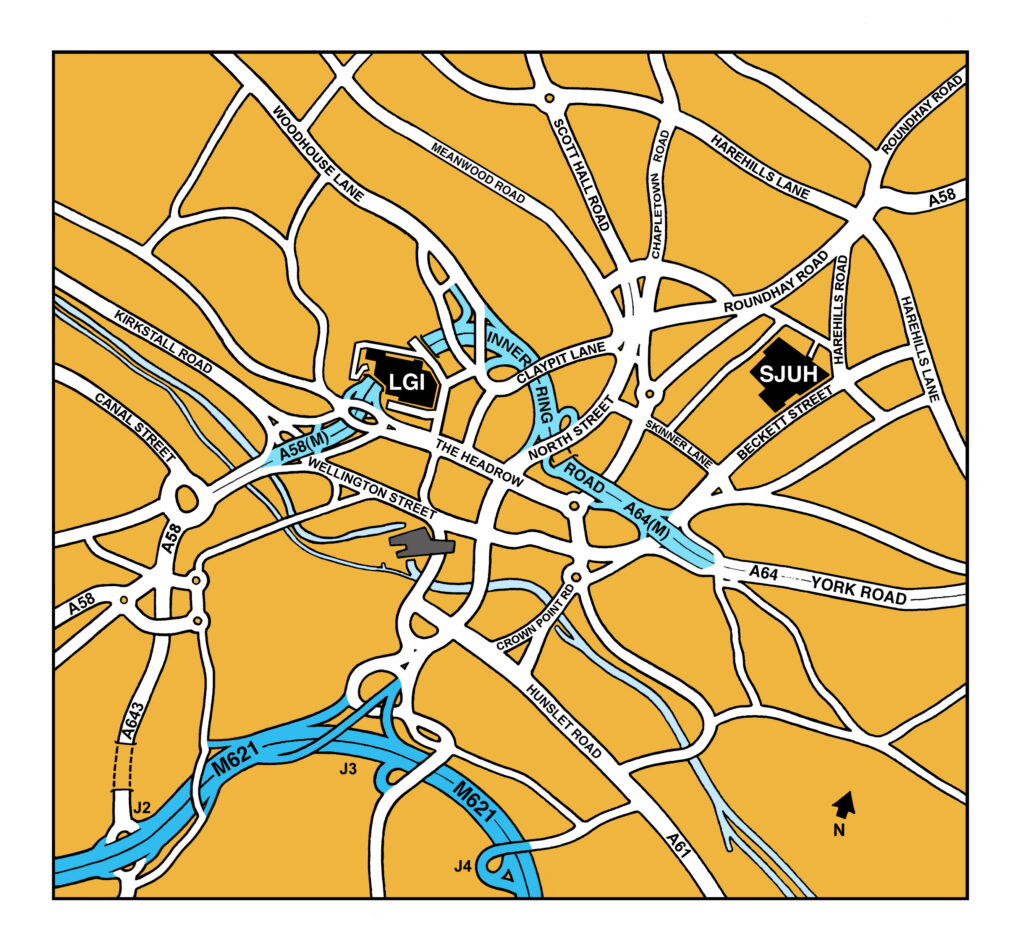
St James’s University Hospital – site plan