
Your doctor has recommended for you to undergo Testicular Vein Embolisation. This information explains what the procedure involves, the intended outcomes and the possible risks.
What is a Testicular Vein Embolisation (TVE)?
A testicular vein embolisation or varicocele embolisation is a non-surgical, permanent treatment for varicoceles that cause health issues.
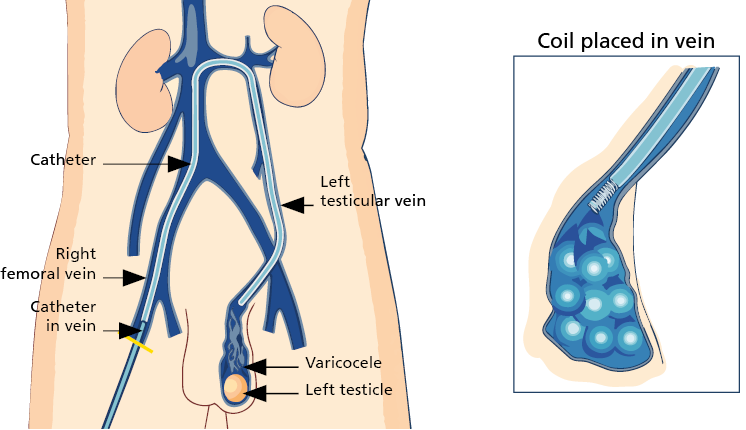
Image based on South Tees Hospital NHS Foundation Trust Illustration.
TVE is done through a small cut in the neck or the groin. We do this procedure in Interventional Radiology operating theatres. Using x-ray guidance, we carefully position a special wire and tube inside the testicular veins. This allows us to treat the affected veins.
The procedure uses special metal coils to block the affected testicular veins. We do not make any changes to the other veins in the testicles.
TVE is a day case procedure. This means that you only need to spend a short time in hospital including the post procedural aftercare recovery.
How do I prepare?
You do not need to fast for this procedure as this is done under local anaesthesia. If you are taking any blood thinning medications (such as warfarin), these may need to be stopped before the procedure. You will be given instructions about this in the pre-assessment clinic. You will be prescribed with antiseptic wash and nasal cream for 5 days prior to your operation.
How is a TVE performed?
Staff involved
Interventional Radiology (IR) procedures are performed by a multidisciplinary team. The team includes the following key Staff:
- Interventional Radiologist (Consultant/Fellow): A doctor specially trained in minimally invasive, image-guided techniques who performs the procedure
- Radiology Nurses: Highly trained nurses who care for the patient before, during, and after the procedure. They assist with sedation, monitor vital signs (heart rate, breathing, oxygen levels), and may “scrub in” to assist the radiologist directly.
- Radiographers: Experts in imaging equipment who operate the machines to provide real-time guidance for the doctor.
- Senior Clinical Support Workers (SCSWs): Assist with the setup of the room, patient positioning, and maintenance of sterile conditions.
What are the risks?
TVE is a safe, minimally invasive procedure, but as with any medical procedure there are some risks and complications that can arise.
- There may occasionally be a small bruise around the site where the thin tube (sheath) has been inserted into the vein. This will heal in a week or two.
- A few patients may experience mild discomfort in the loin or scrotum afterwards which rarely lasts more than a few days.
- There is a very small risk of a coil, used to occlude the vein, could migrate to your lungs. If this happens and it cannot be retrieved it is very unlikely to cause any problems other than a cough and mild chest pain for a few days.
- Unfortunately, there is a possibility that the varicocele may return. This may also happen after any surgical treatment. If this happens, then the procedure may be repeated, or you may be advised to have an operation.
- Allergic reaction to contrast dye (mild symptoms like nausea, itchiness and rashes occur in 3%; moderate to severe symptoms such as severe vomiting, bronchospasm occur in less than 1%; risk of death is rare, estimated at 1:170,000)
- X-rays will be used to make images of your body and guide your doctor during the procedure. X-rays are a type of radiation. We are all exposed to low levels of natural radiation as part of our everyday lives and medical x-rays give an extra dose of radiation. Radiation can increase your chances of developing cancer many years or decades after the exposure. The chances of this happening to you as a result of this procedure are considered to be very low.
- It is important to remember that your doctor thinks that the benefits of this procedure outweigh any risks from the radiation. We will make sure that the amount of radiation used in your procedure is as low as possible.
What to expect from this operation?
Care at home
After a TVE, you will generally be discharged with specific instructions to rest and take it easy following your operation.
- Exercise – take it easy and avoid strenuous activity for at least 24 hours. You should take things easy for the rest of the day with no strenuous exercise or sexual activity
- Work – you can go back to work the following day as long as you avoid any heavy lifting on your work
- Driving/travel – you should not drive for 24-48 hours and make sure you have someone with you for the first 24 hours.
- Medicines – you may take pain medications (like paracetamol) for discomfort, but you should only take them as recommended. Your doctor will tell you when you can resume any blood thinning medications if you take any.
- Follow-up – you may have follow-up appointment with your referring doctor after a few weeks.
- Please seek immediate medical attention if you experience severe symptoms such as signs of infection (fever, chills, redness, swelling, warmth, or pus at the puncture site); bleeding from the site that doesn’t stop with pressure; severe pain at the puncture site.
Contact information
We hope some of your questions have been answered by this leaflet. If there are any questions you would like to ask before you come for your operation, please get in touch.
Interventional Radiology (St James’s University Hospital)




How to get to our department
We are located in the Lincoln Wing of St James’s University Hospital, Ground Floor. Check this link to see how to get to us.
www.accessable.co.uk/leeds-teaching-hospitals-nhs-trust/st-james-s-university-hospital/access-guides/lincoln-wing Back to top