

What is von Willebrand’s disorder?
Von Willebrand’s disorder (vWd) is a condition that affects blood clotting. People with vWd may bleed from cuts for longer than normal, although they do not bleed any faster than normal, and the bleeding does eventually stop.
The severity of vWd varies, but it usually affects people only mildly. Therefore, most people with vWd live completely normal, active lives.
What goes wrong in blood clotting?
There are proteins and cells in blood that make it clot. When a blood vessel is cut, these proteins and cells become active and quickly form a blood clot to seal the cut and stop the bleeding.
In people with vWd, one of the clotting factors, called von Willebrand’s factor (vWf), is missing or does not work properly. Therefore, blood clotting is less efficient than usual.
People with vWd usually have some vWf in their blood, just lower levels than normal. In these people, the disorder is only mild, and the common symptoms are easy bruising, frequent and sometimes severe nose bleeds and, in women, heavy periods. People with severe forms of vWd have little or no vWf in their blood.
This can cause symptoms like those of haemophilia, such as bleeding into the muscles and joints. This is, however, a rare condition.
vWd is inherited
vWd is usually passed on from parents to their children through an abnormal gene. Unlike haemophilia (which is passed on by women and only affects men), vWd affects both women and men, and can be passed on from either the mother or father. Other genetic factors such as blood group can also influence the levels of von Willebrand’s clotting factor.
There are constant reviews as to how vWd is inherited. The current thinking is as follows:
The gene for vWf is very large and a variety of mistakes in it can produce vWd. The abnormal gene that causes vWd is usually “dominant” over its other copy. This dominant inheritance produces variable results – it cannot be predicted that all affected individuals will be affected to the same degree.
Inheritance of the dominant vWd gene
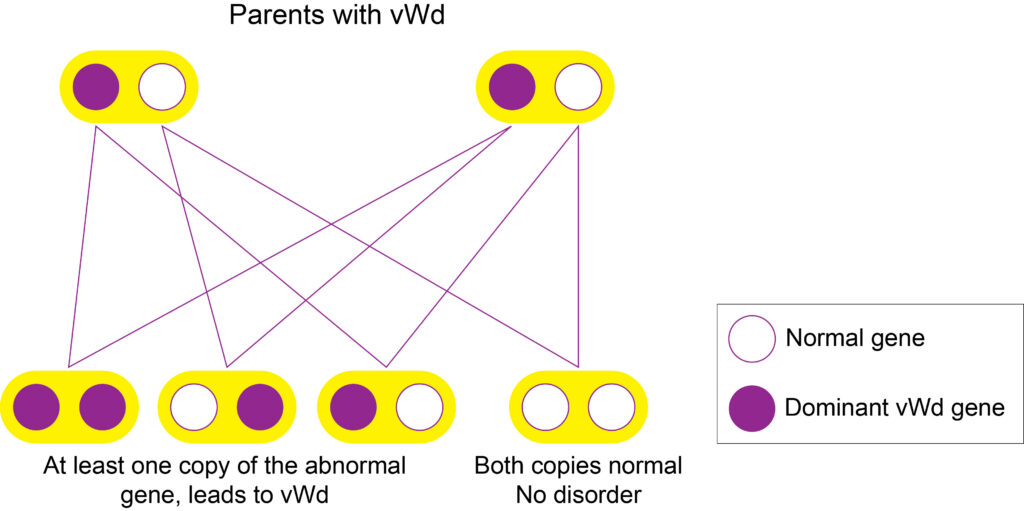
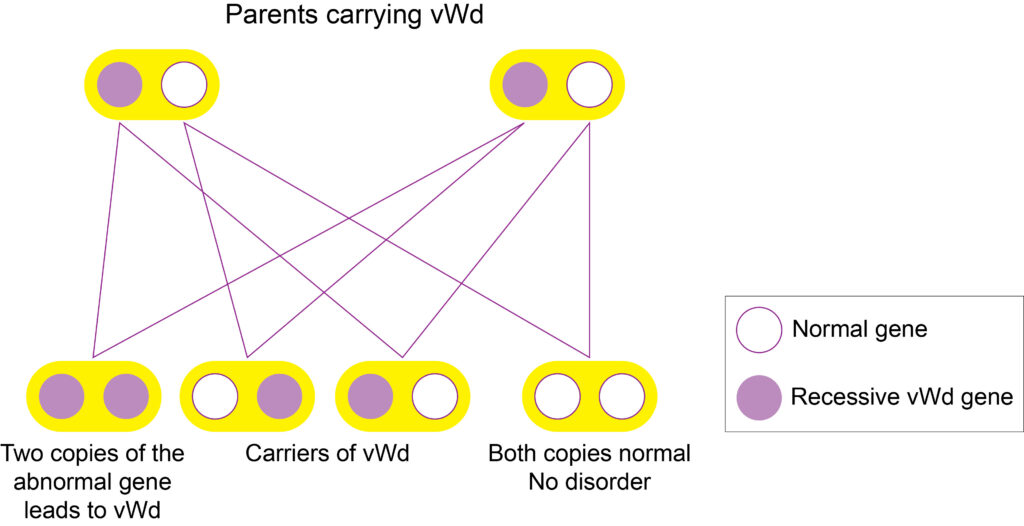
Rarely, the gene for vWd is hidden (“recessive”). In this case, it is possible for parents who do not have vWd to carry it and pass it on to their children. For the recessive gene to produce vWd, a person must have two copies of an abnormal gene, and this usually produces severe disorder.
Inheritance of the recessive vWd gene
Diagnosis of vWd?
Because vWd is usually mild, many people do not experience any problems, and the condition may be undiagnosed for a long time.
Often, the first indication that there may be a problem with blood clotting comes after a minor operation, such as a tooth extraction.
Once the problem is suspected, doctors can conduct blood tests to diagnose the disorder. These tests measure the time that blood takes to clot and the levels of clotting factors present and compares them with those in people known not to have vWd.
A personal and family history will also be taken from the patient, which may give clues to clotting problems in the past, or in relatives.
The diagnosis may be complicated and take some time because many people with vWd have levels of clotting factors in their blood that are borderline. Worrying about going to hospital and having a blood test can also make these levels increase. Therefore, several different tests may be needed to make a final diagnosis and this can take time, and repeat tests are often needed to clarify the diagnosis in mild cases.
Treatment of vWd
Most people with vWd do not need any treatment from day to day.
When it is required, there are three main sorts of treatment available, although all the treatments do not suit everyone.
- Tranexamic acid can be used to treat small but persistent bleeds (e.g. nosebleeds). This medication is taken by mouth, and acts by slowing the breakdown of clots (a process that starts as soon as clots are formed).
- Desmopressin can also be used to treat minor bleeds (including small operations). This medication is given either into a vein or as an injection under the skin. A trial with Desmopressin is usually performed to ensure that there is a rise in the von Willebrand levels as it is not always effective for everyone.
- In patients who are bleeding severely (e.g. after an accident) or require major surgery, or who have a severe form of vWd, concentrated vWf can be given. This is given by injection into a vein, and it replaces the missing vWf, so blood clotting takes place at the normal speed.
Key facts
- vWd is a condition that prevents blood clotting normally.
- People with vWd bleed for longer than usual, but do not bleed any faster.
- The severity of the disorder varies, but it is usually only mild.
- Common symptoms are frequent – nosebleeds, easy bruising and heavy periods.
- The disorder is passed on through an abnormal gene, which can be inherited from either the mother or the father, and affects both male and females.
- vWd is diagnosed by examining family and personal history, and by conducting blood tests.
- Diagnosis can take a long time, particularly if the disorder is only mild.
- Treatment is not often needed, but when it is, several options are available.