
A pancreatic digestive enzyme that appears unchanged in the faeces. Low concentrations are found in patients with exocrine pancreatic insufficiency.
Container / Tube
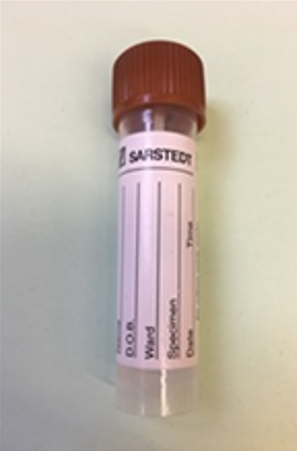
Faeces container.
Collection Conditions
A single random formed stool sample approx. 2 g (cherry-sized). Avoid very watery or very hard stools where possible.
Instructions for laboratory: Refrigerate or freeze if not sending same day. Avoid multiple freeze-thaw cycles. Samples are stable at room temperature and at +4 to 8ºC for 7 days. Samples that are frozen at -20ºC are stable for up to 1 year.
Availability
Weekdays. Batches are run weekly.
Send to
Enterics Laboratory, Microbiology Department, Centre for Laboratory Medicine, St James’s University Hospital, Beckett Street, Leeds, LS9 7TF.
Turnaround Time
2 to 3 weeks.
Additional information
Elastase not fully developed in new-borns. Not useful in identifying mild disease. Very watery samples should be avoided because the dilutional effect of the stool water can lead to a falsely low result. If a low result is found in a watery sample, a repeat sample will be requested by the laboratory. Very hard / dry stool samples cannot be processed.
Reference Range Notes:
Normal: 200 to >500 ug/g stool.
Moderate to mild exocrine pancreatic insufficiency: 100-200 ug/g stool.
Severe exocrine pancreatic insufficiency: <100 ug/g stool.
Units: ug/g (stool)
ID
29947