
Cookie settings

We use some essential cookies to make this website work.

We’d like to set additional cookies to understand how you use www.leedsth.nhs.uk, remember your settings and improve our services.

We also use cookies set by other sites to help us deliver content from their services.

View cookies
You have accepted additional cookies. You can change your cookie settings at any time.
You have rejected additional cookies. You can change your cookie settings at any time.
Skip to main content
Leeds Teaching Hospitals NHS Trust logo
  • About us
  • News
  • Patient resources
  • Careers
  • Contact
  • Charity
  • Reachdeck
  • Home
  • Hospitals

    Our hospitals

    • Leeds General Infirmary
    • St James’s University Hospital
    • Leeds Children’s Hospital
    • Leeds Dental Institute
    • Chapel Allerton Hospital
    • Seacroft Hospital
    • Wharfedale Hospital

    Want to rearrange an appointment?

  • Patients and visitors

    Patients and visitors

    • Is it an emergency?
    • Martha’s Rule – Call 4 Concern
    • Visiting times
    • Appointments
    • Information for visitors
    • Get involved
    • Preparing to come to hospital
    • Patient resources
    • Help and support
    • Make a payment

    Is it an emergency?

  • Services

    Search services

    • A
    • B
    • C
    • D
    • E
    • F
    • G
    • H
    • I
    • J
    • K
    • L
    • M
    • N
    • O
    • P
    • Q
    • R
    • S
    • T
    • U
    • V
    • W
    • X
    • Y
    • Z
    • 0-9
  • Consultants

    Search consultants

    • A
    • B
    • C
    • D
    • E
    • F
    • G
    • H
    • I
    • J
    • K
    • L
    • M
    • N
    • O
    • P
    • Q
    • R
    • S
    • T
    • U
    • V
    • W
    • X
    • Y
    • Z
    • 0-9
  • Research

    Research

    • Our Research
    • R&I Annual Conference 2025
    • Innovation Pop up
    • Be Part of Leeds Research
    • For Researchers
    • Research Academy
    • Contact us
  • Home
  • Our hospitals

    Hospitals - overview
    • Leeds General Infirmary
    • St James’s University Hospital
    • Leeds Children’s Hospital
    • Leeds Dental Institute
    • Chapel Allerton Hospital
    • Seacroft Hospital
    • Wharfedale Hospital

    Want to rearrange an appointment?

  • Patients and visitors

    Patients and visitors - overview
    • Is it an emergency?
    • Martha’s Rule – Call 4 Concern
    • Visiting times
    • Appointments
    • Information for visitors
    • Get involved
    • Preparing to come to hospital
    • Patient resources
    • Help and support
    • Make a payment

    Is it an emergency?

  • Search services

    Services - overview
    • A
    • B
    • C
    • D
    • E
    • F
    • G
    • H
    • I
    • J
    • K
    • L
    • M
    • N
    • O
    • P
    • Q
    • R
    • S
    • T
    • U
    • V
    • W
    • X
    • Y
    • Z
    • 0-9
  • Search consultants

    Consultants - overview
    • A
    • B
    • C
    • D
    • E
    • F
    • G
    • H
    • I
    • J
    • K
    • L
    • M
    • N
    • O
    • P
    • Q
    • R
    • S
    • T
    • U
    • V
    • W
    • X
    • Y
    • Z
    • 0-9
  • Research

    Research - overview
    • Our Research
    • R&I Annual Conference 2025
    • Innovation Pop up
    • Be Part of Leeds Research
    • For Researchers
    • Research Academy
    • Contact us
  • About us
  • News
  • Patient resources
  • Careers
  • Contact
  1. Home
  2. Services
  3. Pathology
  4. Pathology tests & tubes
  5. Methanol

Methanol

A common contaminant of illegal alcohol products and many fluids which can be ingested by accident or in cases of self poisoning. PLEASE CONTACT THE DUTY BIOCHEMIST BEFORE SENDING SAMPLES (Ext: 26922 or Bleep 2607 between 9am and 5pm, out of hours please contact Consultant on call via switchboard). Sample type required: fluoride oxalate whole blood.

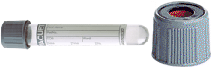
Tube

07 (FP) – Fluoride Oxalate Plasma

ID

Tests&Tubes0215

Additional Information

Methanol is directly toxic due to its suppressive effect on the central nervous system. Methanol is metabolised by alcohol dehydrogenase to formaldehyde, and then by aldehyde dehydrogenase to formic acid. Methanol poisoning can cause visual disturbance, and as little as 4 mL methanol has been reported to cause blindness. However the usual dose reported to cause ocular toxicity in an adult is 30 mL, with 60 mL the usual minimum fatal dose. Symptoms of visual disturbance may be delayed by up to 24h. Formic acid can cause a profound metabolic acidosis. Therapy for methanol poisoning is aimed at blocking the action of alcohol dehydrogenase by administration of ethanol, which is the preferred substrate, or Fomepizole, a competitive inhibitor of the enzyme. Dialysis may also be required to remove methanol and its metabolites and to provide renal support. Morbidity and mortality do not correlate directly with initial methanol concentrations; patient outcomes are significantly better for patients who are treated promptly. Samples for Methanol measurement should be collected before treatment is started and treatment should not be delayed pending a result. Severe clinical effects are associated with concentrations > 500 mg/L although formate concentrations may be a better indicator of potential toxicity than methanol concentrations alone. Symptoms are as follows: 30 to 120 mins post ingestion – clinical effects resemble those of mild ethanol inebriation with drowsiness, confusion and irritability. After a latent phase of between 6 and 30 hours symptoms include dizziness, drowsiness, vomiting, severe abdominal pain and diarrhoea. In severe cases a marked anion gap acidosis will be present and tachypnoea is common as result. Coma and convulsions may also occur. Treatment requires nasogastric aspiration or gastric lavage.

Turn around

Turnaround time stated by Birmingham City Hospital: 24h (from arrival of sample in Birmingham)

Send to

Blood Sciences LGI
(Test referred to: Birmingham City Hospital toxicology lab. )

Collection Con

Minimum Volume: 0.5ml. EDTA plasma and serum also acceptable. Instructions to lab: DO NOT CENTRIFUGE. Contact the Duty Biochemist (or on-call consultant) to discuss request.

Sample REQ

Blood

Share this page

Leeds Teaching Hospitals NHS Trust logo

Telephone

0113 2432799

Switchboard open 24 hours

Quick links

  • Hospitals
  • Patients and visitors
  • Patient resources
  • Patient Feedback
  • Our Partners
  • Contact

Support our charity

Leeds Hospital Charity Logo

Follow us

Visit us on YouTube Visit us on Linkedin Visit us on Facebook Visit us on Instagram
  • Contact
  • Accessibility
  • Privacy
  • Cookies
  • Terms and conditions
  • Staff intranet
  • Information Governance

Copyright © 2026 Leeds Teaching Hospitals NHS Trust.

Lovingly crafted by Mixd