
Radiotherapy Department
The Leeds Cancer Centre’s Radiotherapy Department, based in the Bexley Wing at St James’s University Hospital.
Welcome to Leeds Radiotherapy
Welcome to Leeds Radiotherapy department, based in the Leeds Cancer Centre at St James’s Hospital.
Hello, my name is Courtney and I am one of the radiographers here at Leeds.
This video aims to give you a general overview of what to expect when you come for your Radiotherapy appointments.
You will meet many different professionals from a wide range of genders and backgrounds.
Depending on which type of transport you take, you will be entering the Bexley Wing at St James’s Hospital via one of two entrances.
There is a bus stop at the Beckett Street entrance, or If you are coming by car you can park for free in the multi-storey car park which is directly opposite the main Bexley Wing entrance.
We are situated on level minus 2, which means you will need to walk through the Main Atrium and take a green lift down two floors.
For each appointment in Radiotherapy, please check in at our Main Reception, giving the receptionist your name, date of birth and address.
Depending on your diagnosis and treatment plan, you may have a CT planning scan, or an MRI planning scan, or both. They allow us to plan your Radiotherapy treatment, and are not for diagnostic purposes.
When it is your turn to go for your planning scan, a staff member will call your name, introduce themselves and walk with you towards the scanner rooms.
For some areas of the body, you may have to do a preparation procedure before going in for your scan. Your consultant may have requested a CT scan with contrast, and for this you will be cannulated first. Staff will discuss this with you. If you have any questions, please ask.
At your planning scan staff will take an ID photo, and you will be given a letter informing you when your first radiotherapy treatment will be.
This can sometimes be up to two weeks after the planning scan.
You may be asked to remove some of your clothing, but we will try to keep you covered as much as possible.
For the scan, you will lie on the couch in a position that will be the same as when you come for treatment.
The radiographers will take measurements and draw some pen marks on your skin.
It is important to stay still and breathe normally as you will move in and out of the scanner a few times.
Once the radiographers are happy that you are in the right position, they will leave the room. They will start scanning but will always be watching you. The scan itself usually only takes a few minutes.
After the scan the pen marks that we have drawn on you may be replaced with permanent dots, although for some patients – depending on their diagnosis – there will be no permanent dots.
Some Radiotherapy treatments are planned using data from MRI scans. The MRI radiographers will explain everything to you before you go in, and they will talk you through the process as they go along.
If you are having your head, neck or the very top of your lungs treated, you may need to have a mask made before you go in for your planning scans. This mask needs to be worn for both planning scans and treatment.
The Mould Room technicians will explain everything to you when you go in.
It is not a long procedure and usually takes less than ten minutes.
For treatment to other parts of the body a mask is generally not needed.
Once the mask is made, you are ready to go for your planning scan.
Following your planning scans, the physicists and dosimetrists work together with your consultant to create your individual radiotherapy plan.
On your first day of treatment, please report back to our Main Reception. We have twelve treatment machines, spread over three waiting areas.
You will be given a list with all your radiotherapy appointments.
Treatment is usually given Mondays to Fridays, although there can be some variation in people’s schedules. We may sometimes also treat on a Saturday or Sunday around Bank Holidays.
A volunteer may be available to show you to your designated waiting area.
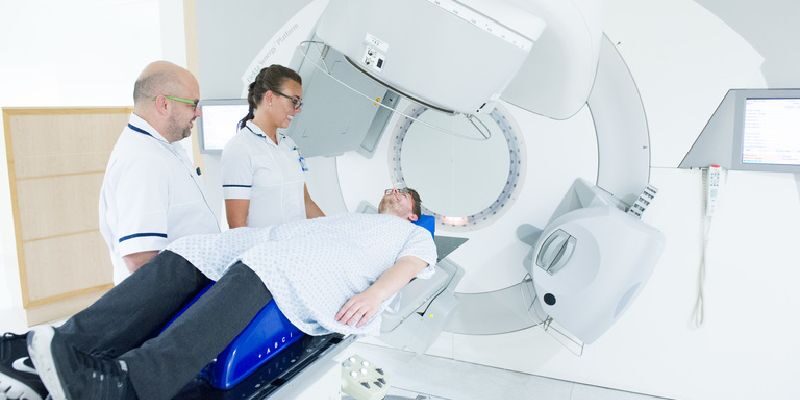
When it is your turn to go in, you will get called in to a cubicle to get changed, and then walk through to the treatment room.
If you are happy to proceed and have no further questions, you will be positioned on the couch in the same way as when you came for your planning scans.
The radiographers control the bed movements, so you may feel the couch gently moving up or down, or sideways.
The machine will not touch you and moves around you in a circular motion.
During your treatment the radiographers are in the control room, watching you all the time.
At times we may take some pictures first, which is a bit like having a quick CT scan.
This is to check whether your position is correct.
You do not see or feel the radiation, though you may hear a buzzing sound when the machine is switched on.
If you need us to stop, you only have to wave.
If required, we can also talk to you over the intercom.
You may be in the treatment room for a total of anywhere between 10 and 40 minutes, however the treatment itself only takes a few minutes.
Once the radiation dose has been delivered, the machine automatically switches off, and the radiographers will come back into the room to help you off the bed.
Your consultant or consultant radiographer will have discussed side effects from the treatment with you, when they saw you to sign the Consent form.
Side effects from Radiotherapy generally do not happen straight away.
It usually takes 1 to 2 weeks before you start noticing anything.
Depending on your diagnosis and treatment plan, you may see your consultant up to several times during your treatment.
If you are having 5 treatments or less, it might not be necessary to see your consultant.
Sometimes you also see the nursing team in the Princess Royal suite.
They may need to take bloods, or weigh you, assess any other issues, or show you how to use equipment.
Other health professionals such as our dietitians or Speech & Language therapists may become involved during your treatment.
Again, this might not necessarily happen as it very much depends on your individual treatment plan.
Your treatment might not always be on the same machine as they are serviced regularly.
This is to ensure that the radiation is delivered safely and effectively.
We have a dedicated team of technicians on site, who carry out all the necessary checks and repairs.
As we are a teaching hospital, we also have student radiographers in the department. They are supervised at all times. Please let us know if you prefer not to have students in the room.
When you are ready to go home after each treatment, you can leave either via the Beckett Street entrance or take the lift back up to level zero.
If you arrived with Hospital Transport, please book in with the Transport desk staff, so they know you’re ready to go home.
On your last day of treatment, you can also ring the End of Treatment Bell if you wish.
We hope this video has helped answer any questions you had. It contains general information, so please do ask us if there’s anything else you need to know. We are here to help you through your treatment.