Cancer is a common disease affecting about one in two people. Getting older is the biggest risk factor for cancer.
How common is cancer?
Some types of cancer are more common than others. For example, breast, prostate and bowel cancer are all common cancers in the UK.
Is cancer inherited?
Most cancer occurs by chance or can be caused by exposure to things in our environment such as UV radiation from the sun or chemicals in cigarette smoke. However, we know that some people inherit a gene change that increases the chance that they will develop certain types of cancer. People who have inherited one of these gene changes can usually be offered additional cancer screening or other options to help manage the risk of cancer.
What are genes?
We all have more than 20,000 genes. Each gene is an instruction within our body; they determine what we look like and how we grow. We have two copies of most of our genes; one inherited from the egg that made us, and one from the sperm.
What is a gene change?
Genes can be thought of as a code made up from a series of letters from a chemical alphabet (DNA). If there is a change in the code it can change the function of the gene. We call this a gene change or mutation.
What are cancer genes?
There are some genes that are important in controlling how our cells divide, and others that act like proofreaders for our genetic code; keeping it healthy.
A change in just one copy of one of these genes will predispose to certain cancers in that person. Not everyone who has a cancer gene change will develop cancer. There is no way at present to reverse the gene change but there is usually extra cancer screening available to help protect against the chance of cancer developing, or to detect it early.
There may be other options available such as surgery or medications that can reduce certain cancer risks. In some cases, there may be lifestyle changes that a person can make to reduce cancer risks.
How is a gene change passed on?
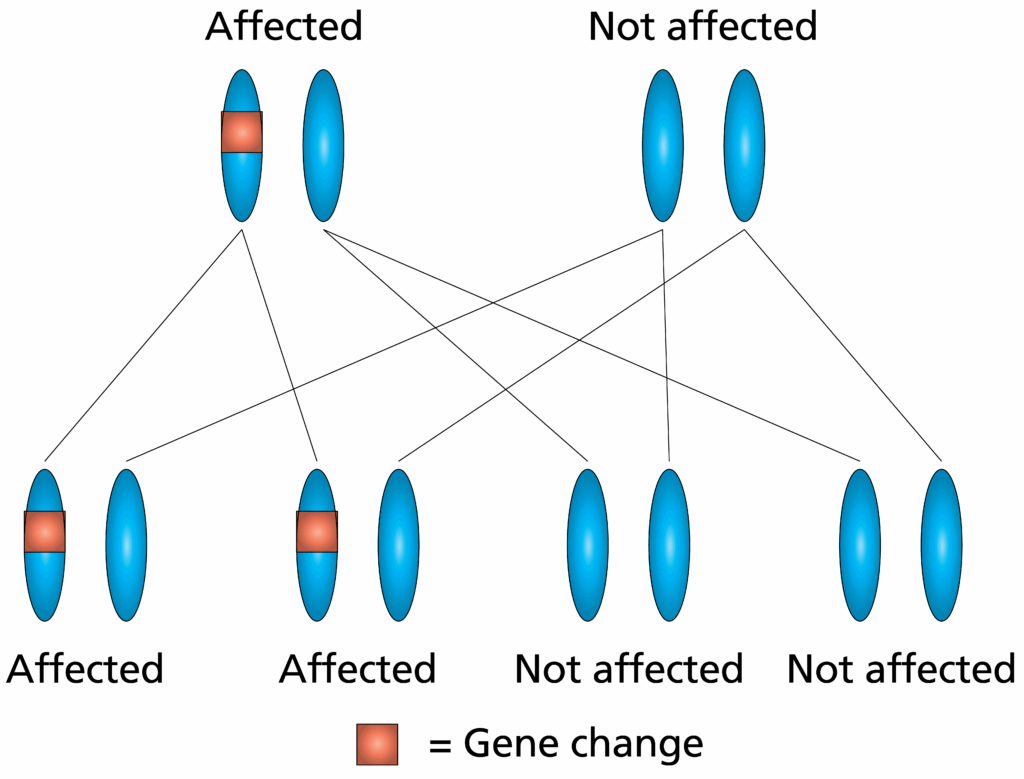
When we have our children we pass on only one copy of each gene, with the other copy coming from our partner. If one parent has a cancer gene change, for each child there is usually a 50% chance that they inherit the gene change. There is a 50% chance that they will not inherit it. The diagram on page four shows this pattern.
While most cancer risk gene changes are passed on in the way described above, there are a a small number of conditions that are are passed on in a different way. For these conditions a gene change must be inherited from both parents in order to cause the cancer risk.
Can I have a gene test?
We offer genetic testing to some families affected by cancer. As most cancer is not caused by one of these gene changes, we only offer testing to certain families. There are guidelines to help us decide which families are most likely to benefit from genetic testing.
To do a genetic test we usually need a blood sample from someone in the family who has had a cancer that could be caused by an inherited cancer gene change. In some families, that may not be possible and so on rare occasions it is possible to test someone in the family who has not had cancer themselves.
The genetic test will look for changes in a panel of genes that are associated with the cancer types in the family. We commonly carry out genetic tests for people/families affected by breast, ovarian and bowel cancer.
Your health professional will be able to provide more information about the tests relevant for you.
Sometimes genetic testing is offered to people who have had cancer themselves but have no family history of the condition. This might be because of the specific type of cancer they have been diagnosed with or the age at which they were diagnosed.
What are the possible results of the test?
No gene changes are found
In many families we cannot find a gene change. The reasons for this are:
- The cancers in your family may have happened by chance, or be due to a combination of genetic and environmental factors that we do not yet understand
- There could be a change in another gene, or genes, that are not included on the offer testing panel at this stage
- There may be a change in one of the genes tested gene that our current testing technology cannot detect even though the testing is very thorough
If we do not find a change in any of the genes tested we will still assess the cancer risks for you and your family. We will also recommend additional screening if this is appropriate for your family.
A gene change linked with cancer risk is found
This confirms that an inherited tendency to certain cancer types is present in the family. Other people in the family can have a predictive genetic test to see if they have inherited the same gene change.
Your health professional will be able to tell you more about the gene change found, and any options for managing the cancer risks linked with it. If your test was carried out by a health professional outside the Genetics team, you can be referred to Genetics for more advice.
A variant of uncertain significance is found
This is a gene change of unknown significance; there is not enough evidence available to decide if the change actually damages the function of the gene. There may be other tests that can give more information but, often, we have to ask you to come back to us for more advice in a few years’ time. We usually cannot offer testing of this gene change to other family members.
What is available to people with a cancer gene change?
The options open to a person with a gene change linked with cancer risk will depend on the exact gene involved. They may include:
- Additional cancer screening such as mammograms, colonoscopies or MRI scans
- Symptom awareness so that you and your doctor know what to look out for
- Medications that help to reduce cancer risks
- Risk-reducing surgery, for example to remove the ovaries
Not all of these options will be appropriate for every person with a gene change. It will depend on factors including the gene involved, the general health of the person in question and the person’s own views. The age of the person can also be relevant as this affects how much cancer risk they have at their current age. For example, when considering lifetime risk a 30 year old has a higher cancer risk than a 70 year old who will have lived through a greater proportion of their lifetime risk.
Is a gene test right for me and my family?
There are many issues to consider with regard to genetic testing, both emotional and practical. Some people prefer to know for certain whether or not they have a gene change, whereas other people feel it is better not to know. The information can help people to make decisions such as to whether to continue with screening or consider surgery.
For some, the motivation for testing comes from wanting to provide information for the family. In that case it is important to think about how you would feel if you knew you had a gene change. It is often useful to discuss genetic testing with family members, or other people close to you.
Additional information sources:
Macmillan Cancer Support
If you or someone you care about has been diagnosed with cancer, we’re here to help. Find out how we support you and get information about different cancer types.