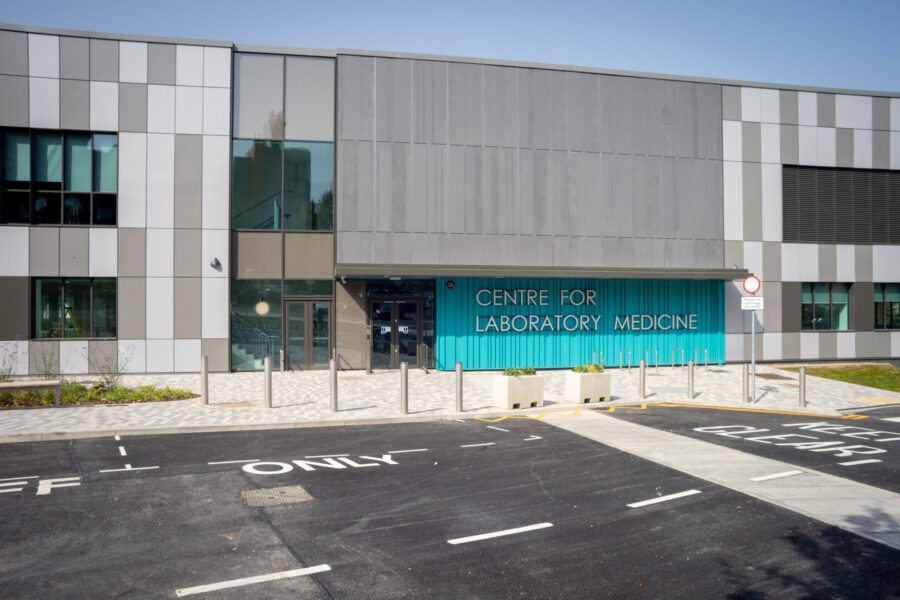
The Centre for Laboratory Medicine (CfLM) is our brand new, state-of-the-art pathology facility at St James’s University Hospital. Completion of construction was officially marked at a ceremony in September 2023 attended by Minister of State for Health and Secondary
Care, Will Quince MP, and the building became fully operational in 2025.
LTHT staff based in the Old Medical School moved into the new building from May 2025, following the installation of new equipment and integration of digital technology, including a single, shared Laboratory Information Management System (LIMS), which facilitates the ordering, tracking, and reporting of pathology tests, such as bloods and urine, electronically to clinical services (hospital and GPs requests) across West Yorkshire and Harrogate.
Work has now started to move Microbiology services from across two of our partnership trusts – Calderdale and Huddersfield NHS Foundation Trust and Mid Yorkshire Teaching NHS Trust – to support changes to how some specialist pathology services are provided across the region. Consolidating pathology services will enable more consistent, clinically appropriate turnaround times, ensuring the right test is available at the right time. It will makes better use of our highly skilled workforce to deliver improved, earlier diagnostic services, supporting better patient outcomes.
This regional partnership, formed through a collaboration with the West Yorkshire Association of Acute Trusts (WYAAT), will support the delivery of innovative testing and diagnostics, using advanced equipment and new technologies to generate results faster and create a more consistent process for all patients no matter where they live in our region.
As well as supporting improvements in diagnosis for people across the region, the new laboratory will help to meet the growing regional demand for specialist treatment and care whilst providing development opportunities for staff.
Check out the latest time-lapse video which shows the roof being completed on our new laboratory.
Email us
If you would like to comment or ask a question, please email:

Frequently Asked Questions
Where is the CfLM located?
The new laboratory is at St James’s University Hospital, located near the Trust Headquarters building.
What will happen to the Old Medical School at Leeds General Infirmary?
Currently, the majority of the Trust’s pathology services are provided from outdated facilities in the Old Medical School at the Leeds General Infirmary (LGI) and from St James’s Hospital.
The new building will bring many of these services together and the vacated Old Medical School will form part of a plan to use surplus estate at the LGI to develop an innovation village which is expected to deliver up to 3,000 new jobs and £11.2 bn in net present value.
Will the new laboratory be modern and sustainable?
The Trust aims to develop a world-class pathology building that is flexible, digital by design and that supports the delivery of net zero carbon. It will be mechanically ventilated with heat recovery and systems to minimise power and re-use heat.
It will also incorporate a single, shared Laboratory Information Management System (LIMS) for the region which will mean tests can be ordered, tracked and results reported electronically to clinical services across West Yorkshire and Harrogate, speeding up results for patients.
Why are staff from Calderdale and Huddersfield NHS Foundation Trust and Mid Yorkshire Teaching NHS Trust moving over to the Centre for Laboratory Medicine?
Creating a new pathology partnership by merging some of our services will be complex, however we are expecting there to be benefits to this change, including:
- A workforce that is sustainable for the future and offers greater opportunities for career development.
2. Improved experiences for staff, clinicians, and patients, including:
- Better working environments for staff and greater support through the network
- Quicker turnaround times for tests, standardised results, and a wider clinical network
- Patients receive the same quality and access to tests.
3. Consistency in pathology testing to reduce variation and ensure all labs provide the same, high-quality accredited service.
4. To create a more sustainable and resilient pathology service which can cope with increased demand and be flexible in times of pressure.
What is Pathology?
Pathology testing helps doctors to diagnose, treat and prevent disease.
Pathology is the study of samples from a person’s body – for example, blood or skin samples – to find out what is causing their illness and how serious it is. The results help doctors to plan the best treatment and care.
Pathology covers all areas of medicine, from testing for cancer to preventing the spread of infection. It also plays a key role in research, for example by studying the effects of new drugs or finding new treatments for disease.