
Genes are passed from parents to offspring and contain the information needed to specify physical and biological traits
What is a gene?
Our DNA is a long line of letters which is split into sections called genes. Genes are the unique instructions for how our bodies develop and function to make each of us an individual. There are thousands of different genes, each carrying a different instruction. We have two copies of most our genes, because we get one copy of a gene pair from each parent.
What is a gene variant?
We all have spelling changes (which are called variants) in our genes. Most variants do not affect our health, they simply make us different from each other. Some variants (called pathogenic or disease-causing) can stop a gene from working as it should which can result in a genetic condition or health
What does autosomal dominant inheritance mean?
Genetic conditions that show autosomal dominant inheritance are caused by a variant in ONE copy of a particular gene pair. This means that a person has one working copy of the gene and one copy which does not work, and so they will be at risk of developing the condition. Having a working copy of the gene cannot prevent the condition from occurring. The diagram below shows two gene pairs, one from a person affected with a dominantly inherited condition and the other is from an unaffected person
Affected
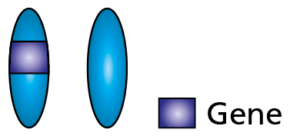
One copy of the gene pair has a variant which can cause the condition
Not affected
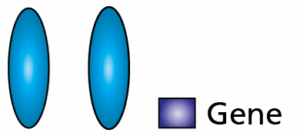
Both copies of the gene pair work correctly
How are autosomal dominant conditions inherited?
If a parent has a variant in one copy of their gene pair, there is a 50% (or 1 in 2) chance that any children they have will inherit this gene copy. This chance is the same for each child, regardless of their sex.
The diagram below shows how, for each pregnancy, there is an equal chance that the pregnancy will inherit the non-working copy of the gene, or the working copy of the gene.
Back to topAffected/Not affected Parent
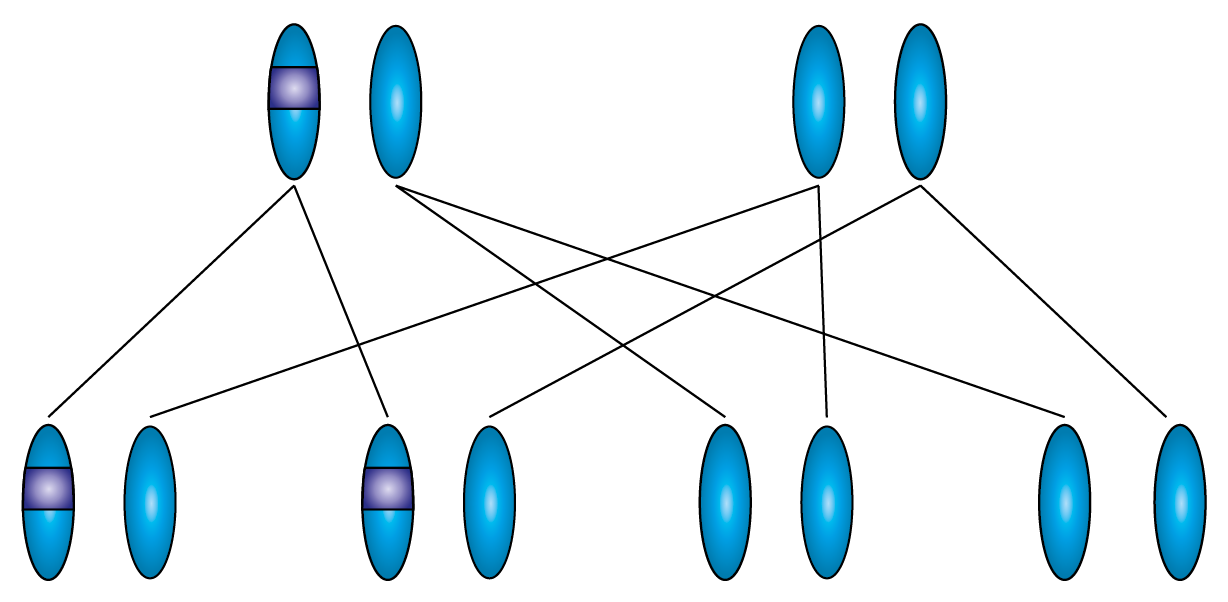
Affected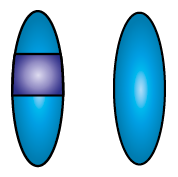 | Affected | Not affected | Not affected |

Some genetic conditions are known as “late onset disorders”. In other words, the individual will only develop symptoms of the condition in adulthood; however, the non-working copy of the gene would have been present in
Can a dominantly inherited condition ‘skip’ a generation?
In families affected by an autosomal dominant condition, it is most common to see people affected in each generation of the family.
In some autosomal dominant conditions, it is possible for someone to inherit non-working copy of the gene without showing any symptoms
of the condition. This person could then go on to have an affected child which may make the condition appear to have “skipped” a generation. In reality, the non-working copy of the gene did not skip a generation at all but the symptoms of the condition were so mild or undetected that it may have appeared to have skipped a generation. Your Doctor or Genetic Counsellor can discuss this with you in more detail, if appropriate.
In some families, if a person develops an autosomal dominant condition for the first time, it could be because of a new variant in that person (a spelling change which arises for the first time). This is called a “de novo” genetic variant. In this case, there is still a 50% (or 1 in 2) chance that each of the person’s children will inherit the non-working copy of the gene.
For more information:
If you need more information, please contact your local Genetics Department. If you live in the Yorkshire region, please contact:
Department of Clinical Genetics



With thanks to The Department of Clinical Genetics at Guy’s & St Thomas’ Hospital
Back to top