
What is Fragile X Syndrome (FXS)?
FXS is the most common cause of inherited learning disability. It affects boys and girls and causes a wide range of problems with learning and behaviour, from mild to severe. Boys are usually more seriously affected than girls. FXS is caused by an alteration in the FMR1 gene that lies on the X chromosome.
What are genes and chromosomes?
Genes are the instructions that make each of us an individual and are important for normal health, growth and development. A complete set of our genes is found in each cell of the body. Genes are packaged in structures called chromosomes. Each chromosome contains thousands of genes. Humans have 46 chromosomes in most of the cells in the body, arranged in 23 pairs, numbered 1 – 22, according to their size. The two remaining chromosomes, X and Y, are commonly called the sex chromosomes. Females typically have two X chromosomes. Males typically have one X chromosome (inherited from their mother) and a Y chromosome inherited from their father.
What causes FXS?
FXS occurs when a gene on the X chromosome is altered so that it contains too many repeated sections of genetic code. It is called a triplet repeat as the section of code reads: CGG CGG CGG CGG many times.
We all have a certain number of these triplet repeats at the beginning of our FMR1 gene. What matters is how many times the code “CGG” is repeated. If the code is repeated too many times, the FMR1 gene fails to work properly.
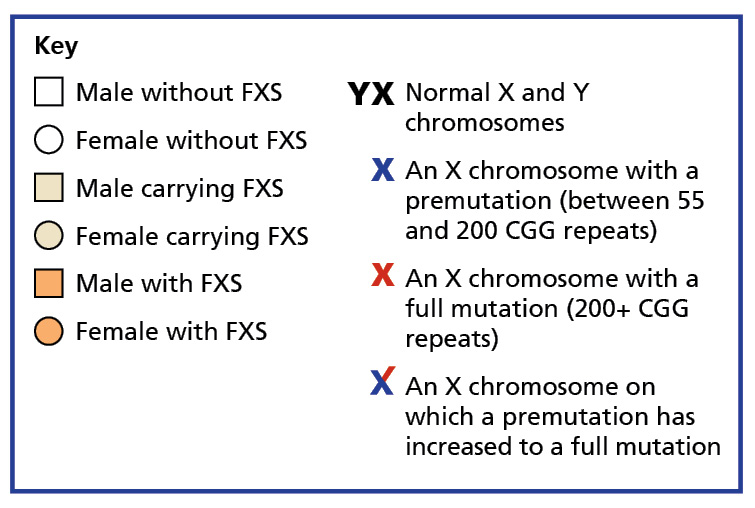
For example, if there are more than 200 repeats in a boy, then he will be affected with FXS, and will have some learning and behaviour difficulties. A repeat of more than 200 is called a “full mutation”. If the code is repeated more than 200 times in a girl, she may also be affected with FXS; however, unlike boys, girls have a second (or “spare”) X chromosome with a normal FMR1 gene. This means that girls are protected from some, if not all, of the effects of the 200 or more repeats on their other X chromosome.
What happens if someone has fewer than 200 repeats ?
If CGG is repeated more than 55 times but less than 200 times, then that person is a carrier of what is called a “premutation”. Both males and females can be carriers of a premutation. A premutation carrier would not be expected to have the learning and behavioural problems seen in FXS. We now know that people with a premutation may develop problems with balance (ataxia) and memory as they reach their 50s or 60s. This is called ‘Fragile X associated Tremor / Ataxia syndrome’ (FXTAS). Current evidence suggests this is more common in males. Women with premutations may develop premature ovarian insufficiency. This happens in around 20% of women who have a premutation. In these cases, women may have irregular periods and early menopause.
How is FXS inherited ?
FXS is inherited when a woman with an FMR1 gene premutation passes this chromosome on to her child. When this happens, the number of CGG repeats can increase so that the child inherits more than 200 repeats. It is this ‘‘unstable’’ nature of the premutation repeat that leads to the condition occurring in the family.
Will a parent who carries or is affected with FXS have an affected child?
This depends on three things:
- Which “X” chromosome is passed on.
- How many CGG repeats the parent has.
- The sex of the parent.
The easiest way of understanding this is to think of men and women separately as described below.
For Men
- Men who carry a “premutation” (55 – 200 CGG repeats)
Men only have one X chromosome and this is passed to all of their daughters. Their sons inherit their Y chromosome. Men who carry a premutation are called “normal transmitting males”. All of their daughters will inherit their father’s premutation and will be carriers of FXS.
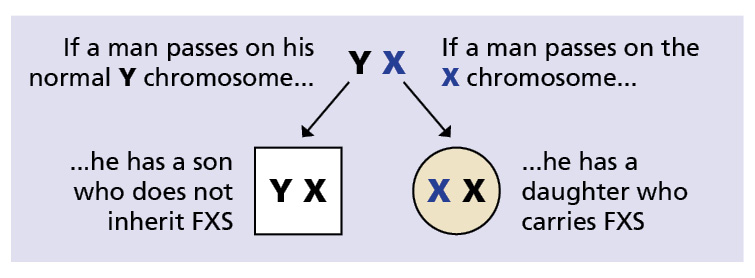
2. Boys who have a “full mutation” (more than 200 CGG repeats
These boys are all affected with FXS. As it is very unusual for boys affected with FXS to have children, we do not yet know whether their daughters would all inherit the full mutation.
For Women
Women can also be divided into two different groups:
- Women who carry a “premutation” (55 – 200 CGG repeats)
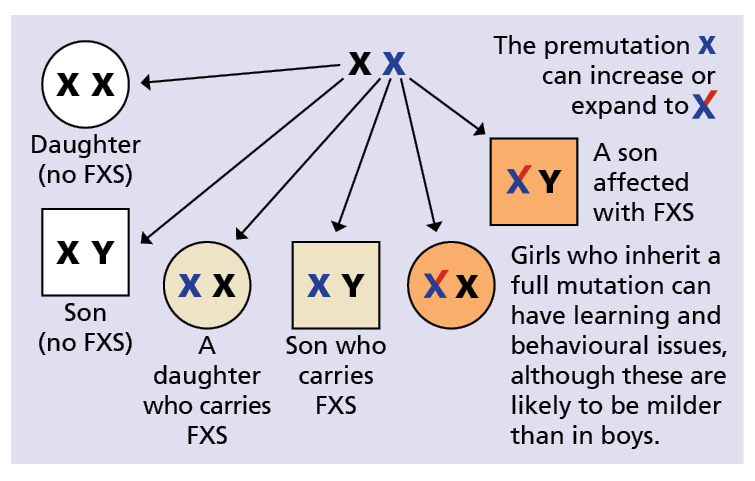
Each of their children have a 50% chance of inheriting their mother’s X chromosome which carries the premutation. When this happens, the number of the CGG repeats often increases in the child.
- If the number stays below 200, then her child will be a “carrier” of a premutation and, like his or her mother, should be unaffected.
- If the number increases to more than 200, then the child has a full mutation.
All sons with a full mutation will be affected with FXS. Girls who inherit a full mutation can have learning and behavioural issues, although these are likely to be milder than in boys.
2. Women who carry a “full mutation” (more than 200 CGG repeats)
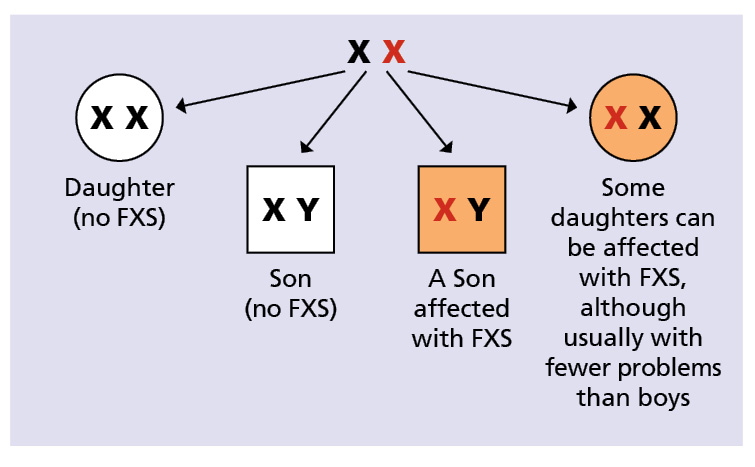
Each of their children will have a 50% chance of inheriting their mother’s X chromosome that carries the full mutation.
- All sons with a full mutation will be affected with FXS.
- Daughters may be affected with FXS, although usually with fewer problems than boys.
For more information:
For more information and contact details, please see:
Leeds Clinical Genomics Service web page