
What are temporomandibular disorders (TMD)?
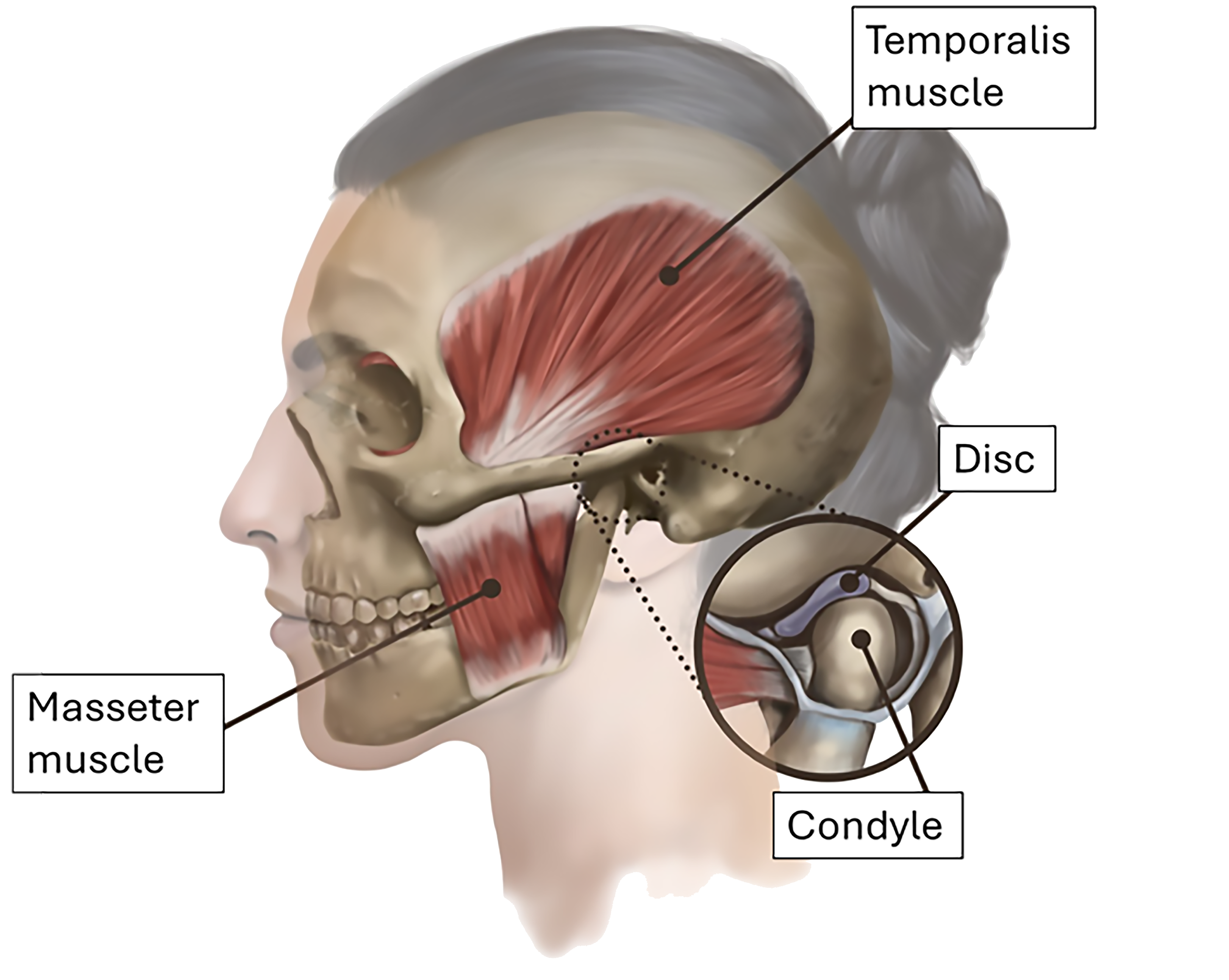
The jaw joint is called the temporomandibular joint, or TMJ. Temporomandibular disorders (TMD) are a group of conditions that affect the jaw joints or the muscles around them. TMD is common: about 1 in 15 people in the UK have it.
In the past, TMD was sometimes called Temporomandibular Joint Pain Dysfunction Syndrome (TMJPDS) or simply ‘TMJ.
What are the symptoms?
Depending on the type of TMD, you might:
- Have pain in your jaw
- Hear clicking or popping sounds from the jaw joint
- Find it hard to open your mouth or move your jaw
The most common TMD is pain in the muscles. Other types can affect the bones of the jaw joint or the small disc of cartilage inside the joint. Some people have a mix of muscle and joint problems.
Painful muscular TMD
The most common TMD is muscle pain. This is called muscular TMD, myogenous TMD (m-TMD), or myalgia.
Symptoms can include:
Symptoms
- Pain or tightness in your jaw
- Trouble chewing or opening your mouth.
- Pain in your teeth, face or around your eyes
- Earache or headaches
- Pain in your neck, shoulders or back.
What causes m-TMD?
There is usually no single cause. Many things can add to the problem.
Injuries to the jaw joint or long dental appointments can sometimes cause short term pain. This usually gets better by itself. You can help the pain settle by:
Settle pain
- Resting your jaw
- Gently massaging the sore muscles
- Avoiding hard or chewy foods for two weeks
Sometimes, pain lasts longer than three months – this is called chronic pain.
Chronic TMD can start without an injury. Body, mind and lifestyle all play a role. These should all be thought about when planning treatment.
Some people with TMD also have other conditions like:
Conditions
- Fibromyalgia
- Chronic fatigue syndrome
- Migraine
- Irritable bowel syndrome
- Anxiety, depression or PTSD
Clenching or grinding your teeth (called bruxism) does not cause TMD but can make it worse.
Will it get better?
YES: Most people’s symptoms improve
Your symptoms might come and go. You might notice that things feel worse when you are:
Things feel worse when you are
- Stressed
- Sleeping badly
- Run down
- Unwell with other health problems
What treatment might be considered?
There are different ways to help TMD. Not every treatment is right for everyone. Some people find one thing works. Others need to try a few things together.
The most important part of treatment is what you do at home every day. This is called supported self-management. You’ll be given advice to help you manage your symptoms now, and during any flare-ups in the future.
Supported self-management
These are the key things you can do to help your TMD. Try to do them every day – being consistent really helps.
Back to topDo your heat or cold therapy, massage and exercises every day, even if the pain is not there. It helps stop pain from coming back.
Watch the videos below for more advice from Newcastle University about self-physiotherapy and massage:
Thermal Modalities for Jaw Pain Relief
If you are going to use ice, you must cover it as shown in the video. Once covered, you apply it to the painful area, commonly the side of your face where your masseter muscle is, either unilaterally or bilaterally, meaning one side or both sides at the same time.
You apply this for five to ten minutes. It should start to feel frozen, but not painfully frozen or painfully numb. Once you have used covered ice for five to ten minutes, you can remove it and, if instructed, carry out the exercises you require.
This can be done two to four times each day, and your clinician will advise you on the appropriate scheduling.
If you wish to use heat, either dry heat or moist heat can be applied for up to twenty minutes, two to four times a day. Some patients prefer moist heat, which can be made by wetting a thin washcloth or flannel with warm water or warming it in the microwave, ensuring it is not too hot.
The heat is then applied to the same area as demonstrated, either on one side or both sides at the same time. Many people find this beneficial, particularly after a day involving lots of talking or work.
Self-Massage for Jaw Muscles
This video shows self-massage, which is helpful for individuals who have muscular pain affecting the masseter muscles and the temporalis muscles. Both of these muscles are demonstrated.
For the masseter muscle, slight rolling movements are performed using the thumb inside the mouth against the inner aspect of the muscle, and the index, middle, and ring fingers on the outside of the mouth on the skin surface of the muscle. Pressure is applied to the painful areas for around one minute.
After this, the muscle is stretched by working back towards the ear and then downwards along the full length of the muscle to the lower jaw, as demonstrated. This can be done on both sides and as frequently as desired, though it is often best performed two to three times a day.
The temporalis muscles, located on either side of the forehead, are massaged using slight circular movements. This is done with the same hand, using the index, middle, and or ring fingers to apply pressure to the painful area for approximately ten seconds
Jaw Relaxation and Coordination Exercise
This exercise is often known as the end stretch or no stretch, or the most comfortable position for your jaw to sit in relaxation.
This is achieved by opening, curling your tongue up towards the top and the back of your mouth, and allowing your jaw to hang loose, then closing slowly or feeling the jaw move more towards your ear.
This is done for 20 repetitions, three times daily.
The end stretch can be combined with coordination training for straight opening. To do this, curl your tongue up to the roof and the back of your mouth and open slowly while observing in a mirror that you are opening in a straight line.
If you are deviating to one side, hold a straight object like a toothbrush or a pen, place your hand on the side of your face that you are deviating to, and gently, very gently, keep your jaw straight as you open into an end stretch.
Isometric Jaw Exercises
These exercises are isometric tension exercises, and there are two versions. The first version is for muscle-based pain.
For this version, in all directions, side to side and up and down, you place the back of your hand under your lower jaw and provide gentle resistance upwards as you try to open your mouth. You then try to open against this resistance and hold your opening for five to six seconds.
You complete five to six of these movements in each direction, up to four times a day. You also perform them side to side.
For disc displacement with reduction producing clicking, you can perform this exercise in a different way. In this version, you do ten repetitions, holding for ten seconds when opening your mouth and gently pushing it forwards.
This will not eliminate the clicking, but it can help decrease the intensity of discomfort and sometimes reduce the frequency of the clicking.
Static Stretch Jaw Exercises
These exercises are static stretch exercises useful for people with decreased mouth opening.
After using moist heat or covered ice as described in the thermal modalities guidance, open your mouth to the point of limitation and then gently cross over your fingers and thumb and place them on your canine teeth on the top and bottom jaws.
Stretch for 30 seconds to the point of discomfort and slightly beyond, and hold for 30 seconds. Do not try to force your mouth open, as this will create more discomfort.
You complete five to six sets of these stretches, up to three times a day. Each time, use either moist heat or ice before the stretches to help decrease discomfort. Avoid overstretching and aim only to reach the point of discomfort and slightly beyond.
If you find these stretches very uncomfortable, it may be helpful to take simple painkillers such as paracetamol or ibuprofen, following the instructions on the packaging. These should be taken about 40 minutes before doing the exercises to allow time for them to take effect.
Jaw Mobilization Exercise
This is a mobilization exercise and is only useful if you have been diagnosed with a disc displacement without reduction with limited opening. Please do not use it unless you have this diagnosis.
The mobilization exercise involves lightly keeping a small cotton wool roll between your teeth at the front part of your mouth. While maintaining light contact with the roll, move your jaw from side to side in a slow and controlled manner over five to six seconds.
You complete five to six sets of these movements, up to four times a day. This exercise helps to mobilize your joint over the displaced disc and can gradually help restore the full range of movement.
Temporomandibular Disorders (TMD)
Temporomandibular disorders can cause a lot of pain in the jaw, temple, ear and other areas of the face.
When the pain first appears or when it flares up, it can be a good idea to rest the jaw by eating softer food. Two weeks is usually long enough to allow pain to calm down before gradually returning to a normal diet.
Painkillers, heat and ice can also be used to minimize the pain. These short-term solutions can give you a chance to learn new habits that will help to minimize pain over time.
Stress and muscle tension usually play a role in all types of pain, so it is important to learn relaxation, good jaw posture and how to massage the muscles, and to practice these skills regularly.
It is equally important to prioritise the things that you feel positive about in life. You can find out more information about helpful ways of responding to pain and organisations that can support you by searching the following.
Surgical Removal of Teeth and Wisdom Tooth Care
Hello and welcome to this short video about surgical removal of teeth in Newcastle Hospitals’ NHS Foundation trust. There are two major reasons why people are often referred to the oral surgery or oral and maxillofacial surgery for the surgical removal of teeth.
The first and most common is that the tooth has developed some decay here in dark grey or a fracture line that affects the nerve of the tooth – here in red – which is now inflamed by the decay and this inflammation leads on to the nerve dying and the formation of an abscess. Both these two types of problems cause considerable pain that can wake you at night time.
The second major reason that people are referred is often to do with their wisdom teeth which don’t always fully erupt into the mouth and sometimes remain partly covered by the gum shown here in pink, but also partly connected to the mouth down the back of the tooth in front and therefore have a connection to the mouth and its contents.
What can then happen is that when people eat food it can get lodged – here in yellow – between the gum in pink the tooth in front and in this case the wisdom tooth below. If that food remains lodged and becomes stagnant or starts to cause a breeding ground for bugs and infection the gum behind the tooth and overlying the tooth can become inflamed and swollen.
This is called pericoronitis this is a Latin term and is simply used to explain that around the crown of the tooth there is swelling of the gum.Before the Dental Hospital see people for treatment there are some things that can be done to try and help with this pain whilst you wait to see a specialist or a member of their team.
The first is that a temporary filling or dressing can be placed in the tooth with decay or fractures to help settle down the pain and help solve the abscess temporarily. This can be topped off by a temporary filling so that you remain comfortable before you are seen by us for an assessment to remove the offending tooth or teeth.
Pericoronitis can be managed by firstly looking to see if your dentist thinks the upper wisdom tooth is biting down on the swollen gum and making both the food impaction and also the gum swelling worse.
If this is the case upper wisdom teeth are often simpler to remove with less risks to remove than the lower wisdom tooth and can be done in dental practices on the High Street under local anaesthetic once the tooth is numb. It’s advisable therefore to ask your dentists whether or not they think the upper wisdom tooth is causing some of the problem.
If the upper wisdom tooth isn’t causing some of the problem, another action that you can take would be to buy something called a single tufted brush, which are available from all major pharmacies at the larger versions of their stores. Using this after each meal or anything that you’ve eaten to get into the gap between the gum, the wisdom tooth below and the tooth in front and clean around the exposed part of the tooth carefully to remove any food debris that might be present.
Equally to help with this you could buy – if you’re not allergic – some Corsodyl mouthwash which can be used two to three times a day for 5 days and you can use that by tilting your head towards the affected tooth and gently moving the fluid in and around that area several times over the course of a minute and then spitting the residual mouthwash out. If you can’t access Corsodyl mouthwash you can make up a warm salt mouthwash by using one level teaspoon in a tumbler of warm water and use it three times a day to do the same job as the Corsodyl mouthwash. This will help resolve the pericoronitis more quickly than any other types of treatment
The following short video shows how to use a single tough brush to clean round partially erupted wisdom teeth. Wisdom teeth as mentioned in the earlier part of the video can sometimes struggle to erupt fully through the gum Cleaning partially erupted wisdom teeth and can end up looking like this in your mouth where they’re slightly below the gum with little elements of the gum over covering them.
This is mostly erupted but on the other side you can see this wisdom tooth here, if I tilt the model, is partially erupted and food can get stuck underneath the gum here and also an upper wisdom tooth can bite down onto the gum causing more pain and swelling here. As discussed in the earlier slides it’s worth discussing with your your dentist whether or not an upper wisdom tooth is part of the problem as these can often be removed much more simply than the lower wisdom tooth and with less risks. and also in the general dental practice on the High Street under local anaesthetic with the tooth numb.
Irrespective of this good cleaning around the wisdom tooth that is partially erupted helps relieve a lot of the symptoms caused by pericoronitis. To do this you can buy a single tufted brush which looks like this, from most major pharmacies in the larger stores. Simply put a little bit of toothpaste on the top of the head of the toothbrush and after each meal go to the partially erupted tooth by coming in through the front of the mouth and then doing circular motions around the area the tooth is poking through the gum like so. Brush with your normal consistency of pressure, for three or four circular motions until the gum is clean. If the gum is inflamed it is likely it will bleed – do not worry about this. Simply brush carefully and consistently and over a number of days that should settle.
To help further decrease the symptoms of pericoronitis, you can also consider using Corsodyl mouthwash or warm salty mouthwashes, if you can’t access Corsodyl mouth wash or are allergic to it. These simple measures done regularly will help settle down pericoronitis in the vast majority of cases. It is important however that you don’t use Corsodyl mouthwash for more than 3 to 5 days as it can leave some stains on your teeth, especially if you drink a lot of tea, coffee or red wine. However, these can normally be simply polished away by the dentist.
The brushing of the area should become part of a routine daily habit so that you keep the area clean and decrease the likelihood of getting further symptoms.
So, in summary in toothache consider asking for a temporary dressing for the nerve Summary with a temporary filling on top from your dentist, which will help keep you comfortable whilst you’re waiting to see us. In pericoronitis, it’s important to ensure that you have done all of the simple treatments so that we know that the lower wisdom tooth would definitely need to come out.
Those include trying a single tufted brush to clean round the partly erupted wisdom tooth after every meal and using Corsodyl or warm warm salty mouth washers if there is a period of sustained problems in the area and also discussing with your dentist whether or not the upper wisdom tooth is biting into the inflamed gum on the lower wisdom tooth and making things worse and if so, whether or not they would think this merits removing the upper wisdom tooth first to see if the problem settles with the removal of the upper wisdom tooth and improved toothbrushing with the single tufted brush around the lower wisdom tooth.
Thank you and we look forward to seeing you at your appointment with us
General wellbeing
Feeling tired, stressed or unwell can make your symptoms worse. To help your body heal:
Try
- Try to get enough sleep
- Eat as well as you can
- Find ways to relax
- Be kind to yourself
Your mental health is important. We can help guide you to support if you are struggling.
Sleep
Poor sleep quality can make pain worse
Try
- Having a relaxing bedtime routine
- Avoiding any screentime for an hour before going to sleep
- Cutting down on caffeine, especially in the evenings
Self-Management Pain Guide
TMD can cause stress and worry. It can stop you from doing the things you enjoy.
We have a free guide to help you learn how to manage long-term jaw and face pain. This includes real stories from people who also live with TMD.
Managing long-term jaw and face painSelf-management of Chronic Orofacial Pain including TMD Authors Karina Lovell, David Richards, Phil Keeley, Joanna Goldthorpe and Vishal Aggarwal (© 2019 The University of Manchester and the University of Leeds)
Back to topOther treatment options
If your home care (self-management) hasn’t helped enough, we might suggest other treatments to try as well.
These include:
Treatments
- Talking therapy
- Physiotherapy
- Splint therapy
- Oral medications
- Botox injection (not available at the Leeds Dental Institute)
Your dental team will talk to you about what might help.
These treatments work best when you are also doing your self-management every day (massages, exercises and heat/cold therapy).
Physiotherapy
Physiotherapy can be really helpful for m-TMD. Your own self-management – massages, exercises and using heat or cold – are all types of physiotherapy.
Sometimes we might suggest seeing a physiotherapist. This can be useful if you also have problems with your neck, shoulders or back.
Some physiotherapy may be available under the NHS.
Splint therapy
A splint (also called a biteguard) is a plastic device worn over your teeth at night. It may help if you clench or grind your teeth (called bruxism). Bruxism doesn’t cause TMD, but it can make symptoms worse.
More information is available in our Bruxism patient information leaflet.
Your dentist will talk to you about whether a splint could help and which type is best for you.
Talking therapy
TMD can make people feel stressed, anxious or low. Talking to someone about how it’s affecting your life may help.
Other mental health issues, like anxiety, depression or PTSD can make TMD symptoms worse.
You might benefit from pain management psychology or other support. We can help you find the right support, you may be able to refer yourself, or we might ask your GP to refer you.
Medicines
Different medicines can sometimes help with TMD:
- Anti-inflammatory medicines (like ibuprofen) may help during flare-ups. Check with your dentist, doctor or pharmacist before taking them. They’re not safe for everyone, especially if you have asthma, stomach ulcers or take other medicines.
Other options may include:
- Muscle relaxants
- Nerve pain medicines
- Low-dose antidepressants
We would write to your GP if we think one of these might help you.
Botox
Botulinum toxin type A, or Botox, can be injected into the jaw muscles. This helps them relax and may reduce pain for a short time. Botox is not suitable for everyone.
Jaw clicking and locking
Why is my jaw clicking?
The jaw joint (called the TMJ) connects your lower jaw to your skull. There is a small piece of cartilage (a soft, rubbery tissue) between the bones of the jaw joint, shaped like a disc. This helps the joint move smoothly when you open and close your mouth.
Sometimes this piece of cartilage can slip out of place. This is called a disc displacement. When you open your mouth, it might make a clicking or popping noise as the cartilage moves back into place. Some people get a click when they open their mouth; others when they close their mouth; or both.
Disc displacement can be more likely if your joints are naturally flexible (hypermobile).
The disc of cartilage is supported by one of the jaw muscles. If this muscle is very tense, it might pull the disc forwards out of place.
Back to topWhy does my jaw get stuck?
If the cartilage disc doesn’t move back into place, your jaw might get stuck.
This is called jaw locking. You may only be able to open your mouth a little way. Sometimes this gets better on its own.
Some people find they can wiggle their jaw to get it working again.
Should I be worried about my jaw clicking?
No. Clicking from the jaw is very common and is usually not a problem. For most people, jaw clicking stays the same over time and doesn’t get worse.
However, some people get pain with the clicking, or their jaw locks more often. If that happens, treatment may be needed, but it’s not possible to know if this will happen to you.
Try not to open your mouth too wide (for example, when yawning). Don’t keep testing to see if it’s still clicking.
What treatment might be considered?
This depends on your symptoms. Your dental team may suggest:
- X-ray or an MRI scans of the jaw joint and the cartilage disc to confirm a diagnosis
- Jaw exercises to help improve movement
- That you see a physiotherapist
In more severe cases, or if other treatments haven’t helped, surgery might be considered.
Surgery might be an option for problems issues with the jaw joint itself (either the disc of cartilage or the bones of the joint). Surgery is not recommended for problems with the muscles (m-TMD).
If surgery is an option, your team will explain everything and help you decide what’s best.
Useful links
NHS Live Well: 10 ways to reduce painFind a TMD physiotherapist
This website has information about TMD and can help you find a physiotherapist with a special interest in treating TMD.
The Association of Chartered Physiotherapists in TMD (ACPTMD)