
It is thought that up to one third of women have a separation of the abdominal muscles at 12 months after giving birth. It is important to seek treatment from a pelvic health physiotherapist as it may not improve naturally.
The front panel of the muscles is in two halves, joined at a centre seam. This is called your Rectus Abdominal muscle. During pregnancy this seam may separate (like a zip under pressure). It is normal to have a small gap between your stomach muscles after pregnancy. However in some women the muscles stretch further than average and can leave a larger gap.
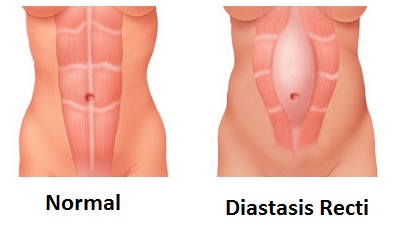
If this has happened to you, you may have noticed your stomach bulging to a peak when you sit up e.g. getting out of the bath or out of bed. You may also notice a visible brown line down the centre of your stomach or that your belly button is now protruding.
Your midwife or physiotherapist will measure how wide the gap is between your muscles. A specialist exercise programme will then be prescribed by your physiotherapist.
If you strengthen your abdominal muscles with physiotherapy this may reduce the risk of:
- Back pain and other back injuries
- Hernia
- Protruding abdomen
- Poor abdominal support in future pregnancies
After birth – your stomach muscles
This video explains how to care for your stomach muscles after birth and manage or prevent diastasis recti.
After birth – your stomach muscles
Your stomach muscles run from the bottom of your rib cage to your pubic bone and are connected by a ligament.
This ligament increases in width during pregnancy to accommodate the growing bump.
Following birth, the ligament may still be stretched and weak for some time.
You may have the feeling of a gap between your six-pack muscles.
For most people, this will improve within eight weeks from birth.
But if after eight weeks you can fit more than two fingers between your stomach muscles at your belly button, and there is a visible bulge—especially when going from lying to sitting—this is called diastasis recti of the abdominal muscles.
If you have diastasis recti of the abdominal muscles, take care to reduce the bulging of your abdominal muscles when moving, lifting, carrying heavy objects, or exercising.
Avoid sit-ups and abdominal exercises that make the abdominal muscles bulge.
Avoid straining with constipation.
When getting in and out of bed, roll onto your side first and push through your hands.
Start gentle core-strengthening exercises.
Good exercises to perform can be found in the PDF which accompanies this video.
Should these symptoms continue beyond eight weeks after birth, please speak to your GP for advice, and they may refer you to physiotherapy.